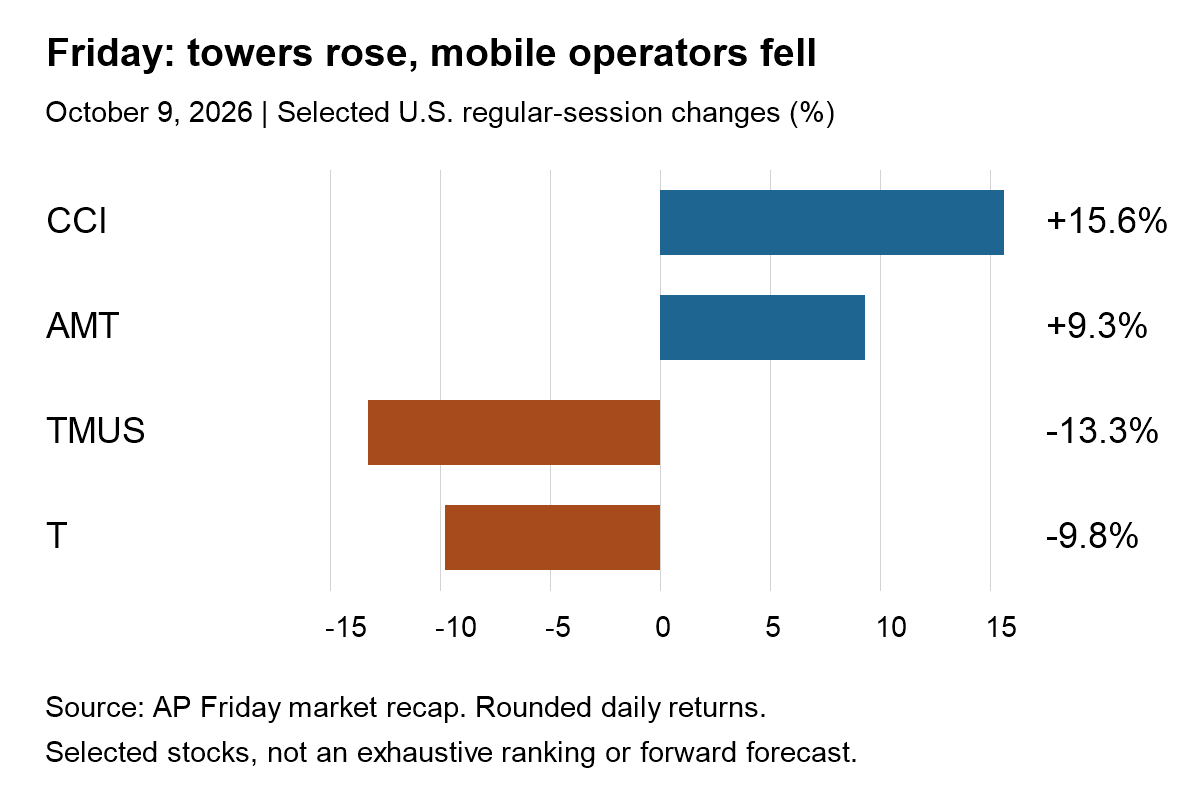
Quick answer: Friday’s rising U.S. stock indexes hid a sharp telecom split: Crown Castle and American Tower rose while T-Mobile and AT&T fell. The useful story is not that “telecom won” or “telecom lost,” but that infrastructure owners and mobile-service operators faced different expectations after a spectrum agreement.
Historical review of the October 9, 2026 U.S. regular session, checked October 10. Selected movers, not a complete gainers ranking, live quote or personalized investment recommendation.
October 9 stock market: the closing scoreboard
| Index | Close | Daily change |
|---|---|---|
| S&P 500 | 7,811.54 | +0.6% |
| Dow Jones Industrial Average | 51,654.95 | +0.8% |
| Nasdaq Composite | 27,366.17 | +0.6% |
| Russell 2000 | 2,806.98 | +0.5% |
Source: AP’s Friday closing-index report. These closes and returns describe the cash session, not the earlier futures market. An up day for benchmarks is not evidence that every constituent rose.
Crown Castle versus T-Mobile: the stocks went opposite ways
| Company | Ticker | Daily change |
|---|---|---|
| Crown Castle | CCI | +15.6% |
| American Tower | AMT | +9.3% |
| T-Mobile US | TMUS | −13.3% |
| AT&T | T | −9.8% |
Source: AP’s October 9 market recap. The chart uses these same rounded returns, not intraday candles or price targets.
The confirmed catalyst—and what was not yet completed
Grain Management’s October 8 announcement states that SpaceX agreed to acquire its nationwide 800 MHz spectrum portfolio. It identifies FCC approval and other closing conditions. An announced agreement is not a completed transaction, a fully built network or verified customer migration.
MGI interpretation: The same potential entrant can pose different questions to different business models. An operator may face concern about future competition; an infrastructure owner may face speculation about future deployment demand. That is a framework for reading the split, not proof of a signed lease, a particular future market share or the exact contribution of the announcement to each share-price move.
A spectrum holding is one input into a network. Regulatory completion, deployment choices, capital requirements, execution and customer adoption remain separate issues. Treating a transaction announcement as already-realized operating revenue skips those steps. The actual outcome can differ from both optimistic and pessimistic scenarios.
Three kinds of number that should not be confused
MGI arithmetic: CCI’s +15.6% and TMUS’s −13.3% imply a 28.9-percentage-point difference between their daily returns. That difference is not the return of a portfolio holding both shares. Portfolio performance depends on allocations, entry prices, costs and whether positions are long or short.
For a purely hypothetical equal-dollar long portfolio, one position gaining 10% and another losing 10% gives approximately 0% before fees over that one period. A 20-percentage-point difference between the two moves does not create a 20% portfolio gain. These hypothetical figures are not a model of Friday’s actual securities.
Finally, a share-price return is not a change in revenue or earnings. Market prices can adjust to expectations before a company reports a business impact. To validate an operating thesis later, look for reported customers, pricing, utilization, signed contracts and cash requirements rather than extrapolating one day’s return.
Why Friday’s rally does not settle the economic outlook
Stocks reflect a collection of expectations; a consumer survey describes a different evidence set. Our October preliminary consumer-sentiment analysis separates household perceptions from actual spending. Do not use a rising stock index to erase that distinction or a weak survey to claim every stock should fall.
The preceding Thursday review provides the prior session’s context. For the next trading day, our October 12 market-hours guide distinguishes equity trading from bond and settlement calendars.
Five checks before chasing Monday’s follow-through
- Use the final regular-session move, not an earlier premarket headline.
- Separate the transaction announcement from its closing conditions.
- Identify the business model before applying a sector-wide label.
- Distinguish portfolio return from the spread between two stock returns.
- Look for subsequent operating evidence; do not assume momentum must continue.
Frequently asked questions
Were telecom-related stocks uniformly weak?
No. The selected infrastructure and service-provider shares moved in different directions.
Does this chart show a guaranteed rebound or trading level?
No. It displays historical daily returns only. No support levels, intraday candles or forecasts are fabricated.
Sources supply dated observations; MGI supplies interpretation and labeled hypothetical arithmetic. The selected stocks are illustrative, not an exhaustive market screen. Educational analysis only.