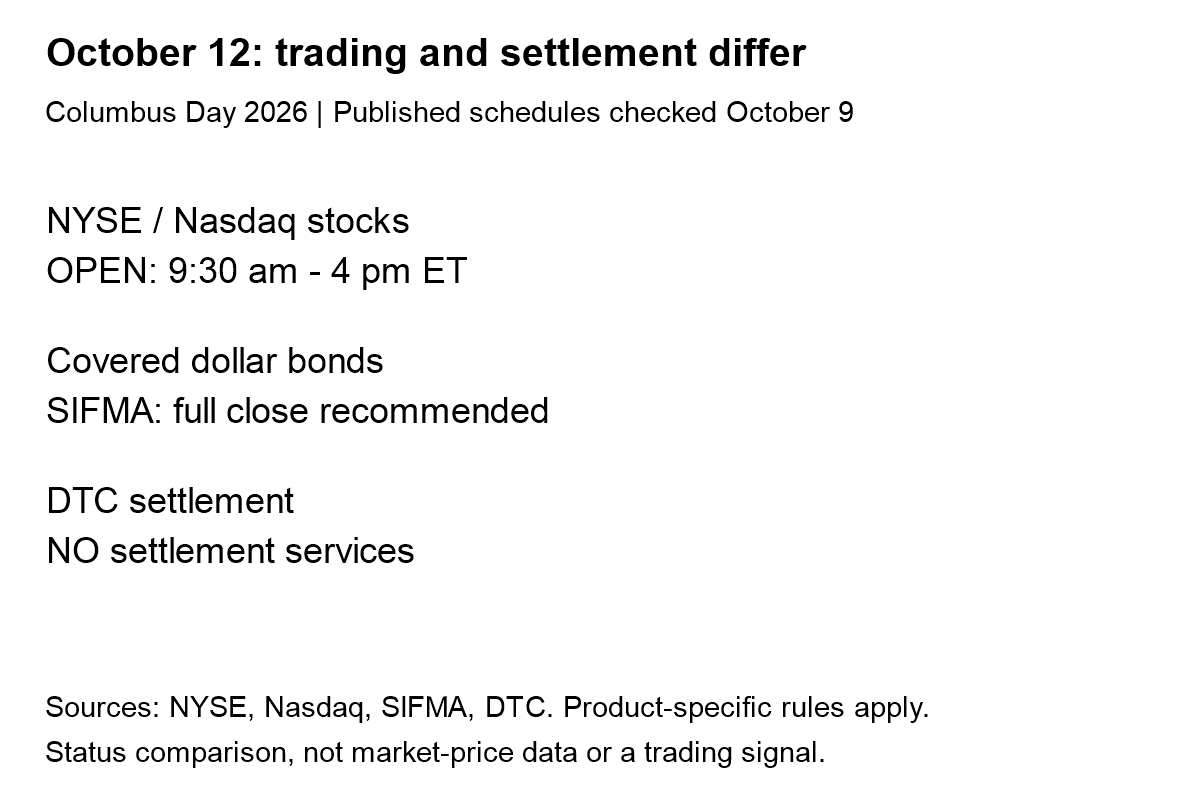
Is the stock market open on Columbus Day 2026? Yes. NYSE and Nasdaq U.S. stock trading is scheduled to run normally on Monday, October 12, 2026, from 9:30 a.m. to 4:00 p.m. Eastern Time. But SIFMA recommends a full close for the covered U.S. dollar fixed-income markets, and DTC will not provide settlement services that day. Trading, settlement and bank processing are different calendars.
Schedules checked October 9, 2026. This guide covers U.S. markets, not every exchange or broker worldwide. Emergency changes and broker-specific restrictions can supersede a published schedule.
October 12: what is open and what is not?
| Market or service | Scheduled status | What to check |
|---|---|---|
| NYSE U.S. equities | Normal core session, 9:30 a.m.–4 p.m. ET | Broker access and order instructions |
| Nasdaq U.S. equities | Normal session, 9:30 a.m.–4 p.m. ET | Regular versus extended hours |
| Covered dollar fixed income | SIFMA recommends full close | Individual firm’s implementation |
| DTC settlement | No settlement services | Contract-note settlement date |
| FedACH | Holiday processing schedule | Bank’s availability and cutoffs |
The NYSE calendar and trading hours and Nasdaq U.S. holiday schedule do not list October 12 as a stock-market closure or early-close day. Nasdaq also distinguishes its U.S. market calendar from other regional schedules. A foreign holiday does not determine the U.S. equity session.
Why the bond-market answer is different
SIFMA’s September 29 notice recommends an October 12 full close for specified U.S. dollar-denominated fixed-income securities in the U.S., U.K. and Japan. This includes government securities and several other debt categories. It is a recommendation; individual firms decide how to implement it.
MGI interpretation: “Wall Street is open” is too broad a shortcut. A stock order and a dealer’s Treasury-bond quote concern different instruments and operating arrangements. Do not infer that a broker must quote a particular bond just because an equity exchange is trading.
Open for trading does not mean settled cash is ready
DTC’s 2026 anticipated holiday schedule marks Columbus Day as open without settlement services. That is not the same as shutting all processing operations. Check the settlement date on your trade confirmation rather than counting Monday as an ordinary settlement day.
For example, a hypothetical investor selling shares to fund a time-sensitive payment should check three separate events: execution, settlement and cash withdrawal availability. An executed order does not itself establish that money can immediately leave the brokerage account. This illustration deliberately does not promise a universal withdrawal date; account rules, product and transfer method matter.
The Federal Reserve Financial Services notice excludes FedNow from its holiday closure and identifies a separate FedACH processing timetable. Do not describe every payment system as switched off all day. Ask the bank which service your transfer actually uses.
What about a bond ETF?
An exchange-traded fund share and the fund’s underlying bonds are not the same instrument. The SEC’s ETF investor bulletin explains that ETF shares trade at market prices that can differ from net asset value and directs investors to inspect spreads and premium/discount information.
MGI checklist: If a bond ETF is trading while its underlying market follows a different schedule, check the share quote’s timestamp, spread and fund disclosures. Do not treat a stale underlying-bond observation as proof that the ETF’s current price is wrong. This is a comparison issue, not a prediction of wider spreads or a recommendation to trade.
Before Monday’s opening bell
- Identify the product: stock, ETF, individual bond or futures contract.
- Use its exchange or market’s own schedule, not a generic federal-holiday list.
- Verify broker availability, order duration and any extended-hours conditions.
- Check settlement separately if cash is needed for a payment.
- Record timestamps before comparing prices across differently operating markets.
For broader context, our October 8 market review separates benchmark moves from individual stocks, and our latest Fed-signal explainer separates policy decisions from expectations.
Frequently asked questions
Is October 12 a 1 p.m. stock-market close?
No scheduled early close is listed for NYSE or Nasdaq U.S. equities on that date.
Are all bond markets legally required to close?
No. The cited SIFMA notice is a recommendation for specified markets, not a universal legal mandate.
Official schedules support the table; MGI provides the operational checklist. Confirm product-specific arrangements with the relevant exchange, firm or bank. General market education, not individualized trading advice.