Quick answer: A pause between Fed rate increases is not a rate cut. Christopher Waller’s October 8 speech supported further hikes if the economy follows his outlook, while allowing flexibility over timing. That is a conditional policy signal—not a newly announced decision for the October meeting.
Evidence checked October 9, 2026. This article distinguishes completed policy, an individual official’s views, projections and hypothetical market mechanics. No live futures probability or trading recommendation is supplied.
What Waller actually signaled
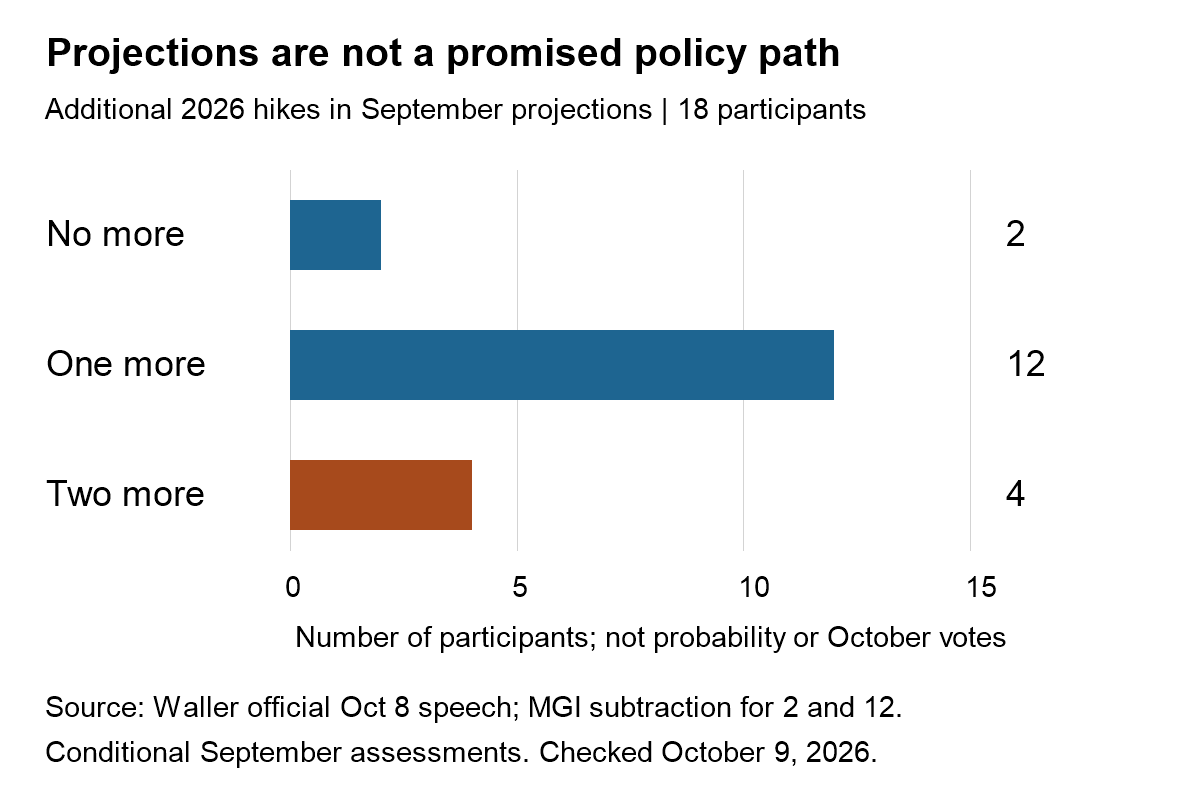
In his official October 8 speech, Waller explained that future increases need not happen at successive meetings. His remarks also described September projections: 16 of 18 participants anticipated at least one additional hike before year-end, including four expecting two. These are participants’ conditional assessments, not 18 votes committing the committee to a schedule.
| Additional hikes anticipated for 2026 | Participants | Reading |
|---|---|---|
| None | 2 | 18 − 16 |
| One | 12 | 16 − 4 |
| Two | 4 | Reported count |
The first two counts are MGI subtraction from the speech’s figures. The chart is a distribution of policymakers’ projections, not a forecast probability and not an October vote count. Our dot-plot explainer covers the broader framework; this article focuses on the latest timing signal.
Separate the policy level, destination and pace
The September meeting minutes document the completed increase to a 3.75%–4.00% federal funds target range. The Fed’s official calendar lists the next meetings for October 27–28 and December 8–9. Those dates are scheduled; their outcomes are not yet known.
MGI framework: Ask three different questions. What rate applies now? What rate might ultimately be appropriate? How quickly might the committee get there? A slower pace can coexist with the same intended destination. Confusing those questions turns an unchanged meeting into an unsupported claim that policy has reversed.
A numerical example: pause, hike and cut are different actions
| Illustrative action | Resulting range | Change |
|---|---|---|
| Hold | 3.75%–4.00% | 0 basis points |
| Raise by 25 bp | 4.00%–4.25% | +0.25 percentage point |
| Cut by 25 bp | 3.50%–3.75% | −0.25 percentage point |
The arithmetic does not assign odds to any outcome. A pause means no change at that meeting; a cut lowers the range. Neither an illustration nor a participant projection gives an investor a guaranteed profitable trade.
Why a policy pause need not lower every borrowing rate
The Fed’s yield-curve model guidance distinguishes expectations from term-premium components. Longer-term yields reflect more than today’s overnight policy setting. A mortgage quote adds loan-specific pricing on top of broader financing conditions.
MGI hypothetical: A reference yield could fall 0.10 percentage point while a lender’s additional pricing component rises 0.10 point. The combined borrowing rate would be unchanged in that simplified example. This is not a decomposition of current market rates. Our mortgage-rate transmission explainer addresses the mechanism in more detail.
Likewise, a stock can rise if new information is less restrictive than investors expected, even if the policy rate stays high. It can fall if earnings expectations deteriorate despite an unchanged rate. The relevant comparison is new information versus the prior expectation—not simply whether the word “pause” appears in a headline.
Five questions for the next policy headline
- Is it an adopted decision, meeting minutes, a projection or one official’s speech?
- Does the statement concern the next meeting or a longer horizon?
- Which condition would change the speaker’s view?
- Does the article distinguish the overnight target from market borrowing rates?
- Are quoted probabilities timestamped, rather than recycled as live odds?
Frequently asked questions
Has Waller announced that the Fed will cut in October?
No. A conditional speech does not announce an October committee decision.
Does 16 of 18 mean an 88.9% chance of a hike?
No. Counting projections is not a calibrated probability model. Participants’ assessments may change before voting.
Educational analysis, not personalized investment advice. Official sources support dated observations; MGI supplies the decision-reading framework and hypothetical arithmetic. Check the next actual statement before treating any scenario as policy.