Quick answer: Delta’s latest earnings show why strong travel demand does not automatically produce faster profit growth. The September-quarter release contains both reported and adjusted revenue, while fuel costs create a separate test of profitability. Match the accounting basis before comparing a revenue headline with earnings or guidance.
Checked October 10, 2026 against the October 9 release for the quarter ended September 30. This is an actual-results analysis, not a live DAL stock quote or personalized investment advice.
This results update follows our October 5 pre-release checklist; its earlier assumptions are historical, not the newly reported quarter.
Delta earnings: why there are two revenue numbers
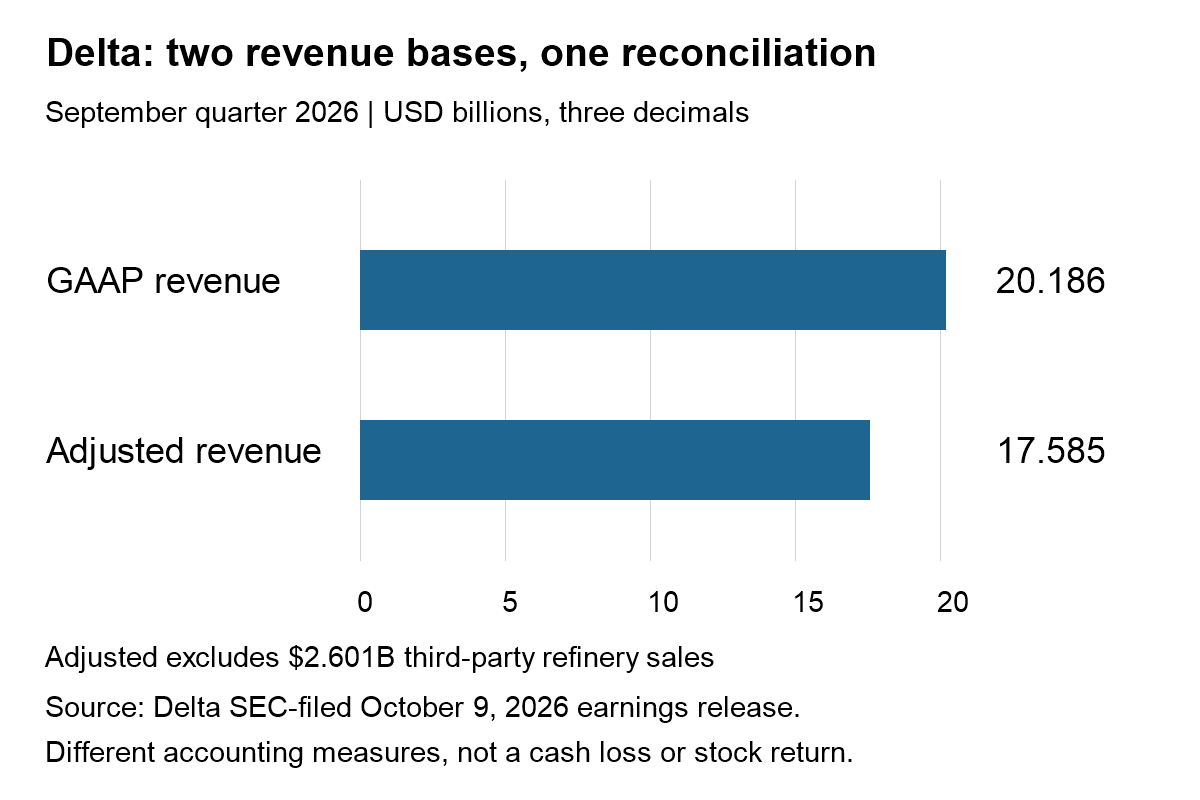
The official Delta results summary reports approximately $20.2 billion of GAAP revenue and $17.6 billion of non-GAAP revenue. The SEC-filed earnings release reconciles $20,186 million of reported revenue by subtracting $2,601 million of third-party refinery sales, yielding $17,585 million of adjusted revenue.
| Line | Amount | Meaning |
|---|---|---|
| Reported operating revenue | 20,186 | GAAP basis |
| Third-party refinery sales removed | −2,601 | Company’s adjustment |
| Adjusted operating revenue | 17,585 | Non-GAAP basis |
MGI calculation: The removed line is approximately 12.9% of reported revenue. This is a reporting-scope reconciliation, not evidence of missing cash, fictitious revenue or an earnings shortfall. A reader should not treat $20.2 billion and $17.6 billion as contradictory estimates of one identical measure.
The fuel test behind the travel-demand headline
Delta’s release reports adjusted fuel expense of approximately $4.1 billion, up 62% year over year. Its current full-year EPS outlook is $5.10–$5.60. That outlook is a forecast, not a completed full-year result. A claim that the forecast was cut requires a like-for-like earlier guidance comparison; this article does not assume one from a news headline.
MGI interpretation: Demand and margin are separate variables. An airline can carry customers willing to pay more and still face increased costs per flight. A revenue record therefore answers “How much business was booked?” more directly than “How much value was left for shareholders?” Neither variable alone establishes whether the stock is cheap.
A small model: how revenue growth can coexist with weaker profit
Imagine a fictional airline with $100 of revenue and $90 of operating costs, including $25 of fuel. Operating profit is $10. If revenue rises 10% to $110, fuel rises 40% to $35, and other costs rise from $65 to $67, total costs become $102 and profit becomes $8.
| Input | Before | After |
|---|---|---|
| Revenue | 100 | 110 |
| Fuel costs | 25 | 35 |
| Other operating costs | 65 | 67 |
| Operating profit | 10 | 8 |
Revenue increased while profit fell 20%; margin went from 10% to about 7.3%. The model is intentionally simple and excludes tax, interest, share count and hedging. It is not a reconstruction of Delta’s quarter. Its purpose is to show why adding a sales-growth percentage to an EPS-growth percentage is not valid analysis.
Five checks before extrapolating airline earnings
- Use the same reported or adjusted revenue basis in both quarters.
- Read the refinery adjustment rather than assuming all revenue is passenger-ticket sales.
- Separate fuel expense changes from demand, capacity and pricing changes.
- Keep full-year guidance distinct from the quarter already reported.
- Look beyond EPS to cash requirements, debt and the costs of maintaining the fleet.
These checks identify questions; they do not supply an unverified future fuel price or a stock-price target. A traveler noticing crowded airports is observing activity, not calculating an airline’s margin. An investor seeing an adjusted figure should inspect its definition, not automatically accept or reject it.
For another reporting-basis example, see our PepsiCo GAAP-versus-core earnings analysis. Our oil-to-pump-price explainer addresses a separate energy-pricing mechanism; jet fuel and retail gasoline are not interchangeable price series.
Frequently asked questions
Is adjusted revenue the same as GAAP revenue?
No. The refinery-sales reconciliation explains the difference in this release.
Does rising fuel expense prove DAL must fall?
No. A share price also reflects expectations, valuation and future outcomes. This article supplies no directional trading forecast.
Company sources supply historical observations and dated guidance; the revenue share and fictional airline are MGI calculations. The chart compares accounting measures, not stock returns. General financial education.