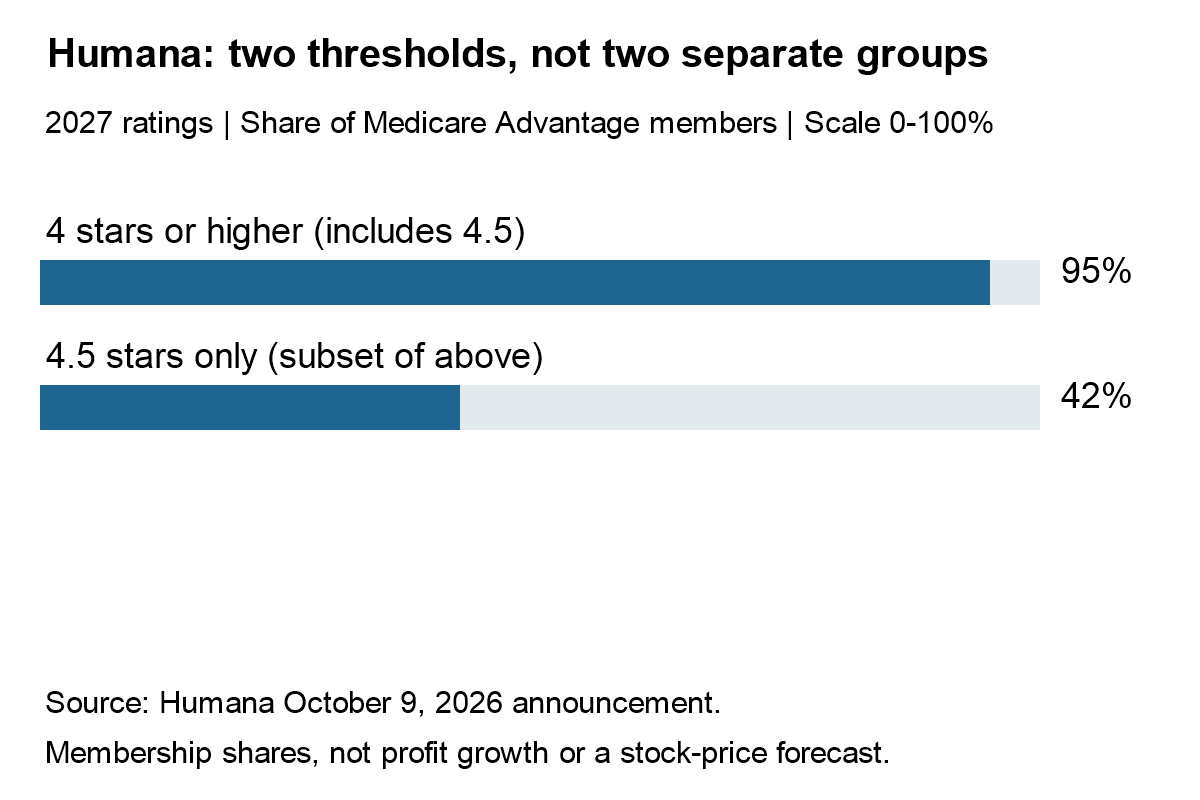
Quick answer: Humana’s latest Star Ratings news is about a better future earnings setup, not an already-delivered profit increase. The company says 95% of its Medicare Advantage members are in plans rated at least four stars for 2027. Its SEC filing identifies 2028 as the bonus year. Those dates are the first distinction to make before interpreting the Humana stock rally.
Checked October 10, 2026. Company disclosures are attributed below; analysis is educational, not a recommendation to buy HUM or select an insurance plan.
What changed in Humana’s 2027 Star Ratings?
Humana’s October 9 announcement reports 95% of Medicare Advantage membership in four-star-or-higher plans and 42% in 4.5-star plans. The second percentage is a subset of the first, not another group to add to it. These figures describe member distribution, not the percentage of contracts, a stock return or earnings growth.
| Reported measure | Share | How to read it |
|---|---|---|
| At least four stars | 95% | Includes the 4.5-star group |
| 4.5 stars | 42% | Subset, not additional membership |
The 2028 catch: ratings are not current-year cash
The October 9 Form 8-K labels the 2027 ratings as Bonus Year 2028. Humana also affirms at least $9 in 2026 adjusted EPS. That remains guidance, not a reported full-year result or a GAAP number. The filing warns that actual 2028 Stars revenue per member will depend on future membership, contract mix, risk scores, benchmarks and rebates. Some outperformance is expected to be one-time; detailed 2028 guidance is not provided here.
MGI interpretation: A share price can respond immediately to a changed expectation even when the associated operating evidence arrives later. A stock rally and a future bonus year can therefore coexist. Neither establishes how much benefit will reach shareholders after expenses, investment, changes in membership and other business conditions.
Four questions that matter more than a one-day chart
| Question | Evidence to seek |
|---|---|
| Which year? | Separate rating year, bonus year and reported earnings period. |
| Which denominator? | Distinguish members, contracts and revenue per member. |
| What is retained? | Look for expenses and investments alongside any revenue benefit. |
| What is recurring? | Separate durable operating improvements from temporary benefits. |
Use this checklist when the next financial disclosure arrives. A helpful exercise is to record the old assumption, the new evidence and what is still unknown in separate columns. Updating one assumption should not silently turn all remaining uncertainties into facts. In particular, a quality-rating improvement cannot by itself establish the future medical-cost trend or the price at which the stock is attractive.
A simple sensitivity test—not a Humana forecast
Imagine a fictional insurer receiving 100 units of additional revenue. If 30 units are spent supporting benefits and 20 on operating investment, 50 units remain before other costs and taxes. If those two expenditures instead total 80, only 20 remain. The same revenue headline gives different retained amounts. These invented units illustrate a reconciliation task; they are not an estimate of Humana’s revenue, expenses or profit.
For a real company, replace every hypothetical input with its disclosed definitions and a consistent reporting period. If a component is missing, leave it unknown. Do not use an analyst price target or an early trading quote as a substitute for the reconciliation. Our GAAP-versus-adjusted EPS comparison explains another reason headline growth can differ from the measure investors intend to evaluate.
How this fits Friday’s market
The October 9 telecom split shows why a sector label or rising index cannot explain every stock. Humana requires its own company-specific evidence rather than borrowing the rationale for another Friday mover. A news catalyst is a starting point for analysis, not a complete valuation.
Frequently asked questions
Does 95% mean earnings rise 95%?
No. It is a reported membership share under a rating threshold, not a profit-growth estimate.
Should 42% be added to 95%?
No. The higher-rated members are already included in the broader four-star-or-higher group.
Are 2028 benefits already booked in 2026 earnings?
The cited filing distinguishes the bonus year from current guidance. It does not report a completed 2028 earnings result.
Source boundary: member shares are company-reported; bonus-year and guidance distinctions come from the SEC filing. Check subsequent filings for updates. No live quote, return forecast or personalized investment or insurance advice is supplied.