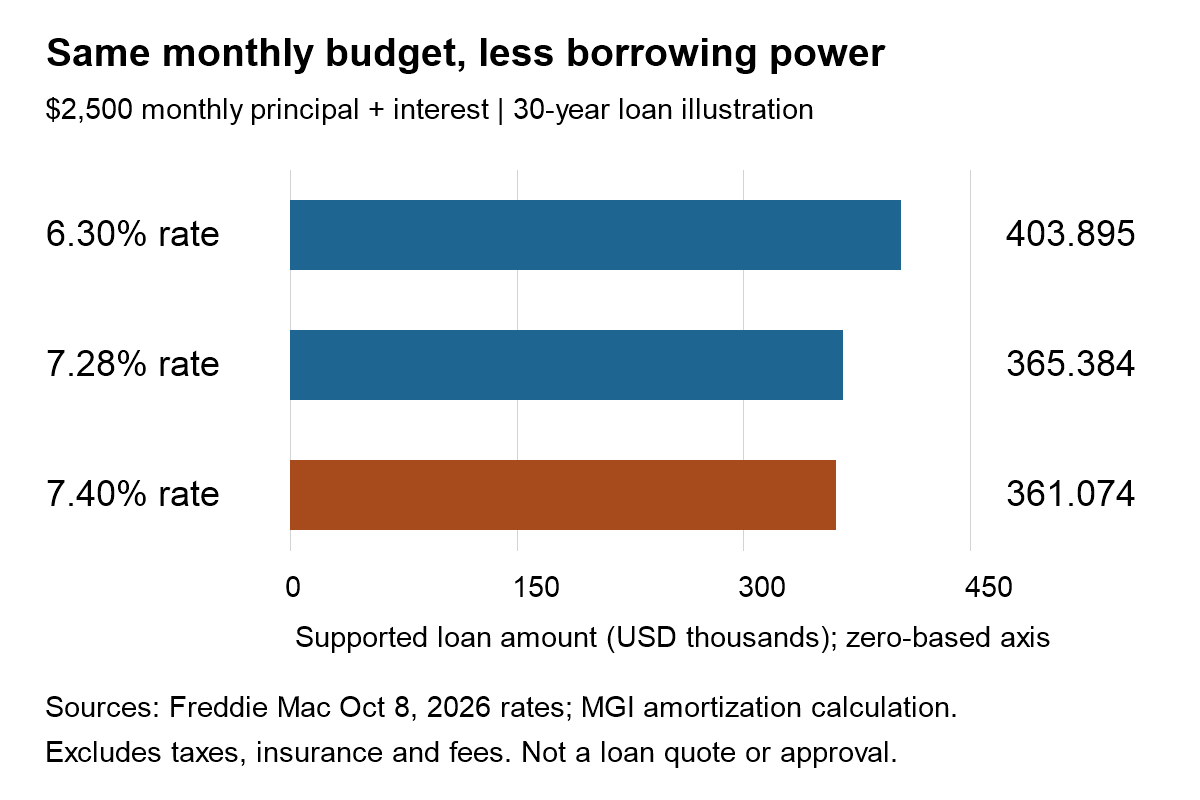
Quick answer: At a 7.40% mortgage rate, a hypothetical $2,500 monthly principal-and-interest budget supports about $361,074 of 30-year borrowing. At 6.30%, it supports about $403,895. That is roughly $42,821 less borrowing capacity—not a forecast that home prices must fall by that amount.
Checked October 9, 2026, using Freddie Mac’s October 8 weekly release. U.S. fixed-rate purchase-loan illustration, not a personalized quote or approval decision. Taxes, insurance, association fees and mortgage insurance are excluded.
What changed in the latest mortgage survey?
Freddie Mac’s official release reports a 7.40% average 30-year fixed rate, compared with 7.28% the previous week and 6.30% one year earlier. Its 15-year average is 6.73%. The survey focuses on conventional, conforming, fully amortizing purchase loans with 20% down and excellent credit. A weekly benchmark is not the rate every borrower can obtain on October 9.
The weekly 30-year move is 0.12 percentage point, or 12 basis points, not a 12% rate increase. Our earlier payment analysis preserves the October 1 benchmark; this update addresses a different question: how a fixed monthly budget changes the loan ceiling.
Same $2,500 budget, different borrowing power
| Annual rate | Supported loan | Illustrative home price, 20% down |
|---|---|---|
| 6.30% | $403,895 | $504,869 |
| 7.28% | $365,384 | $456,730 |
| 7.40% | $361,074 | $451,342 |
Method: Loan amount = monthly payment × [1 − (1 + r)−360] ÷ r, where r is the annual interest rate divided by 12, expressed as a decimal. Calculations use unrounded inputs; displayed dollar amounts round to the nearest dollar. Illustrative home price equals the loan divided by 0.80.
From 6.30% to 7.40%, supported borrowing falls about 10.6%. From 7.28% to 7.40%, the decline is about $4,310. The illustration holds the down-payment percentage constant, not the buyer’s cash contribution: 20% of a smaller home price is a smaller down payment. A buyer with a fixed dollar down payment needs a different calculation.
Why this is not your complete housing budget
Suppose a household has $3,000 available for housing each month and reserves $500 for taxes and insurance. That leaves the $2,500 used here for principal and interest. If those other costs are $800 instead, the remaining $2,200 supports a smaller loan even without another rate increase. This is an illustrative budget, not a local tax or insurance estimate.
Neither table column establishes lender approval. Existing debts, income verification, reserves, property eligibility and loan limits still matter. The calculated home price also excludes closing costs and any renovation budget. Treat it as a sensitivity check, not an instruction to spend up to the ceiling.
A cheaper headline rate can have a higher upfront price
The CFPB distinguishes interest rate from APR: the latter incorporates certain borrowing charges. A lower advertised rate paired with more fees is not automatically the better offer. The CFPB Loan Estimate comparison guide explains how to assess interest and fees over five years; compare like-for-like loan terms rather than rates alone.
MGI interpretation: A buyer can negotiate the property price, compare financing costs or change the loan size. None of those options guarantees that waiting will produce cheaper financing. For the separate decision of replacing an existing loan, see our refinance payment-versus-equity guide.
Four checks before acting on 7.40%
- Record the actual quote date, lock status and loan term.
- Separate principal and interest from all-in housing expenses.
- Compare points, lender credits and closing costs on Loan Estimates.
- Recalculate the budget at the offered rate without assuming a future refinance.
Frequently asked questions
Does 7.40% mean every lender charges that rate?
No. It is a dated survey average for a defined borrower and loan segment, not a universal offer.
Must home prices fall 10.6% because borrowing power fell?
No. The calculation describes one budget constraint. It does not model local supply, cash buyers, household incomes or market-clearing prices.
Source note: Freddie Mac supplies observed benchmark rates; CFPB supplies comparison guidance; MGI supplies the hypothetical budget and amortization calculations. General financial education, not individualized mortgage or investment advice.