Key Takeaways
QuidelOrtho (QDEL) surged after reports that the company may sell its Point-of-Care testing business for approximately $1.5 billion.
The market reaction is not mainly about a sudden improvement in Q1 results. It is about whether a potential asset sale could reduce debt and reshape the company’s valuation.
The reported sale process is meaningful, but it has not yet been confirmed by a final company announcement.
QDEL still faces revenue pressure, GAAP losses, lower full-year guidance, high interest expense, and post-COVID diagnostic demand normalization.
The key question is whether a potential divestiture can materially reduce leverage and allow investors to revalue the remaining diagnostics platform.
Why QDEL Moved Sharply Higher
QuidelOrtho Corporation (NASDAQ: QDEL) is a global in vitro diagnostics company with businesses across Point-of-Care testing, clinical laboratories, immunohematology, molecular diagnostics, and related diagnostic platforms.
The stock moved sharply higher after reports that the company is exploring a sale of its Point-of-Care testing business. The reported valuation is approximately $1.5 billion, and private equity buyers are said to be interested in the asset.
This is an important catalyst because QuidelOrtho has been under pressure since the post-COVID normalization of respiratory testing demand and the debt burden related to the Quidel-Ortho combination.
The reported sale would not simply be a portfolio cleanup. It could become a balance sheet event.
If QuidelOrtho can sell the Point-of-Care business at an attractive price and use proceeds to reduce debt, the market may begin to value the remaining business differently.
That is why QDEL rallied strongly. Investors are not just reacting to the idea of selling a diagnostic unit. They are reacting to the possibility that a sale could reduce leverage, improve financial flexibility, and lower the discount applied to the stock.
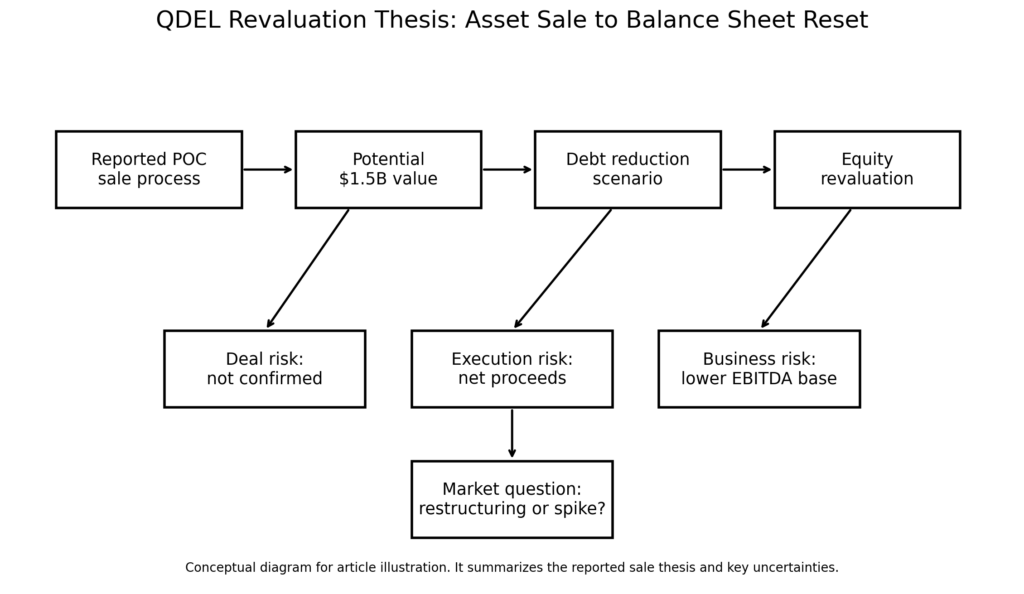
However, the rally should be interpreted carefully. The report does not yet represent a signed transaction. Until the company confirms a definitive agreement, sale price, proceeds, tax impact, transaction costs, and debt repayment plan, the move remains an M&A-expectation rally rather than a confirmed balance sheet reset.
The Core Catalyst: A Possible Point-of-Care Divestiture
The reported asset under review is QuidelOrtho’s Point-of-Care testing business. This segment includes rapid diagnostic products tied to respiratory testing, flu and COVID testing, and certain cardiac-related diagnostics.
This business was once a major source of pandemic-era strength. However, respiratory testing demand has normalized, and recent Point-of-Care revenue has declined sharply.
That makes the potential sale strategically interesting.
On one hand, selling the Point-of-Care business could reduce QuidelOrtho’s exposure to volatile respiratory testing cycles.
On the other hand, it may also remove a business that still produces meaningful EBITDA.
The reported $1.5 billion value is therefore important. If the business generated roughly $150 million of EBITDA, the implied valuation would be around 10 times EBITDA. That is a meaningful number for a company whose equity value has been pressured by leverage and weak sentiment.
The market’s question is simple:
Can QuidelOrtho turn a challenged but cash-generating diagnostic unit into enough cash to materially reduce debt?
If the answer is yes, the stock could deserve a new valuation framework.
If the answer is no, the rally may fade.
Why Debt Reduction Matters More Than the Sale Headline
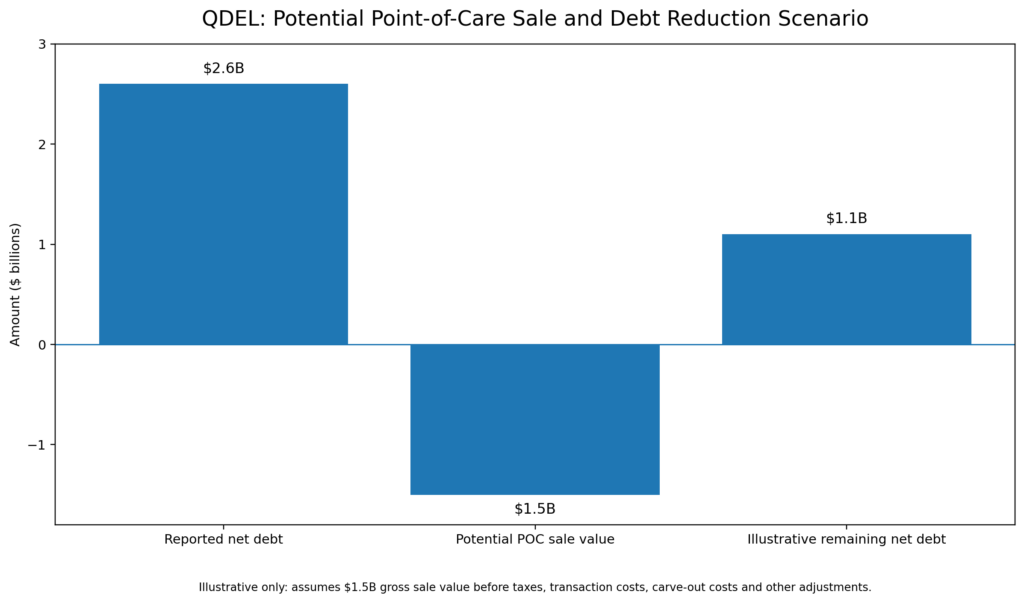
The most important part of the QDEL story is debt.
QuidelOrtho is not a small speculative company with no operating business. It is a real diagnostics company with billions of dollars of annual revenue and meaningful adjusted EBITDA.
The problem is that leverage, interest expense, and weak revenue trends have pressured equity value.
That is why a possible $1.5 billion divestiture matters.
If the company receives significant net proceeds and uses them to reduce debt, several things could improve:
Interest expense could decline.
Financial flexibility could improve.
Leverage ratios could move lower.
Free cash flow could become more valuable to equity holders.
The remaining diagnostics business could trade at a less distressed valuation.
However, investors should not assume that headline sale value equals debt reduction.
The final impact depends on the actual transaction price, taxes, fees, carve-out costs, working capital adjustments, retained liabilities, and management’s use of proceeds.
A $1.5 billion headline is powerful, but the market needs to know how much cash actually reaches the balance sheet and how much debt is repaid.
News Sentiment and Information Quality
The news sentiment around QDEL is clearly positive.
The strongest market keywords are “Point-of-Care sale,” “$1.5 billion valuation,” “private equity interest,” “debt reduction,” and “portfolio restructuring.” These are exactly the kinds of catalysts that can trigger a sharp rebound in a heavily discounted healthcare diagnostics stock.
However, the information quality should be ranked as medium-high, not fully confirmed.
The report appears credible, but it is still a media report. The company has not yet announced a signed transaction.
That distinction is important.
A confirmed divestiture with a signed agreement would be a stronger catalyst. A reported sale process creates upside potential, but it also leaves room for disappointment.
Possible downside scenarios include:
No sale occurs.
The sale price is lower than expected.
The deal takes longer than expected.
Net proceeds are lower than headline value.
The company does not use enough proceeds for debt reduction.
The remaining business loses too much EBITDA.
Therefore, this rally is best described as an M&A-expectation rally, not a completed-deal revaluation.
Price Action and Volume Analysis
QDEL showed strong intraday momentum during the move.
The stock traded from the low-$14 range to a high near $19.72 before pulling back into the $18 range. Even after fading from the intraday high, the stock remained up more than 30% on the day.
That is a strong price reaction.
Volume also expanded, showing that institutional and event-driven traders likely became more active in the name. QDEL is not a tiny micro-cap stock, so this type of move suggests the market is taking the divestiture report seriously.
However, the pullback from the intraday high should not be ignored.
A stock that spikes on M&A speculation often faces profit-taking before the deal is confirmed. Traders who bought the initial headline may reduce exposure if no follow-up news appears quickly.
The key short-term levels are straightforward.
The $18 area is the first support zone.
The $19.72 intraday high is the first resistance zone.
The $20 level is the psychological breakout level.
If QDEL can hold near $18 and later break above $19.72 with strong volume, the rally may gain credibility. If it falls below $18 and volume fades, the move may become a short-term event-driven rebound.
Technical Analysis: Strong Rebound, but Confirmation Needed
Technically, QDEL has entered a strong rebound phase.
The one-day move was large, and volume supported the rally. That combination usually indicates that the stock attracted more than casual retail interest.
However, technical analysis alone cannot confirm a long-term trend reversal here.
This rally depends heavily on whether the reported sale process becomes a real transaction.
If the company confirms a sale at or near the reported valuation, the chart could continue to improve.
If there is no follow-up announcement, or if the reported value proves too optimistic, the stock could give back part of the move.
The most important technical levels are:
$18 as short-term support.
$19.72 as the intraday high and near-term resistance.
$20 as the psychological breakout threshold.
A sustained move above $20 would suggest that investors are beginning to price in a more serious balance sheet reset.
A failure to hold $18 would suggest that the market is still treating the move as speculation.
Sector Context: Diagnostics After the COVID Boom
QuidelOrtho operates in the diagnostics sector, including clinical chemistry, immunoassay, immunohematology, molecular testing, and Point-of-Care diagnostics.
This sector has been under pressure since the COVID testing boom normalized. Many diagnostic companies benefited from pandemic-era demand, but later faced weaker respiratory testing volumes, pricing pressure, customer budget pressure, and regional disruptions.
QuidelOrtho’s own Q1 results reflected some of these issues. Point-of-Care revenue declined sharply due to a weaker respiratory season. Labs revenue also declined, partly because of slower China distributor activity, Middle East disruption, and portfolio-related issues.
That means QDEL’s rally is not simply a broad diagnostics-sector rally.
It is more company-specific.
The market is asking whether QuidelOrtho can use portfolio restructuring to reduce debt and refocus the remaining company on more stable diagnostic businesses.
If the Point-of-Care sale happens, QDEL may become a cleaner story, but also a smaller company.
That trade-off is central to the analysis.
Fundamental Analysis: Weak Q1, But Meaningful EBITDA Base
QDEL’s Q1 2026 results were not strong on a headline basis.
Total revenue was approximately $620 million. Point-of-Care revenue declined sharply, Labs revenue also declined, and GAAP results showed a net loss.
The company reported a GAAP net loss of $92 million and GAAP operating loss of $32 million. Adjusted EBITDA was $109 million.
That mix tells investors two things.
First, the company is not in a clean growth phase. Revenue pressure remains real.
Second, the company still has an operating earnings base. Adjusted EBITDA remains meaningful, which is why balance sheet repair matters.
QuidelOrtho also updated its full-year 2026 guidance. The company now expects revenue of $2.70 billion to $2.75 billion, adjusted EBITDA of $615 million to $630 million, and free cash flow of $100 million to $120 million.
The problem is that these guidance ranges were lowered from previous expectations.
That creates a mixed picture.
QDEL is not a broken business, but it is under pressure. The company still generates adjusted EBITDA, but leverage and weak growth are limiting equity value.
That is why a divestiture could matter so much.
Operating Efficiency: Real Scale, But Margin Pressure
QuidelOrtho is very different from many speculative high-volatility stocks. It has real scale, real products, and an established diagnostics platform.
However, operating efficiency is under pressure.
Adjusted EBITDA remains meaningful, but GAAP losses, revenue declines, interest expense, and restructuring needs make the equity story complicated.
The company’s operating challenge is not whether it can generate sales. It already does.
The challenge is whether it can generate enough durable cash flow after interest expense, restructuring costs, investment needs, and segment-level weakness.
A Point-of-Care divestiture could simplify the business, reduce debt, and improve financial flexibility.
But it could also remove EBITDA from the company.
Therefore, investors should not only ask how much cash QuidelOrtho receives. They should also ask how much EBITDA is lost and what the remaining company’s margin profile looks like.
The ideal outcome would be a sale that materially reduces leverage while leaving the remaining company with a more stable earnings base.
Debt Risk and Balance Sheet Revaluation
Debt is the heart of the QDEL investment case.
The reported sale process is aimed at reducing the company’s debt burden. If successful, it could change how investors value the equity.
High debt creates several problems:
It increases interest expense.
It limits strategic flexibility.
It reduces the value of free cash flow to common shareholders.
It increases refinancing risk.
It forces investors to apply a lower valuation multiple.
If a sale reduces leverage meaningfully, QDEL could benefit from multiple expansion even if revenue growth remains modest.
However, the sale must be judged on net balance sheet impact, not headline value alone.
Investors should track:
Final sale price.
Net after-tax proceeds.
Transaction costs.
Debt repayment amount.
Remaining EBITDA after divestiture.
Interest expense reduction.
Updated leverage ratio.
Updated free cash flow guidance.
This is why the stock reaction was so strong. The market is not just buying an asset sale story. It is buying the possibility of balance sheet revaluation.
QDEL Rally Sustainability Score

Overall Score: 59/100
Rating: Strong M&A-driven momentum, but confirmation is still needed
Catalyst Clarity: 13/15
The reported Point-of-Care sale process is a clear and powerful catalyst. However, it has not yet been confirmed by a definitive company announcement.
News Sentiment and Reliability: 6/10
The report comes from a credible financial news source, but it is still not the same as a signed transaction.
Price and Volume Momentum: 14/15
The stock rose more than 30% intraday with expanded volume, showing strong short-term market interest.
Technical Overheating Risk: 4/10
The rally was large, and the stock pulled back from the intraday high. Chasing after the initial move carries risk.
Sector Confirmation: 8/15
The diagnostics sector is not broadly revaluing. This appears more related to QDEL-specific restructuring expectations.
Fundamental Improvement: 5/15
Q1 results were weak, with revenue declines and GAAP losses. The fundamental improvement depends on the sale being completed and debt being reduced.
Operating Efficiency: 5/10
Adjusted EBITDA remains meaningful, but margin pressure, revenue weakness, and interest expense remain concerns.
Financial Risk Management: 4/10
Debt reduction could be a major positive, but the company has not yet executed the transaction.
What Investors Should Watch Next
The first factor is an official company announcement. A media report is not enough for a full revaluation. Investors need confirmation of a definitive transaction.
The second factor is the sale price. The reported $1.5 billion value is powerful, but the final number matters.
The third factor is net cash proceeds. Taxes, fees, transaction costs, and carve-out expenses may reduce the amount available for debt repayment.
The fourth factor is debt reduction. The market needs to know how much debt will actually be repaid.
The fifth factor is the remaining EBITDA base. Selling a business may reduce debt, but it may also remove earnings. Investors need to compare the lower debt burden with the lower EBITDA base.
The sixth factor is the $18 support zone. If QDEL holds this area, momentum may remain intact.
The seventh factor is the $19.72 intraday high. A breakout above that level with volume would suggest stronger follow-through.
The eighth factor is the $20 level. A sustained move above $20 could signal that investors are pricing in a more serious balance sheet reset.
The ninth factor is full-year free cash flow. The company’s current 2026 free cash flow guidance is $100 million to $120 million, but the range was reduced from prior expectations.
Bottom Line
QDEL’s latest surge is best understood as an asset-sale and debt-reduction rally.
The reported possibility of selling the Point-of-Care testing business for approximately $1.5 billion is a major potential catalyst because QuidelOrtho’s equity value has been pressured by leverage, weak respiratory testing demand, and lower guidance.
However, the rally is not yet a confirmed structural turnaround.
The company has not announced a final sale agreement. Q1 results showed revenue pressure, GAAP losses, lower guidance, and continued operating challenges.
The bullish case depends on execution.
If QuidelOrtho sells the Point-of-Care business at an attractive valuation and uses the proceeds to materially reduce debt, the market could revalue the remaining company.
If the sale does not happen, or if the final proceeds disappoint, the stock may give back part of the move.
For now, QDEL should be viewed as a diagnostics restructuring trade with strong short-term momentum, but not yet a completed balance sheet turnaround.
Related Reading
- https://www.quidelortho.com/us/en
- https://www.ft.com/content/404f832c-89cf-49f7-a546-b0e4eb965f15?syn-25a6b1a6=1
- https://mgiedit.org/wshp-stock-surge-weshop-shareback-low-float-momentum/
- https://mgiedit.org/ped-stock-surge-earnings-revaluation-or-low-float-energy-momentum/
Disclaimer: This article is for informational purposes only and does not constitute investment advice, financial advice, or a recommendation to buy or sell any security. Investors should conduct their own research and consider their risk tolerance before making investment decisions.