Quick answer: falling inflation usually means prices are rising more slowly—not returning to their old levels. Disinflation is a slowdown in inflation; deflation is a sustained decline in the general price level. To understand your grocery bill, compare both the latest rate of change and the cumulative price increase since your chosen starting date.
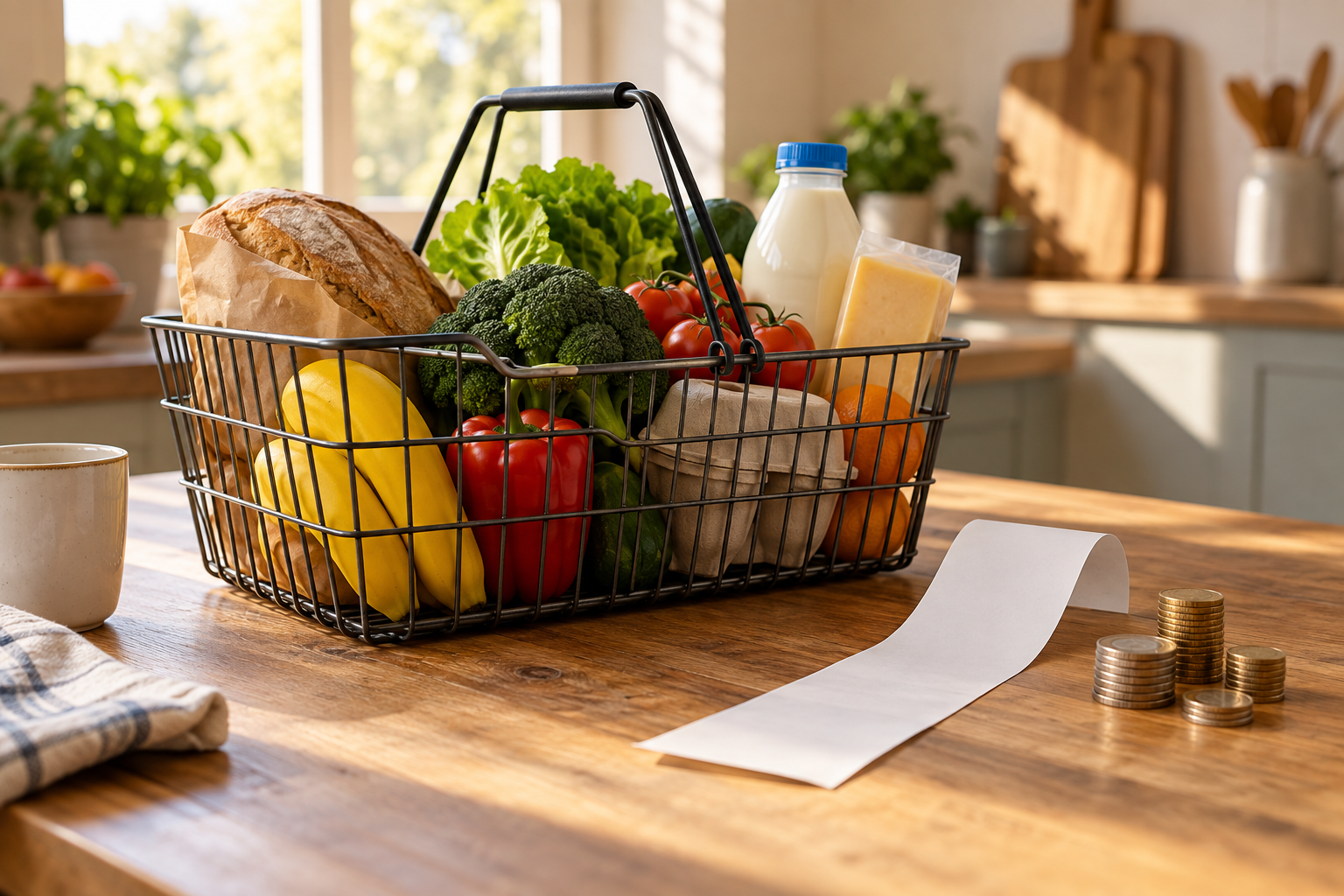
Reviewed October 3, 2026. This evergreen guide uses hypothetical calculations, not a current inflation forecast. Featured image: AI-generated conceptual illustration.
Why are prices still high when inflation is down?
A rate measures movement over a period. A level measures where you are. Mixing them up leads to a common misunderstanding: an improvement in the rate is treated as a reversal of the level.
The St. Louis Fed’s explanation distinguishes inflation, disinflation and deflation. A lower but positive inflation rate still means the average price level is increasing. It does not require every individual product to become more expensive.
| Term | What changes? | Plain-language meaning |
|---|---|---|
| Inflation | General price level rises. | The average basket costs more. |
| Disinflation | Inflation rate slows. | The basket becomes more expensive more slowly when inflation remains positive. |
| Deflation | General price level falls persistently. | The average basket becomes cheaper. |
A $100 basket: 6% inflation followed by 2%
Hypothetical example: start with an unchanged basket costing $100. After a year of 6% inflation, it costs $106. After another year of 2% inflation, it costs $108.12. The inflation rate slowed by four percentage points, but the basket is now 8.12% above the starting price.
| Point in time | Assumed inflation | Basket price |
|---|---|---|
| Starting point | Not applicable | $100.00 |
| End of year one | 6% | $106.00 |
| End of year two | 2% | $108.12 |
The arithmetic is $100 × 1.06 × 1.02. Adding 6% and 2% would give 8%, but the compounded increase is 8.12% because the second increase applies to a larger base.
This example is deliberately independent of any particular country or year. You can reuse the method with verified index levels or with prices for an identical basket. Do not insert a headline inflation rate into your own budget and assume every category moved equally.
How much would prices need to fall to reverse that increase?
Returning from $108.12 to $100 requires a decrease of about 7.51%, not 8.12%. Calculate $100 ÷ $108.12 − 1. A percentage fall is measured from the higher starting point, so it is not the mirror image of the earlier percentage rise.
Zero inflation would leave the basket at $108.12 in this simplified example. It would stop the increase, not undo it. A wage increase might improve affordability without prices returning to $100; that is a different question from whether the price level fell.
Why your personal experience can differ from CPI
The BLS explains that CPI is a statistical average and may not match an individual household. A family spending heavily on a rapidly rising category can experience more pressure than the average. Another family may have a different mix.
For a practical worksheet, record the same quantity and quality of five recurring purchases, their old prices and their current prices. Keep a separate column for quantity changes. Buying more food or changing brands raises spending for reasons beyond the price of an unchanged basket.
That worksheet is a personal comparison, not an official inflation index. Its value is explaining your own bill rather than disputing an aggregate statistic using one item.
Four checks before sharing an inflation headline
- Identify the period: monthly and year-over-year changes answer different questions.
- Identify the measure: all-items and core indexes cover different baskets.
- Check the level: choose a starting date when discussing cumulative prices.
- Separate price from spending: quantity, quality and household composition can change the bill.
For the investment side of purchasing power, read our nominal versus real return guide. For an applied release example, see our PCE prices and real spending analysis. The latter is date-specific; this guide explains the reusable method.
Frequently asked questions
Does 2% inflation mean prices fall by 2%?
No. Positive 2% inflation means the measured price level rises by 2% over the specified period.
Can food prices fall while overall inflation is positive?
Yes. A broad average can rise while some categories or products become cheaper.
Does lower inflation mean everyone can afford more?
Not necessarily. Affordability also depends on income, expenses, debt payments and the goods a household buys.
Bottom line: slower inflation and cheaper prices are not interchangeable. Track the rate, the cumulative level and your own purchasing power separately. This article explains economic concepts and is not personalized financial advice.