Quick answer: The 2027 Social Security tax limit is $192,300, up from $184,500 in 2026. At the unchanged 6.2% employee rate, the maximum annual employee Social Security tax rises by $483.60. That is a maximum increase for someone with enough covered wages in both years—not a new charge for every worker.
Official figures checked October 15, 2026. Examples below hold annual Social Security-covered wages constant and exclude Medicare, income tax and other payroll deductions.
What changed for 2027—and what did not?
SSA’s contribution and benefit base page confirms the $192,300 cap and 6.2% employee rate. The base is wage-indexed. It is different from the 3.6% benefit COLA confirmed in the 2027 Social Security fact sheet. A larger taxable wage base is not a higher tax percentage.
| Measure | 2026 | 2027 |
|---|---|---|
| Taxable wage cap | $184,500 | $192,300 |
| Employee rate | 6.2% | 6.2% |
| Calculated maximum employee tax | $11,439.00 | $11,922.60 |
Who pays the full $483.60 more?
MGI calculation: ($192,300 − $184,500) × 0.062 = $483.60. A worker with at least $192,300 of covered wages in each year reaches both caps and sees that full annual increase in this component.
Someone earning less than the old cap does not become subject to a higher Social Security rate simply because the cap rises. For an unchanged $100,000 of covered wages, the simplified annual calculation remains $6,200 in either year. A raise, bonus or different covered-wage amount can change the outcome, which is why this is a controlled comparison rather than a personalized paycheck forecast.
Same wages, three different payroll outcomes
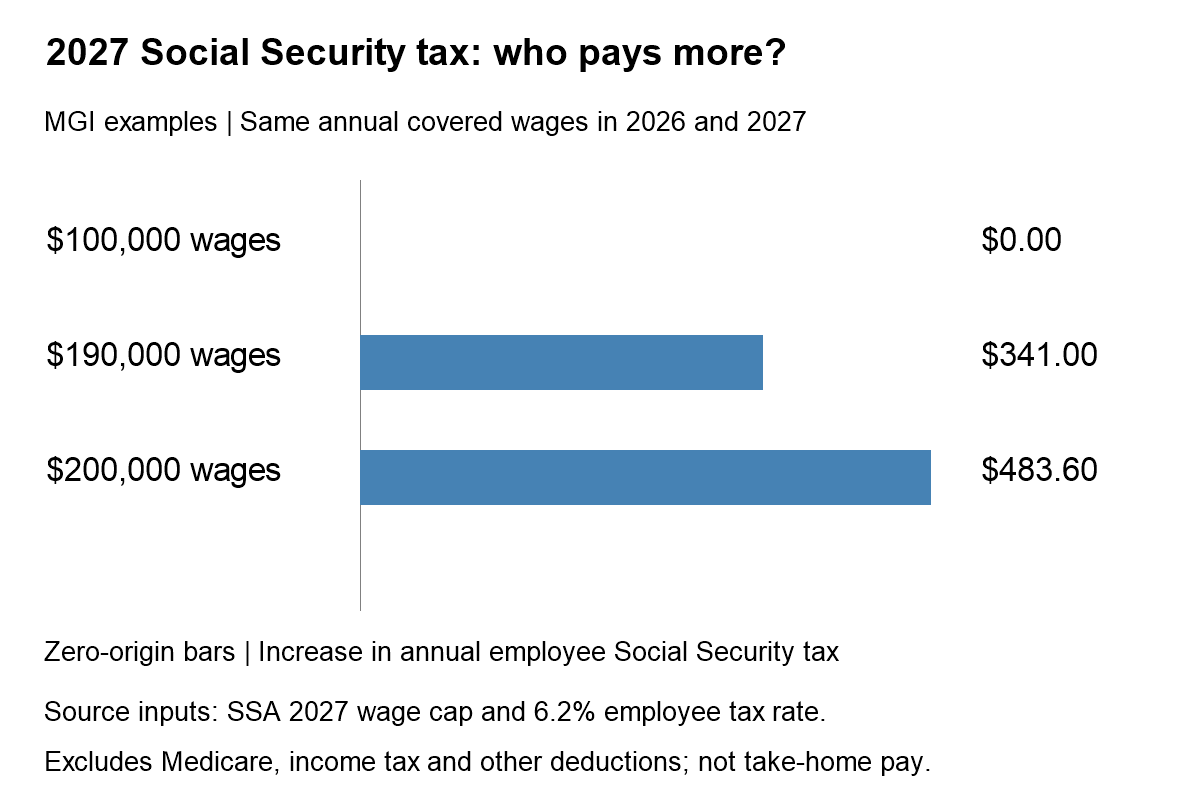
| Annual covered wages | 2026 tax | 2027 tax | Annual increase |
|---|---|---|---|
| $100,000 | $6,200.00 | $6,200.00 | $0.00 |
| $190,000 | $11,439.00 | $11,780.00 | $341.00 |
| $200,000 | $11,439.00 | $11,922.60 | $483.60 |
Use the formula 0.062 × min(covered wages, annual cap). At $190,000, only $5,500 becomes newly taxable compared with the old cap; multiplying that slice by 6.2% produces $341. This middle case is why “everyone pays another $483.60” is misleading.
Dividing the maximum increase by 12 gives $40.30 per month as a budgeting equivalent. It does not mean payroll will withhold exactly $40.30 more every month. Pay frequency, bonuses and when the annual cap is reached affect the timing.
Do not confuse the cap with Medicare or retirement benefits
SSA explains that Medicare’s Hospital Insurance component has no taxable earnings cap. Reaching the Social Security limit therefore does not mean every payroll tax stops. This article isolates the employee Social Security component; it does not estimate total FICA, additional Medicare tax, income tax or take-home pay.
Nor is the wage cap the retirement earnings-test limit. The first determines wages subject to Social Security tax; the second can affect benefits for some people working before full retirement age. For the benefit-claiming distinction, see our retirement-age comparison. For a separate household-budget distinction, read why a lower Medicare Advantage premium need not mean lower total cost.
Paycheck checklist for January
- Locate Social Security-covered wages rather than assuming salary equals the relevant wage amount.
- Check the 6.2% Social Security line separately from Medicare and income-tax withholding.
- Compare equal annual wage assumptions before attributing every change to the new cap.
- If you have multiple employers, check SSA’s multiple-job withholding explanation; each employer withholds independently, and excess withholding may need reconciliation on the tax return.
Frequently asked questions
Is Social Security tax rising to 7.65%?
No. The employee Social Security rate remains 6.2%; 7.65% combines the standard Social Security and Medicare components, as SSA’s fact sheet explains.
Does the $483.60 apply to self-employed people?
No. It is an employee-rate comparison. Self-employment has different rates and calculation rules; do not reuse this paycheck table as a self-employment tax estimate.
Is this the same as a COLA increase?
No. A COLA changes benefits, while this cap limits wages subject to the Social Security tax.
Bottom line: The new cap matters most around and above the old threshold. Compare the newly taxable slice, not just the headline limit. This is general educational information, not individual tax advice.