Quick answer: Diesel prices reflect a refined product, not just crude oil. A cheaper barrel does not guarantee cheaper diesel when refining margins, inventories, transport constraints or retail costs move in the opposite direction.
Checked October 12, 2026. This explains how to evaluate today’s fuel headlines; it does not announce completed deliveries or predict a pump-price decline.
Why do today’s diesel headlines need a separate test?
AP’s October 12 morning report described mixed U.S. futures and Brent above $105 a barrel amid discussion of a proposed Russian diesel purchase. A reported political plan is not evidence that fuel has arrived, cleared the relevant requirements or reached retailers. This article does not treat proposed volumes as delivered supply. AP’s timestamped market report.
Investors and households need two answers: has crude become cheaper, and has the supply of usable diesel improved? Those questions can produce different answers on the same day. A crude benchmark quote alone cannot settle either the regional retail price or a company’s eventual fuel bill.
What makes up a diesel price?
The U.S. Energy Information Administration separates retail diesel into crude purchases, refining costs and profits, distribution/marketing/retail costs and profits, and taxes. Component shares vary with place and time. Product demand, refinery problems, imports, inventories and distribution constraints can affect diesel independently of a headline crude quote.
Keep the comparison consistent: wholesale diesel is not a retail national average; dollars per barrel are not dollars per gallon; a futures price is not necessarily the cost of physical fuel delivered to a particular location.
The $10-per-barrel trap: convert units before comparing
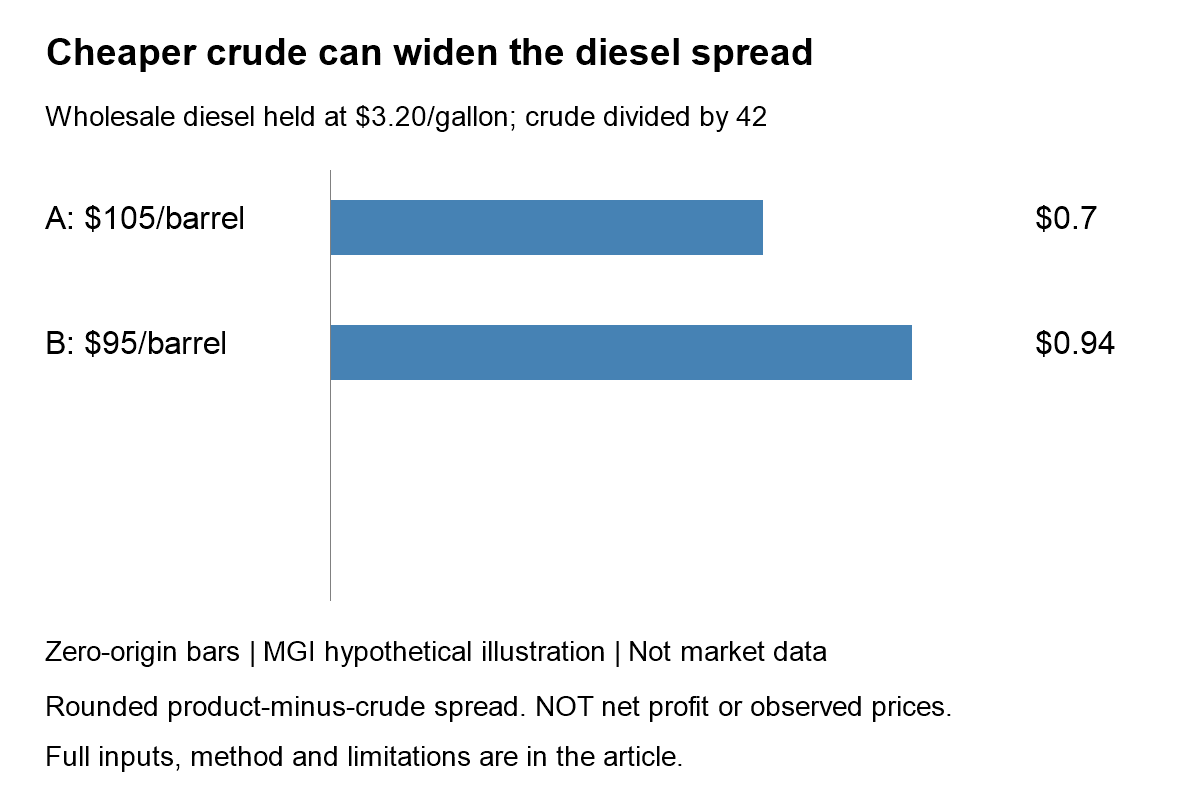
The EIA’s units guide defines one petroleum barrel as 42 U.S. gallons. In a hypothetical comparison, crude at $105 per barrel is $2.50 per gallon; at $95, it is about $2.26. The $10 barrel decline therefore equals roughly 23.8 cents per gallon of crude—not a promised 23.8-cent retail diesel reduction.
| Input or calculation | Scenario A | Scenario B |
|---|---|---|
| Hypothetical crude, per barrel | $105.00 | $95.00 |
| Crude price divided by 42 | $2.50/gallon | $2.2619/gallon |
| Hypothetical wholesale diesel | $3.20/gallon | $3.20/gallon |
| Simple product-minus-crude spread | $0.70/gallon | $0.9381/gallon |
Wholesale diesel is deliberately held constant to isolate the arithmetic. The spread widens by the same 23.8 cents that crude falls. This is neither an observed crack spread nor net refinery profit: it omits operating expenses, yields, other products and location differences. It shows why assuming one-for-one pass-through can fail.
Five pieces of evidence to watch before calling a price breakthrough
- Delivery evidence: distinguish an announcement, contract, loading and actual arrival. Do not combine proposed shipment stages into realized supply.
- Product prices: compare wholesale diesel with a matched crude benchmark, location and date—not gasoline with diesel.
- Inventories and availability: check an official dated stock series alongside refinery and distribution conditions. A stock change alone does not prove the cause.
- Retail confirmation: use the applicable region and fuel grade. EIA’s pump-component methodology notes that spot and retail price adjustments can lag; it does not promise a fixed delay.
- Company exposure: inspect the contract, hedging, usage and surcharge rules before translating fuel relief into earnings. Retail diesel savings are not automatically airline fuel savings.
For gasoline’s different retail question, read why gas prices can fall slower than oil. Our Delta revenue and refinery analysis shows why refining and transport businesses need company-specific accounting.
Frequently asked questions
Does falling Brent mean diesel must fall?
No. Crude is one component; product-market and distribution conditions may offset its movement.
Is a diesel supply announcement a price forecast?
No. Execution, usable quantities, timing and location must be verified first.
Bottom line: Separate the barrel, the refined product and the pump. Use verified delivery and matched-price evidence before claiming household savings or corporate profit gains. Educational analysis, not a trading recommendation.