Quick answer: In 2027, a Social Security beneficiary who is under full retirement age for the whole year can earn up to $25,560 ($2,130 a month) before any benefits are withheld; above that, SSA withholds $1 of benefits for every $2 of earnings. In the year a person reaches full retirement age, the limit is $67,920 ($5,660 a month), the rate is $1 for every $3, and only earnings before the month of full retirement age count. From that month on there is no limit, and benefits withheld earlier are credited back through a higher monthly benefit.
Data as of November 12, 2026. Examples are MGI calculations from SSA’s published 2027 amounts and ignore taxes, Medicare premiums and SSA’s rounding.
The 2027 earnings limits at a glance
SSA calls these limits the retirement earnings test exempt amounts. They rise with the national average wage, not with the 3.6% benefit increase covered in our 2027 COLA calculator. SSA’s Federal Register notice of October 26, 2026 sets the monthly amounts and states that the annual amounts are exactly 12 times the monthly ones.
| Situation | 2026 | 2027 | Withholding above the limit |
|---|---|---|---|
| Under full retirement age all year, annual | $24,480 | $25,560 | $1 for every $2 |
| Under full retirement age all year, monthly | $2,040 | $2,130 | See the first-year rule below |
| Year of reaching full retirement age, annual | $65,160 | $67,920 | $1 for every $3 |
| Year of reaching full retirement age, monthly | $5,430 | $5,660 | See the first-year rule below |
| Month of full retirement age and later | No limit | No limit | None |
MGI check: $2,130 × 12 = $25,560 and $5,660 × 12 = $67,920. The lower limit rose by $1,080 and the higher one by $2,760.
Which row applies to you?
Full retirement age is 67 for people born in 1960 or later. A person born in 1960 therefore reaches it during 2027 and uses the $67,920 row. Someone born in 1961 or later is under full retirement age for all of 2027 and uses the $25,560 row. Our claiming-age comparison has the full table by birth year. If you have not claimed benefits yet, the earnings test does not apply to you at all.
How much is withheld at $30,000, $40,000, $50,000 and $70,000
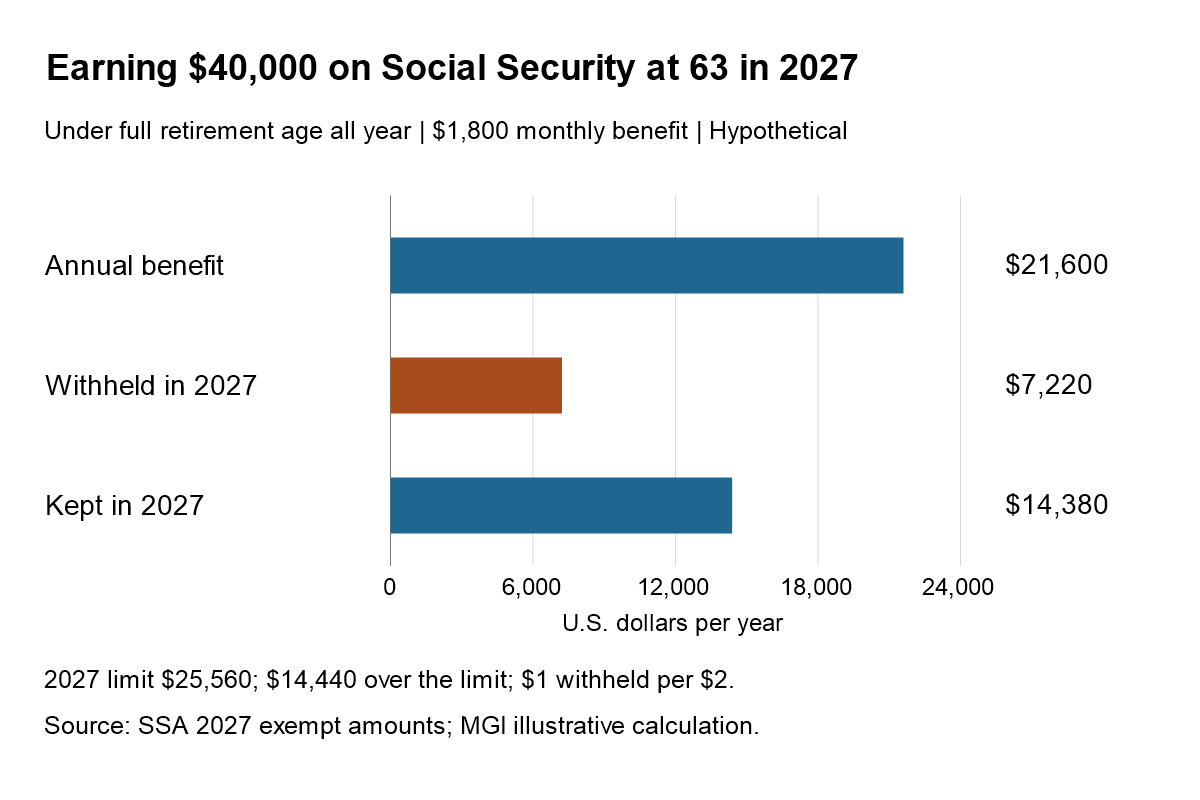
The formula for someone under full retirement age all year is (annual earnings − $25,560) ÷ 2. The table applies it to an illustrative benefit of $1,800 a month, or $21,600 for the year.
| 2027 earnings | Amount over $25,560 | Benefits withheld (÷ 2) | Whole checks held | Benefits kept for the year |
|---|---|---|---|---|
| $30,000 | $4,440 | $2,220 | 2 | $19,380 |
| $40,000 | $14,440 | $7,220 | 5 | $14,380 |
| $50,000 | $24,440 | $12,220 | 7 | $9,380 |
| $70,000 | $44,440 | $21,600 (formula gives $22,220) | 12 | $0 |
Arithmetic for the $40,000 row: $40,000 − $25,560 = $14,440; $14,440 ÷ 2 = $7,220; $21,600 − $7,220 = $14,380. At $70,000 the formula produces more than the whole year’s benefit, so everything is withheld. For a $1,800 benefit that point is reached at $25,560 + (2 × $21,600) = $68,760 of earnings. A larger benefit pushes the point higher.
SSA withholds whole checks first, not a slice of each one
Many people expect a smaller check every month. That is not how it works. SSA’s publication on working while receiving benefits describes withholding full monthly payments from the start of the year until the required amount is covered, then paying the regular benefit for the remaining months. Any amount withheld beyond what was required is paid back the following year.
MGI example with the $40,000 row: $7,220 ÷ $1,800 = 4.01, so five checks are held (January through May), which is $9,000. Regular $1,800 payments run from June through December: 7 × $1,800 = $12,600. The excess, $9,000 − $7,220 = $1,780, is paid in 2028. Total for 2027: $12,600 + $1,780 = $14,380, matching the table.
The cash-flow consequence is the practical point: five months with no Social Security deposit. A household that budgets on a slightly reduced monthly check will be short early in the year. Our 2027 Social Security tax limit article covers a different number, the $192,300 wage base for payroll tax, which is unrelated to this test.
The year you reach full retirement age
For 2027 this covers people born in 1960. Only earnings in the months before the month of full retirement age are counted, the limit is $67,920, and the rate is $1 for every $3. MGI examples for someone whose full retirement age arrives in September 2027, using January-through-August earnings:
| Earnings, January–August | Amount over $67,920 | Benefits withheld (÷ 3) |
|---|---|---|
| $60,000 | $0 | $0 |
| $72,000 | $4,080 | $1,360 |
| $84,000 | $16,080 | $5,360 |
Earnings from September onward do not count, however large.
The special monthly rule for the first year of retirement
Someone who retires partway through the year has often already earned more than the annual limit. SSA’s special rule lets it pay a full benefit for any whole month it considers a person retired, regardless of yearly earnings. In 2027 a month qualifies if earnings are $2,130 or less for a person under full retirement age all year ($5,660 or less in the year of reaching it) and the person did not perform substantial services in self-employment.
SSA generally treats more than 45 hours a month in a business as substantial, and 15 to 45 hours as substantial when the occupation is highly skilled; under 15 hours counts as retired. The monthly rule usually applies for one year only. After that, only the annual limit applies.
MGI example: a 63-year-old earns $60,000 from January through June 2027, retires on June 30 and claims benefits from July. She then earns $1,500 a month part-time. Annual earnings of $69,000 are far above $25,560, but each month from July to December is under $2,130, so all six checks are payable.
What counts as earnings
- Counted: wages from a job and net earnings from self-employment.
- Not counted: pensions, annuities, interest, investment income, veterans benefits and other government or military retirement benefits.
Withdrawals from retirement accounts and dividends therefore do not trigger withholding, although they can matter for income tax. The test described here is for retirement benefits; SSA applies different work rules to disability benefits and Supplemental Security Income.
Withheld benefits are not lost
SSA states that when benefits are withheld because of earnings, the monthly benefit is increased starting at full retirement age to account for the months withheld. It does this by recomputing the early-claiming reduction as though the person had claimed that many months later.
MGI illustration: a worker with a full retirement age of 67 and a full-age amount of $2,000 claims at 62, 60 months early. The reduction is 30%, so the benefit is $1,400. If 12 monthly checks are withheld before 67, the reduction is refigured for 48 months: (36 × 5/9%) + (12 × 5/12%) = 20% + 5% = 25%. From 67 the benefit is $1,500, before COLAs. SSA’s own example uses the same proportions: $910 becomes $975. The withheld money is returned gradually, so the outcome over a lifetime depends on how long benefits are collected.
Common mistakes
- Treating it as a 50% tax. It is a deferral of benefits, not a tax, and it ends at full retirement age.
- Expecting a small monthly reduction. Whole checks stop at the start of the year.
- Counting the wrong income. A pension or an IRA withdrawal does not count; a part-time wage does.
- Using the $67,920 limit too early. It applies only in the calendar year full retirement age is reached.
- Ignoring the first-year rule. Mid-year retirees are tested month by month, which often removes the problem entirely.
Frequently asked questions
How much can I earn in 2027 without losing any Social Security?
$25,560 if you are under full retirement age all year; $67,920 in the months before full retirement age if you reach it in 2027; any amount from the month you reach it.
Is the limit based on gross or take-home pay?
SSA counts wages and net self-employment earnings, not take-home pay after tax withholding. Check with SSA how specific items such as bonuses or deferred pay are assigned to a year.
Does my spouse’s income or my investment income count?
The test looks at the beneficiary’s own wages and net self-employment earnings. Investment income, interest, pensions and annuities are not counted.
Will the limits rise again in 2028?
They are indexed to average wages and are normally announced each October. The 2028 amounts have not been published.
Sources
- SSA, Cost-of-Living Increase and Other Determinations for 2027, 91 FR 67380 (October 26, 2026): https://www.govinfo.gov/content/pkg/FR-2026-10-26/html/2026-21796.htm
- SSA, Exempt Amounts Under the Earnings Test: https://www.ssa.gov/oact/cola/rtea.html
- SSA, 2027 COLA Fact Sheet: https://www.ssa.gov/news/en/cola/factsheets/2027.html
- SSA, Receiving Benefits While Working: https://www.ssa.gov/benefits/retirement/planner/whileworking.html
- SSA, Special Earnings Limit Rule: https://www.ssa.gov/benefits/retirement/planner/rule.html
- SSA, How Work Affects Your Benefits (Publication 05-10069): https://www.ssa.gov/pubs/EN-05-10069.pdf
- SSA, Program Explainer: Retirement Earnings Test: https://www.ssa.gov/policy/docs/program-explainers/retirement-earnings-test.html
- SSA, Retirement Earnings Test Calculator: https://www.ssa.gov/oact/cola/RTeffect.html
General educational information, not individual benefits or tax advice. SSA determines actual withholding from your own earnings record and estimate; confirm your situation with SSA.