Quick answer: For 2027, CMS set the Part D out-of-pocket cap at $2,400 (up from $2,100 in 2026) and the highest deductible a plan may charge at $700 (up from $615). After the deductible you pay 25% under the standard benefit, and after $2,400 you pay $0 for covered drugs for the rest of the year. Under that standard design, the cap is reached only when covered drug costs pass $7,500 in the year.
Data as of November 12, 2026. Open enrollment runs through December 7, 2026. General information, not insurance or medical advice.
The 2027 numbers
| Item | 2026 | 2027 |
|---|---|---|
| Standard deductible (most a plan may charge) | $615 | $700 |
| Coinsurance after the deductible (standard benefit) | 25% | 25% |
| Annual out-of-pocket threshold (the cap) | $2,100 | $2,400 |
| Cost sharing after the cap | $0 | $0 |
| National base beneficiary premium | $38.99 | $41.33 |
| Average stand-alone Part D plan premium (CMS projection) | $35.09 | $36 |
CMS updates the deductible and the cap each year by a statutory index of per-person Part D drug spending, which was 13.65% for 2027. The deductible is rounded to the nearest $5 and the cap to the nearest $50. The base beneficiary premium is a reference figure used for late-enrollment penalties, not what any plan charges; its increase is limited to 6% a year ($38.99 × 1.06 = $41.33).
The three phases
- Deductible. You pay the full cost of covered drugs until you have paid the plan’s deductible, which can be anything from $0 to $700. Some plans exempt certain tiers.
- Initial coverage. Under the standard benefit you pay 25% of the drug’s cost. Many plans use fixed copays by tier instead.
- Catastrophic. Once your out-of-pocket spending on covered drugs reaches $2,400, you pay $0 for covered Part D drugs for the rest of the calendar year.
There is no longer a coverage gap between phases 2 and 3. A final rule issued in April 2026 wrote this structure into regulation for 2027 and later years.
When the standard benefit reaches the cap
You pay the first $700, then need another $2,400 − $700 = $1,700 at 25%. That takes $1,700 ÷ 0.25 = $6,800 of drug costs. Total: $700 + $6,800 = $7,500. In 2026 the same calculation was $615 + ($1,485 ÷ 0.25) = $6,555. Someone with $7,000 of annual drug costs hit the cap in 2026 and will not in 2027.
What counts toward the $2,400
Counts: what you pay for drugs on your plan’s formulary (deductible, coinsurance and copays), and certain payments made on your behalf, such as Extra Help. Medicare.gov says State Pharmaceutical Assistance Program contributions may count. Under CMS’s 2026 instructions, insulin copays also count.
Does not count:
- Your monthly plan premium, any Part D income-related adjustment and any late-enrollment penalty.
- Drugs that are not covered by your plan.
- Drugs covered under Part B, such as those given in a doctor’s office. A Medicare Advantage plan’s medical out-of-pocket limit is separate, as explained in our Medicare Advantage total-cost guide.
One open item: in 2025 and 2026, CMS instructions counted the extra coverage an enhanced plan provides toward the threshold, which lets some enrollees reach the cap after paying less than the full amount themselves. We did not confirm the 2027 treatment in a primary source. Your plan’s Evidence of Coverage is the place to check.
Month-by-month worked example
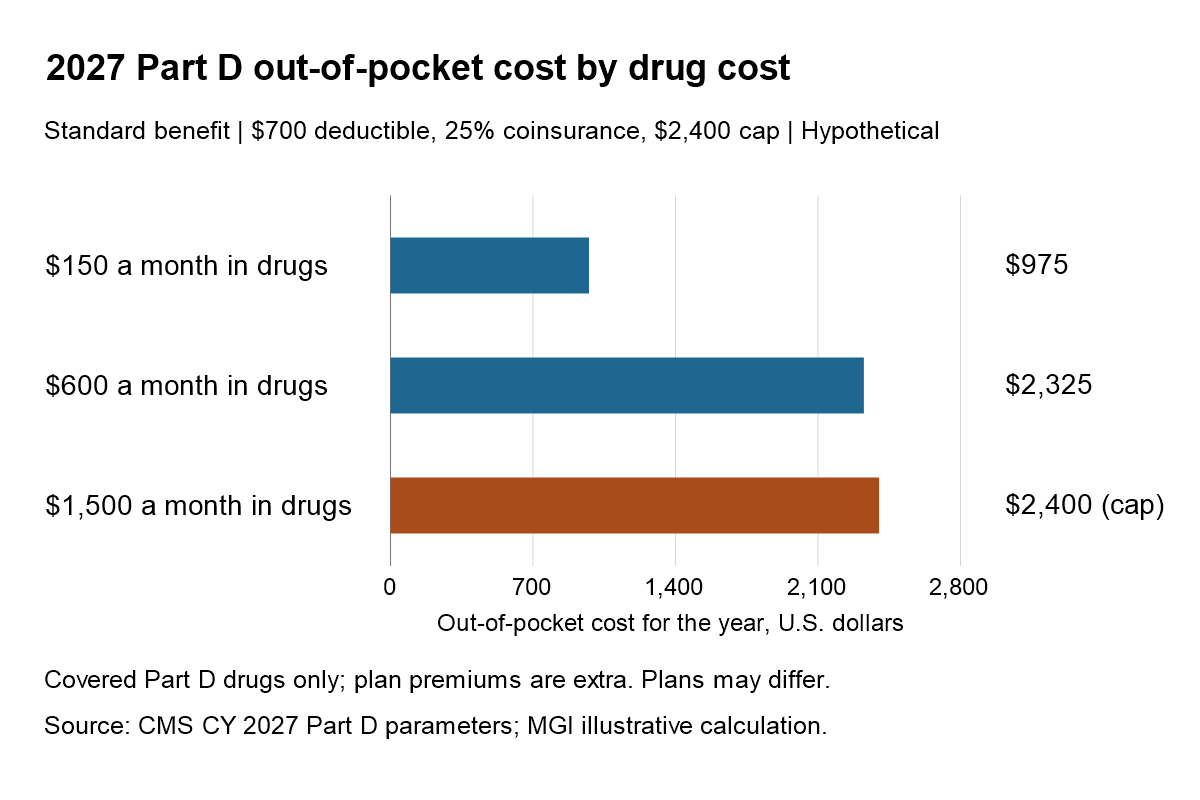
Two hypothetical people fill one covered brand-name drug each month in a 2027 plan that uses the standard benefit with the full $700 deductible. Person A’s drug costs $600 a month ($7,200 a year). Person B’s costs $150 a month ($1,800 a year).
| Month | A pays ($600 drug) | A running total | B pays ($150 drug) | B running total |
|---|---|---|---|---|
| January | $600.00 | $600.00 | $150.00 | $150.00 |
| February | $225.00 | $825.00 | $150.00 | $300.00 |
| March | $150.00 | $975.00 | $150.00 | $450.00 |
| April | $150.00 | $1,125.00 | $150.00 | $600.00 |
| May | $150.00 | $1,275.00 | $112.50 | $712.50 |
| June | $150.00 | $1,425.00 | $37.50 | $750.00 |
| July | $150.00 | $1,575.00 | $37.50 | $787.50 |
| August | $150.00 | $1,725.00 | $37.50 | $825.00 |
| September | $150.00 | $1,875.00 | $37.50 | $862.50 |
| October | $150.00 | $2,025.00 | $37.50 | $900.00 |
| November | $150.00 | $2,175.00 | $37.50 | $937.50 |
| December | $150.00 | $2,325.00 | $37.50 | $975.00 |
Person A. January’s $600 falls entirely in the deductible. In February the last $100 of the deductible is paid in full and the other $500 at 25%: $100 + $125 = $225. From March on, $600 × 25% = $150. The year ends at $2,325, which is $75 short of the cap, so A never reaches the $0 phase. Check: $700 + 25% × ($7,200 − $700) = $700 + $1,625 = $2,325. In 2026 the same person would have stopped at $2,100, so the 2027 change costs A $225.
Person B. Four months at $150 make $600. In May the last $100 of the deductible is paid in full and the remaining $50 at 25%: $100 + $12.50 = $112.50. After that, $150 × 25% = $37.50 a month. Year total: $975. Check: $700 + 25% × ($1,800 − $700) = $975.
For contrast, a $1,500-a-month drug reaches the cap in May: January is $700 + 25% × $800 = $900, then $375 a month for four months, and $900 + $1,500 = $2,400. June through December cost $0.
Insulin and vaccines
Both protections remain in effect. The Medicare & You 2027 handbook states that plans cannot charge more than $35 for a one-month supply of each Part D-covered insulin and that no deductible applies to insulin. It also says Part D generally covers adult vaccines recommended by the Advisory Committee on Immunization Practices, such as shingles and RSV, at no cost to you.
The Medicare Prescription Payment Plan
Every Part D plan must offer this option. Instead of paying the pharmacy, you are billed monthly by the plan, with costs spread over the rest of the calendar year. Joining is free. Medicare.gov is direct about its limits: it “doesn’t save you money or lower your drug costs.”
The first bill cannot exceed the cap, minus anything you already paid that year, divided by the months left. Each later bill is the remaining balance plus new costs, divided by the months left. For Person A starting in January 2027:
- January: the lesser of $600 or $2,400 ÷ 12 = $200. Bill: $200. Balance: $400.
- February: ($400 + $225) ÷ 11 = $56.82. Balance: $568.18.
- March: ($568.18 + $150) ÷ 10 = $71.82.
The bills then rise each month, reaching $496.16 in December, and the year still totals $2,325. The option moves the January spike to later months; it does not remove it. Medicare.gov says it helps most when costs are high early in the year, and least for people with level costs, people who join after September, and people who get Extra Help. If you stay in the same plan, participation renews automatically. A reserve can do the same smoothing; our cash-runway worksheet shows how to size one.
Common mistakes
- Reading $2,400 as what everyone pays. It is a ceiling. Person B pays $975.
- Adding premiums to the cap. Premiums are a separate, uncapped cost.
- Assuming a $700 deductible. That is the maximum, and some plans charge less or nothing.
- Ignoring the formulary. A drug the plan does not cover earns no credit toward the cap.
- Confusing this cap with Part B costs. Part B has its own premium; see what is confirmed for 2027.
Frequently asked questions
What is the Part D out-of-pocket maximum for 2027?
$2,400 for covered drugs, up from $2,100 in 2026. It applies to stand-alone drug plans and to Medicare Advantage drug coverage.
What is the Part D deductible for 2027?
No plan may charge more than $700, up from $615. Your plan’s own deductible is in its Annual Notice of Change.
Does the cap reset?
Yes, every January 1. Spending does not carry over.
Do I need to apply for the cap?
No. Medicare.gov says catastrophic coverage starts automatically once you reach the limit.
Sources
- CMS, Announcement of Calendar Year 2027 Medicare Advantage Capitation Rates and Part C and Part D Payment Policies, Attachment V (April 6, 2026): https://www.cms.gov/files/document/2027-announcement.pdf
- Medicare & You 2027 handbook: https://www.medicare.gov/publications/10050-medicare-and-you.pdf
- Medicare.gov, Part D costs: https://www.medicare.gov/health-drug-plans/part-d/basics/costs
- Medicare.gov, Medicare Prescription Payment Plan: https://www.medicare.gov/prescription-payment-plan
- Medicare.gov, payment plan examples: https://www.medicare.gov/prescription-payment-plan/examples
- Medicare.gov, insulin: https://www.medicare.gov/coverage/insulin
- CMS, Medicare Part D 2027 National Average Monthly Bid Amount Information (July 28, 2026): https://www.cms.gov/newsroom/fact-sheets/medicare-part-d-2027-national-average-monthly-bid-amount-information
- CMS, Medicare Advantage and Part D programs expected to remain stable in 2027 (September 28, 2026): https://www.cms.gov/newsroom/press-releases/medicare-advantage-medicare-prescription-drug-programs-expected-remain-stable-2027
- CMS, Contract Year 2027 Medicare Advantage and Part D Final Rule fact sheet (April 2, 2026): https://www.cms.gov/newsroom/fact-sheets/contract-year-2027-medicare-advantage-part-d-final-rule
- CMS, Final CY 2026 Part D Redesign Program Instructions: https://www.cms.gov/files/document/final-cy-2026-part-d-redesign-program-instruction.pdf
General financial information only; not individualized insurance, medical or tax advice. For plan-specific costs, use Medicare.gov or call 1-800-MEDICARE.