Two stocks, two very different evidence trails. Tesla (TSLA) finished Friday, October 2, at $370.59, up 4.65%. MaxLinear (MXL) closed at $105.93, up 14.99%. Both attracted attention, but the percentage gain alone does not tell you whether a move reflects a new operating development, a rebound, or a riskier repricing.
This is a selective review of two movers—not a comprehensive ranking of U.S. gainers or a recommendation to chase either stock. All prices below refer to the U.S. regular-session close at 4 p.m. Eastern on October 2, 2026; after-hours trading is excluded.
Friday’s price and volume: the quick comparison
| Measure | Tesla (TSLA) | MaxLinear (MXL) |
|---|---|---|
| Friday close | $370.59 | $105.93 |
| One-day change | +4.65% | +14.99% |
| Friday share volume | 53.92 million | 4.76 million |
| Versus preceding four sessions’ average volume | 1.53× | 1.82× |
| Next confirmed earnings checkpoint | October 21, after close | October 22, 4:30 p.m. Eastern call |
Price and volume: Tesla history and MaxLinear history, supplied through Stock Analysis by S&P Global Market Intelligence. Volume multiples are MGI EDIT calculations, excluding Friday from the comparison average. They are not 20-day relative-volume readings.
Tesla: a strong Friday, but not a fresh weekly breakout
Tesla reported 486,532 third-quarter deliveries and 464,391 vehicles produced in its official October 2 release. Those figures give readers a concrete business development to examine. They do not, by themselves, establish revenue quality, automotive margin, free cash flow, or the contribution of incentives.
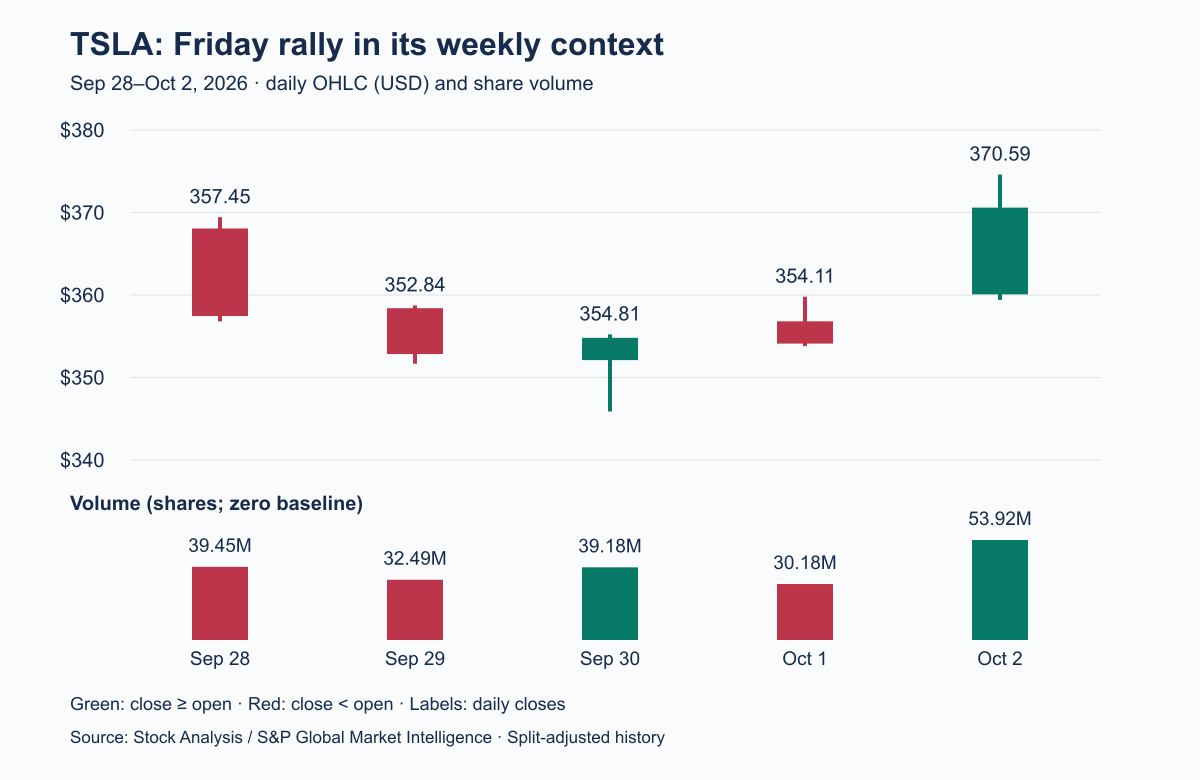
The important counterweight is the previous Friday’s $372.11 close: October 2 ended about 0.41% below that level. A conspicuous green day therefore did not produce a positive Friday-to-Friday return. That is why “Tesla surges” and “Tesla breaks out” are not interchangeable headlines.
The next useful test is not whether social-media excitement continues. It is whether the October 21 earnings report supports a stronger profit and cash-generation story. For the operating-detail checklist, see Tesla’s deliveries versus profit: what to check next.
MaxLinear: a bigger jump, with a less certain explanation
MaxLinear’s October 2 gain was more than three times Tesla’s percentage increase. Its volume also exceeded the average of the preceding four sessions. That supports the narrower statement that trading activity increased; it does not identify the buyers, prove institutional accumulation, or validate a valuation.
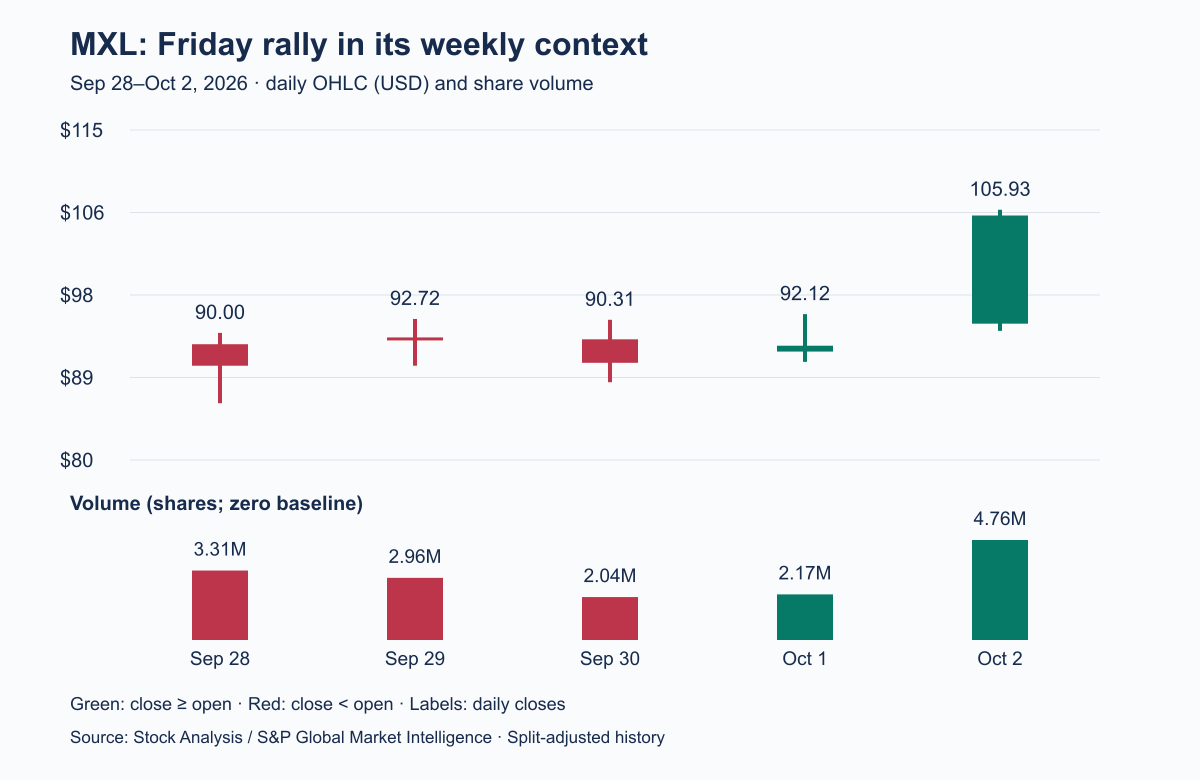
The company’s investor-relations page lists a September 28 Puma 9 product announcement and an October 1 notice scheduling the October 22 results call. These are documented developments, but neither establishes that a new Friday earnings release or a newly disclosed contract caused the rally. This review has not verified a single October 2 catalyst.
That uncertainty changes the editorial conclusion. MXL belongs on a research watchlist, not in an invented “AI deal sends shares soaring” narrative. Before assigning a fundamental explanation, check new filings, customer disclosures, revenue guidance and the distinction between product capabilities and booked sales.
Three checks before treating a Friday winner as a market leader
- Verify the news timestamp. A release from an earlier session can be relevant context without being a newly confirmed catalyst.
- Separate participation from direction. Higher volume records transactions; it cannot show that every buyer is informed or that the next session will continue upward.
- Compare the rebound with the broader path. Review prior closes, longer history, earnings risk and valuation. These five-session charts deliberately do not answer a three-month trend question.
For the broader backdrop to the session, read why stocks can rise on weak jobs data. A broad-market narrative and a company-specific narrative may coexist; neither should automatically be treated as the sole cause of a stock’s move.
What should readers watch at the next open?
Use Friday’s closing prices as reference observations, not guaranteed support levels. Check whether fresh company information changes the thesis, whether trading remains liquid, and whether an opening gap reverses rather than extends. A market order in a volatile name can execute far from the price shown on a screenshot.
Bottom line: Tesla offers a documented operating-data checkpoint; MaxLinear offers a larger verified price move with an unresolved causal story. The stronger research habit is to demand evidence proportional to the excitement—not to assume the fastest mover is the best investment.
Method: daily return = Friday close ÷ Thursday close − 1. Volume comparison = Friday volume ÷ mean volume from September 28–October 1. Historical prices are split-adjusted as described by the vendor; this is not a dividend-adjusted total-return comparison. Vendors may report different volumes, so one source is used consistently. Charts contain actual observations with no generated or interpolated prices. Educational information only; not individualized investment advice.