

SEER Stock Analysis: Why Seer Is Surging After the $2.45 Buyout Proposal
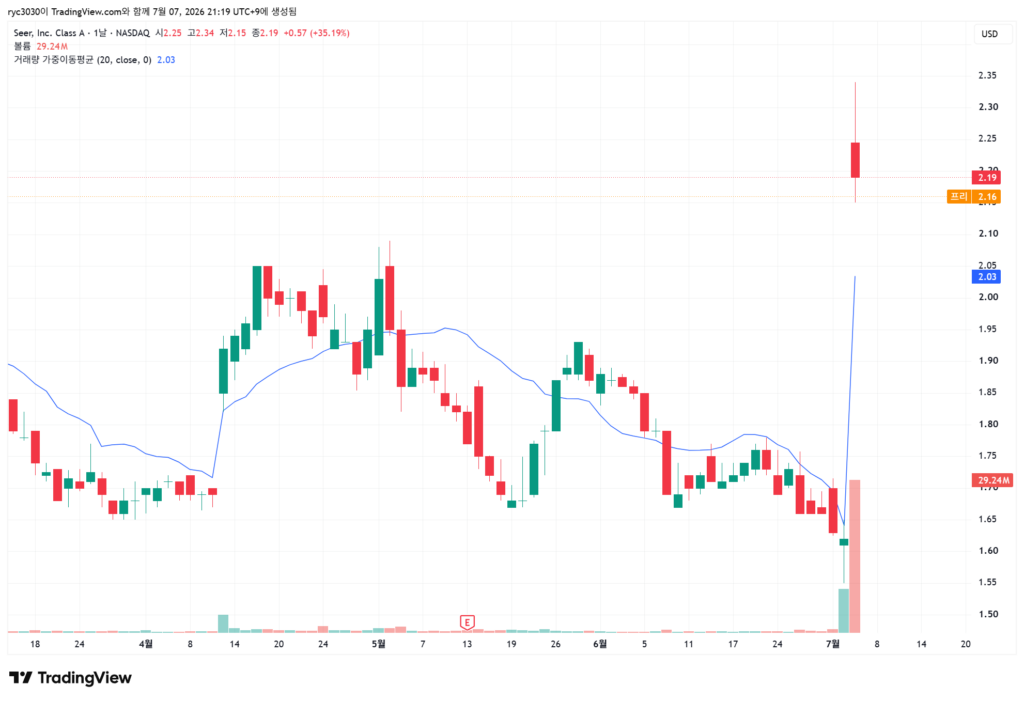
Seer, Inc. (NASDAQ: SEER) jumped sharply after the company received an unsolicited, non-binding acquisition proposal from its Chair and CEO, Omid Farokhzad, M.D. The proposal would acquire all outstanding shares of Seer’s Class A common stock for $2.45 per share in cash, plus two separate contingent value rights.
At the time of writing, SEER was trading around $2.19, with a market capitalization of approximately $122.6 million, EPS of -$1.24, and a negative P/E ratio. That means the stock is not being valued on current earnings. Instead, the market is reacting to a mix of buyout speculation, governance pressure, cash value, and Seer’s long-term AI proteomics story.
The key question for investors is simple: Is SEER rising because the company is being revalued as an AI proteomics platform, or is this mainly a short-term M&A event driven by competing acquisition proposals?
Key Takeaways
- Seer received a $2.45 per share cash proposal plus two CVRs from Chair and CEO Omid Farokhzad. The proposal is unsolicited and non-binding, so no transaction is guaranteed.
- The board plans to establish a Special Committee of independent directors to evaluate the proposal and other strategic alternatives.
- The proposal follows a separate $2.40 per share cash plus CVR proposal from the Radoff-JEC Group, which Seer’s board unanimously rejected in May 2026.
- Seer ended Q1 2026 with approximately $220 million in cash, cash equivalents, and investments, which is higher than the company’s current market capitalization.
- The company’s operating business remains under pressure: Q1 2026 revenue fell 34% year over year to $2.8 million, while free cash flow was approximately negative $15.7 million.
- The current rally appears to be driven more by M&A and governance events than by a near-term improvement in core revenue.
What Does Seer Do?
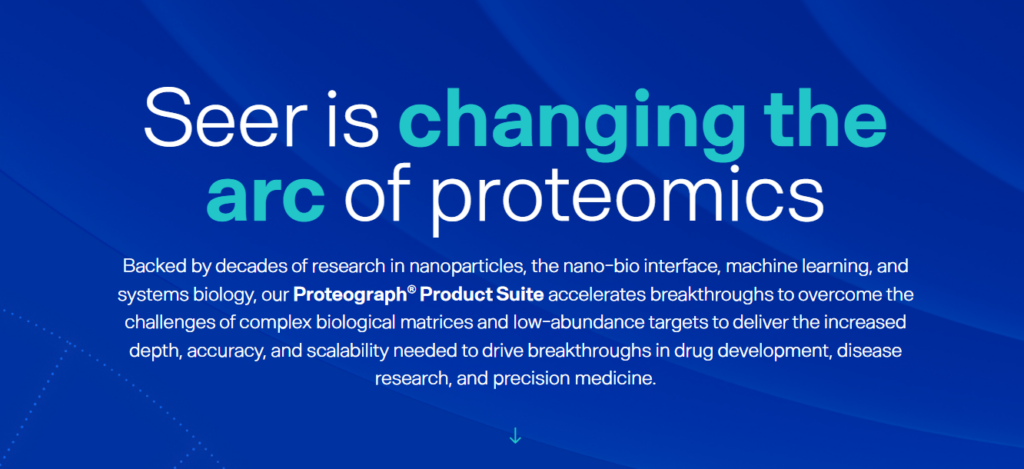
Seer is a life sciences tools company focused on proteomics, the large-scale study of proteins. Its main product is the Proteograph Product Suite, which combines engineered nanoparticles, automation instrumentation, consumables, and analytical software to help researchers generate deeper proteomic data. The company says its products are for research use only and are not intended for diagnostic procedures.
In simple terms, Seer is trying to help researchers analyze proteins at greater depth and scale. That matters because proteins are closely connected to disease biology, drug discovery, biomarker research, and precision medicine.
The long-term bull case is that large-scale proteomics data could become increasingly valuable for AI-driven biology. Seer has positioned itself as a company that can help generate the kind of deep, standardized biological data needed to train future AI models in healthcare and life sciences.
Why SEER Stock Is Rising
The most immediate reason SEER stock is rising is the $2.45 per share acquisition proposal from Omid Farokhzad, Seer’s Chair and CEO. According to Seer, the proposal would acquire all outstanding Class A shares for cash plus two contingent value rights.
This gives the market a clear reference point. If SEER is trading below $2.45, traders may see a potential spread between the current market price and the proposed acquisition price. However, the spread also reflects uncertainty. The offer is non-binding, the Special Committee has not approved it, and the terms may change.
This is why SEER should not be viewed as a simple earnings-driven rally. It is better understood as an event-driven stock move.
The Radoff-JEC Offer Adds More Pressure
The CEO’s proposal did not happen in isolation. Earlier in 2026, Bradley Radoff and Michael Torok, together with their affiliates, submitted multiple proposals to acquire Seer.
On May 21, 2026, Seer announced that its board had unanimously rejected a revised unsolicited non-binding proposal from the Radoff-JEC Group to acquire all outstanding Class A shares for $2.40 per share in cash plus a contingent value right. Seer said the proposal undervalued the company and failed to reflect its long-term growth prospects.
This matters because SEER now has two visible price anchors:
- Radoff-JEC proposal: $2.40 per share plus CVR
- CEO proposal: $2.45 per share plus two CVRs
For short-term traders, those levels become important reference prices. For long-term investors, the bigger question is whether either proposal fairly reflects Seer’s cash, intellectual property, platform value, and future commercial opportunity.
Why the Special Committee Matters
Seer’s board said it will establish a Special Committee made up solely of independent directors. The committee will evaluate the CEO’s proposal, review other alternatives available to Seer, and decide what course of action is in the best interests of the company and its stockholders.
This is one of the most important next steps. A proposal from a sitting CEO creates potential conflicts of interest, so independent review is critical. The committee could reject the proposal, negotiate for a higher price, seek competing bids, explore strategic alternatives, or decide that remaining public is the better option.
Until the committee provides an update, SEER is likely to trade based on deal probability rather than operating fundamentals.
Seer’s Cash Position Is a Major Part of the Story
One reason SEER is attracting attention is its balance sheet. Seer ended the first quarter of 2026 with approximately $220 million in cash, cash equivalents, and investments.
That is important because the company’s market capitalization was only about $122.6 million at the time of writing.
This gap does not automatically mean the stock is risk-free or deeply undervalued. Companies with declining revenue and ongoing cash burn can trade below cash value because investors expect future losses to reduce the balance sheet. Still, Seer’s cash position gives both activists and potential acquirers a strong argument that the company has strategic value beyond its current stock price.
The Core Business Remains Weak
The main risk is that Seer’s operating business has not yet shown strong commercial momentum. In Q1 2026, revenue was $2.8 million, down 34% from $4.2 million in the prior-year period. The company cited a depressed academic funding environment and competitive activity in the space. Product revenue was $2.1 million, service revenue was $596,000, and gross margin was 35%.
Seer has reduced costs, but it is still losing money. Operating expenses were $18.2 million in Q1 2026, down from $22.8 million in the prior-year period. Net loss was $16.8 million, compared with $19.9 million a year earlier. Free cash flow was approximately negative $15.7 million.
This is the key tension in the SEER story. The balance sheet is strong, but the current revenue base is small. The platform may have long-term scientific value, but investors still need evidence that the company can turn that technology into sustainable commercial growth.
The AI Proteomics Angle
Seer is trying to position itself at the intersection of proteomics and AI-driven precision medicine. In a July 2026 investor presentation, Seer said it is uniquely positioned to help power the next era of AI-driven precision medicine. The company highlighted its ability to generate deep, unbiased proteomics data that could help train foundation models and reveal biological insights.
The company also said the proteomics market could reach a $23 billion total addressable market opportunity by 2034, citing Canaccord Genuity, and noted that its installed base has grown at a 62% CAGR since 2021.
This is the part of the story that gives SEER long-term optionality. If proteomics becomes a more important layer of AI-driven biology, Seer’s platform could become more valuable. But that remains a future-facing thesis, not a near-term earnings driver.
Korea University Data Adds Scientific Momentum
Seer also recently highlighted preliminary data from a collaboration with Korea University focused on AI-driven plasma proteomics for multi-cancer screening. The analysis included more than 5,500 plasma samples across ten major cancer types and healthy controls. The collaboration is expected to analyze more than 20,000 clinical plasma samples across ten of Korea’s highest-incidence cancer types.
This supports Seer’s AI proteomics narrative. Large-scale biological datasets are valuable because AI models require depth, quality, and scale. However, investors should be careful not to overstate the commercial impact. The company’s products are research-use only, and the Korea University work is still preliminary research rather than an approved diagnostic product.
Intellectual Property Is Another Bullish Factor
Seer also announced positive intellectual property developments in July 2026. The company said the European Patent Office concluded that European Patent No. EP4056263 would be maintained on the basis of claims covering particle-based enrichment for proteomics. Seer also said the U.S. International Trade Commission instituted an investigation into Nanomics products that Seer alleges infringe five of its U.S. patents.
Seer said it holds more than 250 patent applications and issued patents, including 84 issued patents worldwide, much of which protects the intellectual property behind the Proteograph Product Suite.
For investors, this matters because Seer’s value is not only tied to current revenue. Its platform, patents, research relationships, and future applications may also influence strategic value.
Bull Case for SEER Stock
The bull case for SEER has four main points.
First, there is a clear event catalyst. The CEO’s $2.45 proposal and the prior Radoff-JEC $2.40 proposal give investors visible deal-price reference points.
Second, Seer has a strong cash position. With approximately $220 million in cash, cash equivalents, and investments as of March 31, 2026, the company has meaningful financial flexibility relative to its current market capitalization.
Third, Seer has a differentiated technology story in deep, unbiased proteomics. The company’s Proteograph platform, patent estate, and scientific collaborations give it potential strategic value beyond its current revenue base.
Fourth, AI biology remains a powerful market narrative. If investors become more interested in companies that can generate high-quality biological data for AI models, Seer could benefit from renewed attention.
Key Risks for SEER Stock
The biggest risk is that the acquisition proposal is not binding. The CEO’s proposal may not lead to a definitive agreement, and the Special Committee could reject it or pursue another path.
The second risk is weak revenue momentum. Q1 2026 revenue declined 34% year over year, and the company continues to report significant losses.
The third risk is cash burn. Even though Seer has a large cash balance, free cash flow was negative $15.7 million in Q1 2026. If revenue does not improve, the cash cushion will shrink over time.
The fourth risk is governance uncertainty. The dispute involving Radoff-JEC, the board, and management may keep the stock volatile around the July 28, 2026 annual meeting. Seer has urged stockholders to vote for its director nominees, while activists have pushed for board change and a sale process.
The fifth risk is that the AI proteomics story may take time to convert into revenue. Scientific validation, patent strength, and market opportunity are important, but investors still need to see commercial adoption, repeat consumables revenue, and stronger growth.
What Investors Should Watch Next
The first thing to watch is the Special Committee’s response to the CEO proposal. Any update on whether the committee accepts, rejects, negotiates, or seeks alternatives could move the stock quickly.
The second thing to watch is whether SEER trades closer to the $2.40–$2.45 offer range. If the stock remains meaningfully below that range, the market may be discounting deal risk. If it moves above that range, investors may be pricing in either a higher bid or greater strategic optionality.
The third key date is the July 28, 2026 annual meeting, where governance and board composition will be important issues.
The fourth item is Q2 2026 revenue. If Seer can show that Q1 weakness was temporary, the long-term platform thesis becomes more credible. If revenue remains weak, the stock may remain dependent on M&A speculation.
Finally, investors should watch cash burn. The company’s cash position is a major part of the investment case, but that value depends on how quickly Seer can reduce losses or accelerate commercial adoption.
Bottom Line
SEER’s rally is best understood as an M&A and governance-driven move, not a traditional fundamentals-driven rally.
The $2.45 cash proposal from CEO Omid Farokhzad, the prior $2.40 Radoff-JEC proposal, the upcoming annual meeting, and Seer’s large cash position have created a clear event-driven setup.
At the same time, the company’s operating business remains challenged. Revenue declined sharply in Q1 2026, losses continue, and free cash flow remains negative.
Seer’s AI proteomics platform, patent portfolio, and research collaborations give the company long-term optionality. But for now, SEER stock is mainly trading on the probability of a transaction, the possibility of a higher bid, and the outcome of the company’s governance battle.
For investors, the most important questions are: Will the Special Committee support a sale? Could another bidder emerge? Will SEER trade closer to or above the $2.45 proposal price? And can the company prove that its proteomics platform can generate stronger commercial revenue?
This article is for informational purposes only and is not financial advice. Investors should conduct their own research before making any investment decision.
FAQ
Why did SEER stock jump?
SEER stock jumped after Seer received an unsolicited, non-binding acquisition proposal from Chair and CEO Omid Farokhzad to acquire all outstanding Class A shares for $2.45 per share in cash plus two contingent value rights.
Is the Seer buyout proposal binding?
No. The proposal is non-binding. Seer’s board plans to establish a Special Committee of independent directors to evaluate the proposal and other alternatives.
What was the Radoff-JEC offer for Seer?
The Radoff-JEC Group submitted a revised non-binding proposal to acquire Seer for $2.40 per share in cash plus a contingent value right. Seer’s board unanimously rejected the proposal.
Does Seer have a strong balance sheet?
Seer ended Q1 2026 with approximately $220 million in cash, cash equivalents, and investments. That cash position is a major part of the current investment debate.
Is Seer an AI stock?
Seer is not a pure AI software company. It is a proteomics platform company that is positioning its data-generation capabilities as useful for AI-driven precision medicine and biological discovery.
What are the biggest risks for SEER stock?
The biggest risks are deal uncertainty, weak revenue growth, continued cash burn, governance conflict, and the possibility that Seer’s AI proteomics story takes longer than expected to become a commercial growth driver.
Related Reading
- https://seer.bio/
- https://www.nasdaq.com/market-activity/stocks/seer
- https://mgiedit.org/clro-stock-explodes-cortigent-reverse-merger-bci-medical-device/
- https://mgiedit.org/dmra-stock-rises-dmr-001-mutcalr-blood-cancer-pipeline/
- https://mgiedit.org/fig-stock-jumps-figma-raises-guidance-ai-saas-growth/
Disclaimer: This article is for informational purposes only and does not constitute investment advice, financial advice, medical advice, or a recommendation to buy or sell any security. Investors should conduct their own research and consider their risk tolerance before making investment decisions.