
Key Takeaways
Damora Therapeutics (NASDAQ: DMRA) rose as investors focused on the company’s DMR-001 program, a potential targeted therapy for mutant calreticulin-driven blood cancers.
DMRA stock is not moving because of commercial revenue or earnings. The company remains a clinical-development biotech story.
The main catalyst is DMR-001, an anti-mutCALR antibody designed for patients with mutant calreticulin-driven essential thrombocythemia and myelofibrosis.
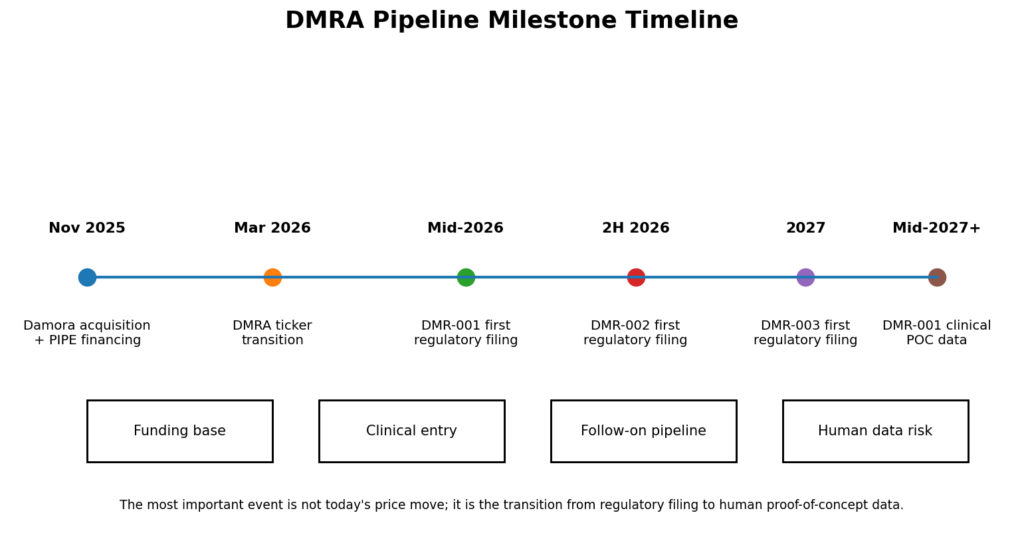
Damora expects its first regulatory submission for DMR-001 in mid-2026 and expects clinical proof-of-concept data beginning in mid-2027.
The company’s strong cash position, with runway expected into 2029, reduces near-term financing pressure and allows investors to focus on pipeline execution.
However, DMRA remains high risk because DMR-001 has not yet proven safety or efficacy in humans.
Why DMRA Stock Is Rising
DMRA stock moved higher as investors reassessed Damora Therapeutics’ mutCALR blood cancer pipeline.
The stock recently traded around $29.98, up roughly 10.6% on the day, with an intraday range of $26.79 to $30.16.
That price action suggests that buyers are paying attention to the company’s upcoming clinical transition.
The move does not appear to be driven by revenue growth, profitability, or a commercial product launch.
Instead, DMRA is rising because the market is focusing on four things:
DMR-001’s planned regulatory submission in 2026.
The company’s upcoming Phase 1/1b trial in mutCALR-driven ET and MF.
Expected clinical proof-of-concept data beginning in 2027.
A strong cash position expected to fund operations into 2029.
For a biotech company, this combination matters.
A clear disease target, a differentiated therapeutic approach, near-term regulatory milestones, and sufficient cash runway can create strong investor interest even before human data are available.
What Damora Therapeutics Does

Damora Therapeutics is a biotechnology company focused on developing antibody-based therapies for blood disorders.
The company’s core focus is mutant calreticulin, commonly called mutCALR.
MutCALR is a driver mutation found in certain myeloproliferative neoplasms, or MPNs.
MPNs are chronic blood cancers in which the bone marrow produces too many blood cells.
Damora is focusing mainly on two MPN indications:
Essential thrombocythemia, or ET.
Myelofibrosis, or MF.
The company estimates that approximately 42,000 patients in the United States have mutCALR-driven MPNs.
This makes Damora a targeted oncology and hematology biotech company, not a broad commercial pharmaceutical company.
The company’s value depends mainly on whether its anti-mutCALR pipeline can produce meaningful clinical results.
Why mutCALR Matters
Mutant calreticulin is important because it is directly linked to disease biology in certain blood cancers.
In essential thrombocythemia and myelofibrosis, mutCALR can drive abnormal signaling that contributes to excessive blood cell production and disease progression.
A therapy that directly targets mutCALR could potentially become disease-modifying if it can reduce the malignant clone or interrupt the disease pathway.
That is why investors are paying attention.
Many current treatments for MPNs manage symptoms, blood counts, or disease complications. A targeted therapy against the underlying mutCALR driver could represent a more precise approach.
However, this is still an early-stage investment thesis.
The biology is compelling, but the clinical proof still needs to happen.
DMR-001: The Main Reason Investors Are Watching DMRA Stock
DMR-001 is Damora’s lead candidate.
It is an Fc-null anti-mutCALR monoclonal antibody designed to block mutCALR-mediated oncogenic signaling.
The company is positioning DMR-001 as a potentially best-in-class therapy for mutCALR-driven ET and MF.
DMR-001 is designed to target both Type 1 and Type 2 mutCALR mutations.
This is important because a therapy with activity across the mutCALR spectrum could have broader clinical relevance.
Damora also aims to use half-life extension technology to support lower-dose subcutaneous administration.
That could matter commercially if DMR-001 eventually reaches the market, because dosing convenience is important in chronic diseases.
The next key step is clinical entry.
Damora expects its first regulatory submission for DMR-001 in mid-2026 and plans a global Phase 1/1b trial in patients with mutCALR-driven ET and MF.
DMR-002 and DMR-003: Why the Pipeline Is More Than One Drug
DMRA is not only a DMR-001 story.
Damora also has DMR-002 and DMR-003 in development.
DMR-002 is an afucosylated anti-mutCALR antibody designed to enhance antibody-dependent cellular cytotoxicity, or ADCC.
That means DMR-002 may be designed not only to block signaling, but also to help immune cells eliminate malignant cells.
The company expects a first regulatory submission for DMR-002 in the second half of 2026.
DMR-003 is a bispecific T-cell engager antibody program.
This approach is designed to recruit T cells to attack malignant cells.
Damora expects the first regulatory submission for DMR-003 in 2027.
This pipeline structure is important.
DMR-001 is the lead program, but DMR-002 and DMR-003 provide follow-on opportunities and may reduce single-asset dependency over time.
However, all three programs still require clinical validation.
Why the Cash Runway Matters
One of the strongest parts of the DMRA investment case is the balance sheet.
Damora reported approximately $532.9 million in cash and cash equivalents as of March 31, 2026.
The company expects this cash position to fund operations into 2029.
For an early-stage biotech company, that is meaningful.
Many small biotech stocks face constant financing risk. If a company needs to raise money before key data, investors often worry about dilution.
Damora’s current cash runway gives the company more flexibility.
It may be able to advance DMR-001 through early proof-of-concept data while also progressing DMR-002 and DMR-003.
That does not remove clinical risk.
But it does reduce near-term funding risk.
Q1 2026 Financial Snapshot
Damora’s Q1 2026 financial results reflect a company entering active pipeline development.
Research and development expenses were $23.8 million.
General and administrative expenses were $7.0 million.
Net loss was $27.8 million.
Those losses are expected for a biotech company developing preclinical and early clinical assets.
The key issue is whether the company’s spending creates clinical value.
Because Damora does not yet have product revenue, traditional earnings analysis is less useful.
Investors should focus on:
Cash runway.
Regulatory submissions.
Clinical trial execution.
Safety data.
Early efficacy signals.
Pipeline prioritization.
Future dilution risk.
Price Action: Why $30 Matters for DMRA Stock
DMRA traded close to the $30 level after its latest move.
The stock’s intraday high was $30.16, while the current price was near $29.98.
That makes $30 the key short-term level to watch.
If DMRA breaks above $30 and holds that level with volume, the market may be confirming stronger momentum ahead of the DMR-001 regulatory submission.
If the stock fails at $30, traders may take profits after the recent move.
The $26.79 intraday low is the first downside reference point.
However, for a development-stage biotech like DMRA, price levels are secondary to clinical milestones.
The real drivers are regulatory submissions, trial design, dosing, safety, and proof-of-concept data.
Why Investors Like the DMRA Story
There are several reasons investors may be interested in DMRA.
First, the target is clear.
MutCALR-driven MPNs are genetically defined diseases, which may allow for a more targeted development strategy.
Second, the pipeline is focused.
Damora is not spreading itself across many unrelated therapeutic areas. It is building a concentrated anti-mutCALR portfolio.
Third, the lead program has a defined clinical path.
DMR-001 is expected to enter clinical development through a planned global Phase 1/1b study.
Fourth, cash runway is strong.
Funding into 2029 gives the company time to reach meaningful data.
Fifth, the investor base includes experienced healthcare-focused investors.
That can support credibility around the platform and development plan.
Key Risks for DMRA Stock
The biggest risk is clinical translation.
DMR-001 may look promising in preclinical models, but that does not guarantee success in humans.
The second risk is safety.
Any therapy targeting blood cancer biology must demonstrate an acceptable safety profile, especially in chronic disease settings.
The third risk is competition.
Damora has acknowledged that other mutCALR programs are ahead in development. To win long term, Damora may need to show better efficacy, safety, dosing convenience, or durability.
The fourth risk is timeline.
The most important proof-of-concept data are not expected until 2027. That means the stock may remain sensitive to sentiment before major human data are available.
The fifth risk is valuation.
With a market cap above $1 billion and no product revenue, DMRA already reflects meaningful pipeline expectations.
The sixth risk is dilution over the long term.
The current cash position is strong, but late-stage trials and commercialization planning can require substantial additional capital.
DMRA Rally Sustainability Score
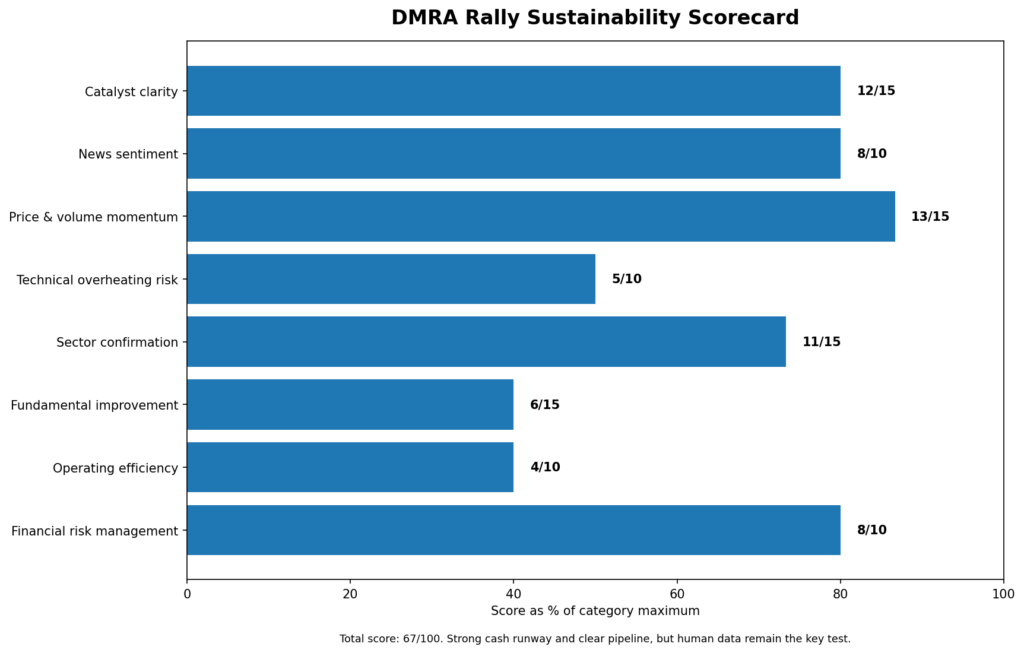
Overall Score: 67/100
Rating: Interesting clinical-entry biotech story, but human data remain the key test
Catalyst Clarity: 12/15
The catalyst is clear: DMR-001 regulatory submission timing, EHA preclinical data, and expected clinical development in mutCALR-driven ET and MF.
News Sentiment and Reliability: 8/10
The key information comes from company updates and SEC filings, but the current story is still based mainly on preclinical and planned clinical milestones.
Price and Volume Momentum: 13/15
The stock moved near the $30 level and held close to its intraday high, showing positive short-term momentum.
Technical Overheating Risk: 5/10
The stock is rising, but this is not a tiny microcap squeeze. Still, failure at $30 could trigger profit-taking.
Sector Confirmation: 11/15
DMRA is linked to hematology, targeted oncology, antibody therapeutics, rare blood cancers, and precision medicine.
Fundamental Improvement: 6/15
The cash position is strong, but the company has no product revenue and still needs clinical validation.
Operating Efficiency: 4/10
Current spending reflects R&D buildout. Operating efficiency will be easier to judge after clinical data.
Financial Risk Management: 8/10
Cash runway into 2029 is a major strength, though long-term development risk remains.
What Investors Should Watch Next
The first factor is whether DMRA holds above $30.
The second factor is DMR-001’s first regulatory submission, expected in mid-2026.
The third factor is the design of the Phase 1/1b trial.
Investors should watch dose escalation, expansion cohorts, patient selection, endpoints, and whether the trial includes both ET and MF patients.
The fourth factor is first patient dosing.
The fifth factor is proof-of-concept data expected beginning in mid-2027.
The sixth factor is whether DMR-002 and DMR-003 stay on schedule.
The seventh factor is cash burn.
The company has a strong cash balance, but investors should watch quarterly R&D spending as clinical development expands.
The eighth factor is competitive data from other mutCALR programs.
Bottom Line

DMRA stock is rising because Damora Therapeutics has become a focused mutCALR blood cancer pipeline story.
The company has a clear target, a lead candidate in DMR-001, follow-on programs in DMR-002 and DMR-003, and a cash runway expected to support operations into 2029.
That combination gives investors a reason to pay attention.
However, DMRA is still a development-stage biotech stock.
The company has no product revenue, its key programs still need human validation, and the most important proof-of-concept data are expected in 2027.
For now, DMRA looks like a credible precision hematology biotech story with strong funding and clear milestones.
But the rally will only become durable if the company successfully files DMR-001, starts the Phase 1/1b trial, shows acceptable safety, and eventually produces convincing proof-of-concept data.
Until then, DMRA remains a high-potential but high-risk biotech stock.
FAQ
Why did DMRA stock go up?
DMRA stock rose as investors focused on Damora Therapeutics’ DMR-001 program, upcoming regulatory submission timing, strong cash runway, and mutCALR blood cancer pipeline.
What is DMR-001?
DMR-001 is Damora’s lead anti-mutCALR antibody candidate designed for patients with mutant calreticulin-driven essential thrombocythemia and myelofibrosis.
What diseases is Damora targeting?
Damora is targeting mutCALR-driven myeloproliferative neoplasms, especially essential thrombocythemia and myelofibrosis.
Does Damora have product revenue?
No. Damora is a development-stage biotech company and does not yet have approved commercial products.
Why is Damora’s cash runway important?
Damora expects its cash position to fund operations into 2029, which reduces near-term financing pressure and allows the company to advance its pipeline toward clinical proof-of-concept data.
What is the biggest risk for DMRA stock?
The biggest risk is clinical translation. DMR-001 and the rest of the pipeline still need to prove safety and efficacy in humans.
Related Reading
- https://damoratx.com/
- https://finance.yahoo.com/quote/DMRA/
- https://mgiedit.org/clro-stock-explodes-cortigent-reverse-merger-bci-medical-device/
- https://mgiedit.org/fig-stock-jumps-figma-raises-guidance-ai-saas-growth/
Disclaimer: This article is for informational purposes only and does not constitute investment advice, financial advice, medical advice, or a recommendation to buy or sell any security. Investors should conduct their own research and consider their risk tolerance before making investment decisions.