
Key Takeaways
Moderna (NASDAQ: MRNA) jumped more than 10% as investors reassessed the company’s mRNA vaccine and oncology pipeline.
The rally was driven by two major catalysts: FDA advisers backing Moderna’s mRNA flu vaccine and strong five-year melanoma data from Moderna’s personalized cancer vaccine program with Merck.
MRNA stock is now being valued less as a post-COVID vaccine decline story and more as a broader mRNA platform recovery story.
However, Moderna still has large losses, negative EPS, and a long path before flu, combination vaccines, and cancer vaccines fully replace the lost COVID revenue base.
The key level to watch is $80. A sustained move above $80 could confirm stronger momentum, while a break below $75 could suggest fully replace the lost COVID revenue base.
The key level to watch is $80. A sustained the rally is fading.
Why MRNA Stock Is Up
MRNA stock rose after investors responded to renewed confidence in Moderna’s mRNA platform.
The move was not based on a single earnings surprise. Instead, the rally reflects a combination of regulatory progress, oncology data, respiratory vaccine optionality, and improving sentiment toward Moderna’s post-COVID strategy.
The first major catalyst was Moderna’s mRNA-based flu vaccine.
FDA advisers unanimously backed the benefit-risk profile of Moderna’s mRNA flu vaccine, mFlusiva, for adults aged 50 and older. If approved, it could become the first seasonal influenza vaccine in the United States made with mRNA technology.
That matters because Moderna needs new respiratory vaccine revenue after the decline in COVID vaccine demand.
The second catalyst was cancer vaccine data.
Moderna and Merck reported that their personalized cancer vaccine combination with Keytruda continued to show durable benefit in high-risk melanoma patients after five years of follow-up.
For investors, this supports the idea that Moderna’s mRNA technology may have value beyond infectious disease vaccines.
The third catalyst is broader pipeline revaluation.
Moderna is trying to rebuild its growth story through respiratory vaccines, flu-COVID combination vaccines, RSV, oncology, and rare disease programs.
That is why MRNA stock is no longer being analyzed only as a COVID vaccine stock.
What Moderna Does
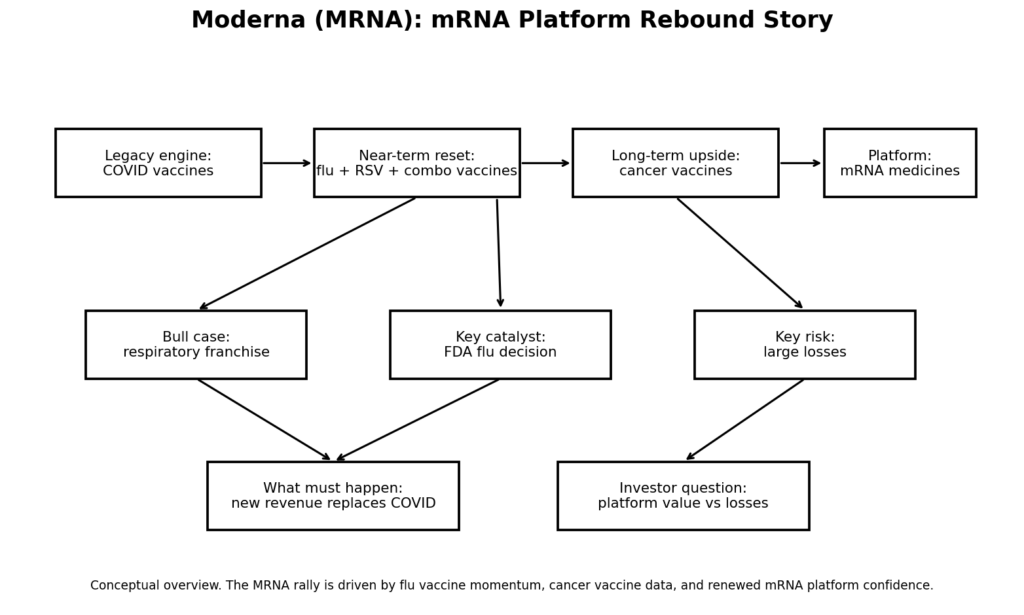
Moderna is a biotechnology company built around messenger RNA technology.
The company became globally known because of its COVID-19 vaccine, Spikevax, which generated enormous revenue during the pandemic.
However, after COVID vaccine demand fell, Moderna’s revenue declined sharply and the stock lost much of its pandemic-era premium.
Now the company is trying to prove that its mRNA platform can support multiple product categories.
Moderna’s current strategy includes:
COVID vaccines.
Next-generation COVID vaccines.
Seasonal flu vaccines.
RSV vaccines.
Flu-COVID combination vaccines.
Pandemic flu vaccines.
Personalized cancer vaccines.
Rare disease therapeutics.
This makes Moderna a platform biotech company, not just a single-product vaccine company.
The market’s key question is simple:
Can Moderna turn its mRNA technology into a diversified commercial portfolio?
Main Catalyst 1: Moderna’s mRNA Flu Vaccine
The most immediate catalyst for MRNA stock is Moderna’s mRNA flu vaccine, mFlusiva.
FDA advisers backed the vaccine for adults aged 50 and older after reviewing its benefit-risk profile.
The committee vote is important because it moves Moderna closer to a potential U.S. approval decision.
If approved, mFlusiva could become the first mRNA-based seasonal flu vaccine in the U.S.
This would be strategically important for Moderna because the flu vaccine market is large, recurring, and seasonal.
Traditional flu vaccines require months of strain selection and manufacturing. Moderna argues that mRNA technology may allow faster adaptation to changing flu strains.
However, investors should not treat advisory committee support as final approval.
The FDA decision is still pending, and even if the vaccine is approved, meaningful revenue may take time because contracting windows and market adoption matter.
Main Catalyst 2: Moderna and Merck Cancer Vaccine Data
The second major reason MRNA stock is rising is the cancer vaccine program with Merck.
Moderna’s individualized cancer vaccine, intismeran autogene, also known as mRNA-4157 or V940, is being tested in combination with Merck’s Keytruda.
The five-year data in high-risk melanoma are important because they suggest the combination may provide durable benefit after surgery.
Reuters reported that the combination reduced the risk of melanoma spreading to another part of the body or death by 59% after five years of follow-up.
The combination also previously showed a 49% reduction in the risk of recurrence or death after five years.
This matters because oncology could become one of Moderna’s most important long-term growth areas.
If mRNA cancer vaccines work across multiple tumor types, Moderna’s platform could be worth much more than a respiratory vaccine franchise alone.
However, the cancer vaccine is still investigational.
The key question is whether Phase 3 data can confirm the earlier benefit and support regulatory approval.
Why the mRNA Platform Is Being Revalued
The recent rally suggests that investors are beginning to separate Moderna’s platform value from its declining COVID vaccine revenue.
During the pandemic, Moderna was valued as a massive COVID vaccine winner.
After the pandemic, the market became skeptical because COVID sales declined faster than the company could replace them.
Now, the narrative is shifting again.
The flu vaccine advisory committee result shows potential in respiratory vaccines.
The Merck cancer vaccine data supports potential in oncology.
The pipeline includes approved and late-stage programs in COVID, RSV, flu, flu-COVID combination vaccines, pandemic flu, norovirus, oncology, and rare disease therapeutics.
This creates a broader investment thesis.
Moderna does not need to become only a COVID vaccine company.
It needs to prove that mRNA can become a repeatable platform for multiple diseases.
That is the core bull case for MRNA stock.
Q1 2026 Results: Revenue Recovery, but Losses Remain Large
Moderna’s Q1 2026 results showed both progress and risk.
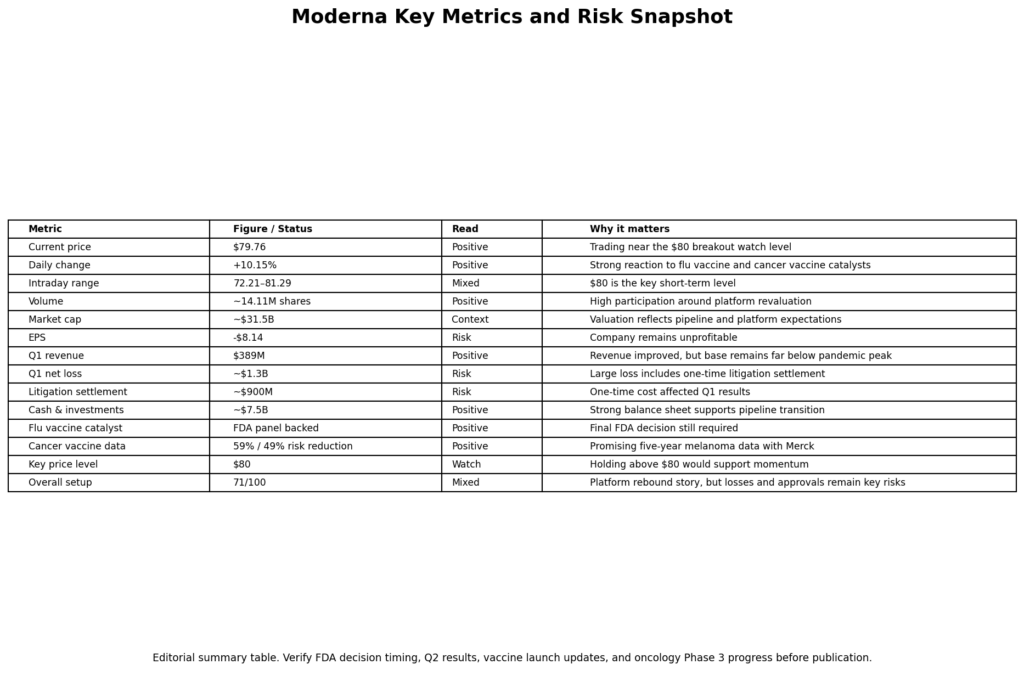
Revenue was $389 million, more than triple the prior-year period, helped by international COVID vaccine sales.
However, the company still reported a large net loss.
Moderna’s GAAP EPS remains negative, and the company is still in a post-COVID restructuring and portfolio-rebuild phase.
The company also has a large cash and investment position, which gives it time to fund vaccine launches, oncology trials, and rare disease programs.
This is important because Moderna’s pipeline requires significant investment.
But the market will eventually demand more than scientific progress.
Investors need to see a path toward revenue growth, operating leverage, and reduced losses.
Respiratory Vaccine Portfolio: The Near-Term Revenue Engine
Moderna’s respiratory vaccine portfolio is the most important near-term revenue driver.
The company’s commercial and late-stage respiratory assets include:
Spikevax.
mNEXSPIKE.
mRESVIA.
mCOMBRIAX.
mRNA-1010.
mRNA-1018.
The flu vaccine and flu-COVID combination vaccine are especially important because they could create recurring seasonal revenue.
mCOMBRIAX, Moderna’s flu-COVID combination vaccine, has already received regulatory progress outside the United States, while U.S. approval remains a key watch item.
If Moderna can build a respiratory vaccine franchise across COVID, flu, RSV, and combination vaccines, the company may reduce its dependence on a single product cycle.
However, competition is intense.
Moderna faces major pharmaceutical competitors in flu, RSV, and COVID vaccines.
Pricing, contracting, public health recommendations, and regulatory requirements will all affect the commercial outcome.
Oncology Pipeline: The Long-Term Upside Case
The oncology pipeline is the biggest long-term upside case for Moderna.
The personalized cancer vaccine program with Merck is the centerpiece.
Intismeran autogene is designed to use a patient’s tumor-specific genetic profile to train the immune system to recognize and attack cancer cells.
That is different from a traditional off-the-shelf therapy.
It is personalized, complex, and potentially powerful.
The program is being studied in melanoma and other tumor types, including lung cancer.
If late-stage trials confirm the Phase 2 benefit, Moderna could become one of the leaders in mRNA-based cancer immunotherapy.
But this is not a near-term revenue certainty.
Personalized cancer vaccines require complex manufacturing, regulatory approval, clinical adoption, reimbursement, and strong Phase 3 data.
Investors should view oncology as a major option on the future, not a fully proven commercial business yet.
Price Action: Why $80 Matters for MRNA Stock
MRNA recently traded at $79.76 after rising more than 10%.
The intraday high was $81.29, while the intraday low was $72.21.
This makes the $80 level important.
If MRNA holds above $80 with strong volume, the market may be confirming a stronger platform revaluation.
If the stock fails to hold $80 and falls below $75, the rally may look more like a short-term reaction to flu vaccine and cancer vaccine headlines.
The stock’s volume also matters.
Trading volume expanded to more than 14 million shares, which shows institutional and active-trader interest.
However, Moderna is still a volatile biotech stock.
The next major moves will likely depend on FDA decisions, pipeline updates, earnings, and Phase 3 oncology progress.
Positive Factors for MRNA Stock
The first positive factor is regulatory momentum.
FDA advisers backed the mRNA flu vaccine, moving Moderna closer to a potential new product approval.
The second positive factor is oncology data.
The five-year melanoma data support the idea that Moderna’s mRNA platform can extend beyond infectious disease.
The third positive factor is pipeline breadth.
Moderna has commercial and late-stage programs across respiratory vaccines, oncology, and rare disease.
The fourth positive factor is cash strength.
The company has enough financial flexibility to keep investing in major pipeline programs.
The fifth positive factor is cost discipline.
Management has been focused on reducing operating expenses after the COVID revenue decline.
Key Risks for MRNA Stock
The first risk is continued losses.
Moderna remains unprofitable, with negative EPS and large ongoing R&D and commercial expenses.
The second risk is FDA uncertainty.
The mRNA flu vaccine has advisory committee support, but final approval is still pending.
The third risk is commercial adoption.
Even if approved, a flu vaccine must compete in a crowded seasonal market.
The fourth risk is cancer vaccine execution.
The melanoma data are promising, but Phase 3 confirmation is essential.
The fifth risk is policy and regulatory pressure.
mRNA vaccine regulation and government support have become more uncertain.
The sixth risk is post-COVID revenue replacement.
Moderna still needs new products to replace the pandemic-era revenue base.
The seventh risk is valuation.
At a market cap above $30 billion, investors are already pricing in meaningful pipeline success.
MRNA Rally Sustainability Score
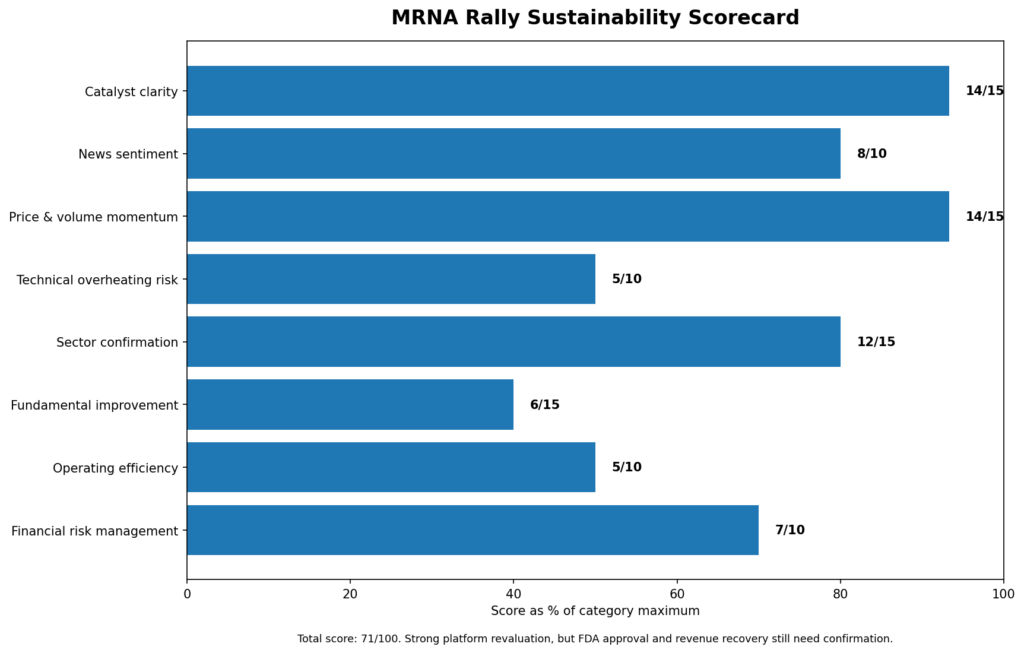
Overall Score: 71/100
Rating: Strong platform revaluation, but FDA approval and revenue recovery still need confirmation
Catalyst Clarity: 14/15
The rally has clear catalysts: mRNA flu vaccine advisory committee support, cancer vaccine five-year data, and renewed mRNA platform optimism.
News Sentiment and Reliability: 8/10
The catalysts are based on FDA advisory committee activity and clinical data updates, but final approvals and Phase 3 outcomes are still pending.
Price and Volume Momentum: 14/15
MRNA rose more than 10% with over 14 million shares traded, showing strong short-term demand.
Technical Overheating Risk: 5/10
The stock is near the $80 resistance area. A failure to hold that level could trigger profit-taking.
Sector Confirmation: 12/15
Moderna is aligned with mRNA vaccines, flu vaccines, cancer vaccines, oncology immunotherapy, and biotech platform themes.
Fundamental Improvement: 6/15
Revenue has shown signs of recovery, but the company still has large losses and needs new product revenue.
Operating Efficiency: 5/10
Cost reduction efforts are positive, but R&D and commercialization spending remain significant.
Financial Risk Management: 7/10
The balance sheet is strong, but continued losses and pipeline risk remain important.
What Investors Should Watch Next
The first factor is whether MRNA can hold above $80.
The second factor is the FDA decision on Moderna’s mRNA flu vaccine.
The third factor is commercial planning for mFlusiva if approved.
The fourth factor is the U.S. regulatory path for Moderna’s flu-COVID combination vaccine.
The fifth factor is Phase 3 progress for the personalized cancer vaccine program with Merck.
The sixth factor is Q2 results and whether revenue stabilization continues.
The seventh factor is operating expense reduction.
The eighth factor is mRNA policy risk and regulatory scrutiny.
Bottom Line
MRNA stock is rising because investors are reassessing Moderna as more than a post-COVID vaccine company.
The mRNA flu vaccine advisory committee vote gives Moderna a near-term respiratory vaccine catalyst.
The five-year melanoma data from the Merck cancer vaccine partnership gives Moderna a long-term oncology catalyst.
Together, these updates support a broader mRNA platform revaluation.
However, Moderna still has major challenges.
The company remains unprofitable, COVID revenue has declined sharply from pandemic levels, and the new pipeline must prove it can become a durable commercial engine.
For the rally to continue, Moderna needs to hold above $80, secure FDA approval for its mRNA flu vaccine, show continued respiratory vaccine progress, reduce losses, and deliver strong Phase 3 oncology data.
For now, MRNA looks like a credible mRNA platform rebound story, but not yet a fully confirmed turnaround.
FAQ
Why did MRNA stock go up?
MRNA stock rose after FDA advisers backed Moderna’s mRNA flu vaccine and investors reacted positively to five-year cancer vaccine data from Moderna and Merck.
What is Moderna’s mRNA flu vaccine?
Moderna’s mRNA flu vaccine, mFlusiva, is designed for adults aged 50 and older. If approved, it could become the first seasonal flu vaccine in the U.S. made with mRNA technology.
What is Moderna’s cancer vaccine?
Moderna’s cancer vaccine, intismeran autogene, also known as mRNA-4157 or V940, is an individualized neoantigen therapy being developed with Merck’s Keytruda.
Is Moderna profitable?
No. Moderna remains unprofitable on a GAAP basis and has negative EPS, although it has a large cash and investment position.
What price level matters for MRNA stock?
The $80 level is the key short-term level. Holding above $80 could support momentum, while a move below $75 could weaken the rally.
Is Moderna still just a COVID vaccine company?
No. Moderna is trying to expand into respiratory vaccines, flu-COVID combination vaccines, RSV, oncology, and rare disease therapeutics.
Related Reading
- https://www.modernatx.com/en-AU
- https://finance.yahoo.com/quote/MRNA/
- https://finance.yahoo.com/markets/stocks/articles/jim-cramer-says-first-time-143014976.html
- https://mgiedit.org/clro-stock-explodes-cortigent-reverse-merger-bci-medical-device/
- https://mgiedit.org/dmra-stock-rises-dmr-001-mutcalr-blood-cancer-pipeline/
- https://mgiedit.org/fig-stock-jumps-figma-raises-guidance-ai-saas-growth/
Disclaimer: This article is for informational purposes only and does not constitute investment advice, financial advice, medical advice, or a recommendation to buy or sell any security. Investors should conduct their own research and consider their risk tolerance before making investment decisions.