
Key Takeaways
Figma (NYSE: FIG) jumped after strong Q1 2026 earnings, faster revenue growth, and a higher full-year revenue outlook.
The company reported Q1 revenue of $333.4 million, up 46% year over year, showing growth acceleration from the prior two quarters.
Figma also raised its 2026 revenue guidance and delivered strong free cash flow, reinforcing the bull case for FIG stock.
The AI story is becoming more important, especially after early signals that Figma’s AI credit model can drive continued usage and future monetization.
However, FIG remains a high-growth SaaS stock with GAAP losses, stock-based compensation risk, post-IPO valuation concerns, and resistance near the $22 level.
Why FIG Stock Is Up
FIG stock rose because investors reacted positively to Figma’s Q1 2026 earnings report, revenue growth acceleration, and raised full-year guidance.
The most important number was revenue.
Figma reported Q1 revenue of $333.4 million, up 46% year over year.
That growth rate was especially important because it accelerated from 40% year-over-year growth in Q4 2025 and 38% in Q3 2025.
For a newly public software company, reaccelerating revenue growth matters.
It tells investors that Figma may still have a long runway in collaborative design, product development workflows, AI-powered creation tools, and enterprise expansion.
The second major catalyst was guidance.
Figma raised its full-year 2026 revenue outlook to $1.422 billion to $1.428 billion, up by $55 million from the prior view.
That gave investors a reason to reassess the stock after a difficult post-IPO decline.
The third catalyst was AI monetization.
Figma’s AI credit system is showing early signs that users may be willing to keep engaging with AI-powered features even after limits are introduced.
That matters because investors want to know whether Figma can turn AI into revenue, not just product hype.
What Figma Does

Figma is a cloud-based collaborative design and product development platform.
It started as a browser-based interface design tool, but the company has expanded far beyond traditional UI and UX design.
Today, Figma’s platform supports design collaboration, prototyping, developer handoff, whiteboarding, slides, AI-assisted design generation, design-to-code workflows, marketing content, motion, image editing, and team collaboration.
That is why investors increasingly view Figma as more than a design tool.
The bull case is that Figma can become a broader product development workspace where designers, developers, product managers, marketers, and AI agents work together.
This positioning is important for FIG stock.
If the market values Figma as a niche design software company, the multiple may stay limited.
If the market values Figma as an AI-enabled workflow platform for product development, the stock could receive a higher growth premium.
Q1 2026 Earnings: The Main Reason FIG Stock Rebounded
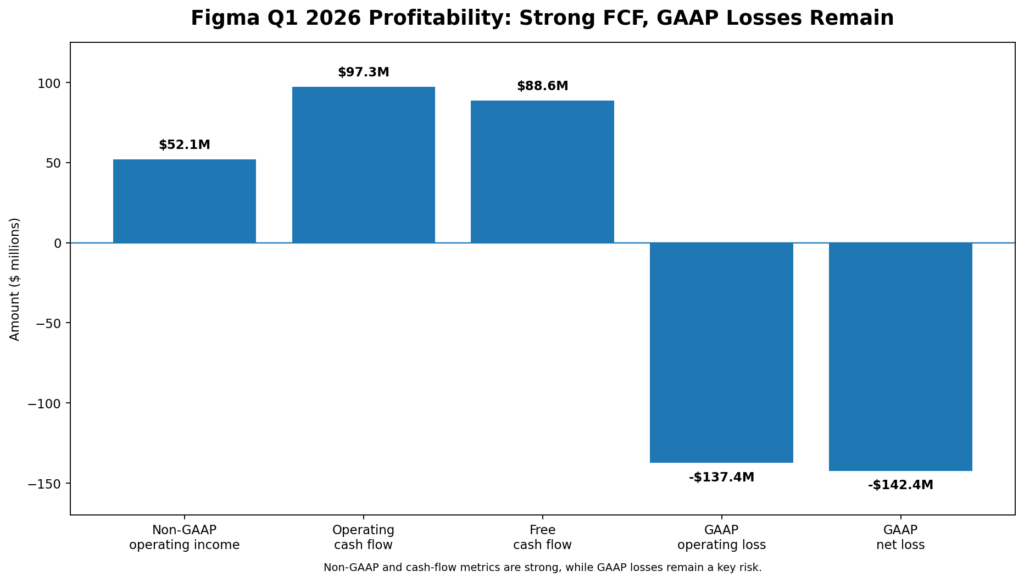
Figma’s Q1 results were strong.
Revenue was $333.4 million, up 46% year over year.
Non-GAAP operating income was $52.1 million.
Non-GAAP operating margin was 16%.
Operating cash flow was $97.3 million.
Free cash flow was $88.6 million.
Free cash flow margin was 27%.
These numbers are important because they show that Figma is not only growing quickly, but also generating meaningful cash flow on a non-GAAP and free cash flow basis.
That is a major difference between Figma and many unprofitable growth software companies.
However, the GAAP picture is less attractive.
Figma reported a GAAP operating loss of $137.4 million and a GAAP net loss of $142.4 million.
That means investors should separate two things:
Figma has strong revenue growth and free cash flow.
Figma still has large GAAP losses, partly due to stock-based compensation and public-company cost structure.
That is the core debate behind FIG stock.
Why the 2026 Guidance Raise Matters
The guidance raise is one of the biggest reasons FIG stock moved higher.
Figma now expects full-year 2026 revenue of $1.422 billion to $1.428 billion.
The company also guided Q2 2026 revenue to $348 million to $350 million, implying continued strong growth.
Guidance matters because investors had become skeptical after Figma’s post-IPO pullback.
The stock had fallen far below the euphoric first-day IPO trading levels.
By raising guidance, Figma gave investors evidence that the business is still performing better than expected.
This does not eliminate valuation risk.
But it does make the rebound more credible than a simple short-covering move.
AI Credit Monetization: The Key Growth Story
Figma’s AI strategy is becoming a major part of the FIG stock story.
The company introduced AI credit limits across seats in March 2026.
After that, Figma reported that more than 75% of Org and Enterprise users who exceeded AI credit limits continued using AI credits in April.
The company also said more than 95% of those users remained active on the platform.
This is an important early signal.
AI features are expensive to operate, especially when they rely on large-scale compute. Investors want to know whether software companies can monetize AI usage rather than simply absorbing higher infrastructure costs.
Figma’s AI credit model may help solve that problem.
If customers continue using AI credits, Figma could create a new usage-based monetization layer on top of seats and subscriptions.
That is why AI credit adoption is a major catalyst to watch.
Config 2026: Figma Is Expanding Beyond Design
Figma’s Config 2026 announcements also support the AI platform narrative.
The company introduced or highlighted features such as Code Layers, Figma Motion, shaders, generative plugins, Weave tools, and AI-assisted workflows.
These tools point in one direction:
Figma wants more of the product creation process to happen inside its canvas.
That includes design, code, animation, visual effects, marketing assets, prototyping, and AI-generated workflows.
This strategy could expand Figma’s addressable market.
It could also increase customer lock-in, because teams may use Figma not just to design screens, but to move from idea to prototype to code to launch.
The risk is competition.
AI coding tools, design automation tools, Adobe products, Canva, product management platforms, and developer workflow tools all compete for parts of this market.
Figma’s challenge is to stay at the center of the workflow.
Customer Metrics: Why NDR 139% Matters
Figma’s customer metrics were strong.
Net Dollar Retention Rate was 139% at the end of Q1.
ARR customers above $10,000 reached 15,218.
ARR customers above $100,000 reached 1,525.
Paid customers reached approximately 690,000, up 54% year over year.
These numbers are important because they show expansion from both small customers and large enterprises.
A 139% NDR means existing customers are spending significantly more over time.
That is one of the strongest indicators of product-market fit in SaaS.
For FIG stock, NDR is one of the most important metrics to watch.
If NDR stays high, investors may continue to assign Figma a premium SaaS valuation.
If NDR declines, the market may reduce that premium.
Price Action: Why $22 Matters for FIG Stock
FIG recently traded around $21.34 after rising more than 9%.
The intraday high was $21.87, which makes the $22 level important.
If FIG breaks above $22 and holds that level with strong volume, the market may be confirming a stronger post-earnings rebound.
If the stock fails near $22, traders may take profits after the earnings rally.
The $20 level is also important.
A move back below $20 would suggest that the rally was more of a short-term reaction than a durable revaluation.
The stock remains well below the $33 IPO price and far below its first-day IPO close of $115.50.
That makes the current setup a post-IPO rebound, not a return to IPO euphoria.
Valuation: Is FIG Stock Cheap or Still Expensive?
Figma’s valuation is more reasonable than it was during the IPO frenzy, but it is not obviously cheap.
At a market cap of roughly $11.17 billion and 2026 revenue guidance midpoint near $1.425 billion, FIG trades at roughly 7.8 times forward revenue.
That is far lower than the extreme valuation implied by the IPO first-day close, but it still reflects a premium software multiple.
The premium may be justified if Figma continues to grow revenue above 40%, maintain strong NDR, monetize AI credits, and generate free cash flow.
The premium becomes harder to justify if growth slows, GAAP losses remain large, AI monetization disappoints, or stock-based compensation continues to pressure shareholders.
This is why FIG is not a simple value stock.
It is a high-growth SaaS revaluation story.
Risks for FIG Stock
The first risk is GAAP losses.
Figma’s non-GAAP profitability and free cash flow are positive, but GAAP operating loss and GAAP net loss remain significant.
The second risk is stock-based compensation.
Large stock-based compensation can create dilution and make GAAP profitability harder to achieve.
The third risk is valuation.
FIG still trades at a premium revenue multiple.
The fourth risk is AI competition.
AI coding and design automation tools could expand Figma’s opportunity, but they could also change how design and development work.
The fifth risk is post-IPO supply.
After an IPO, early investors, employees, and lockup-related supply can affect trading.
The sixth risk is $22 resistance.
The stock needs to prove that it can hold above the post-earnings breakout area.
FIG Rally Sustainability Score

Overall Score: 78/100
Rating: Strong earnings-driven rebound, but $22 breakout and Q2 execution still matter
Catalyst Clarity: 13/15
The catalyst is clear: strong Q1 earnings, faster revenue growth, raised guidance, and AI credit monetization signals.
News Sentiment and Reliability: 9/10
The core data comes from Figma’s official Q1 2026 results.
Price and Volume Momentum: 13/15
A 9%+ rally with more than 25 million shares traded shows strong market attention.
Technical Overheating Risk: 6/10
The stock is still below its IPO price, so it is not euphoric, but failure near $22 could lead to profit-taking.
Sector Confirmation: 12/15
Figma is aligned with AI software, SaaS, design collaboration, product development, and design-to-code workflows.
Fundamental Improvement: 11/15
Revenue growth reaccelerated, NDR was strong, and free cash flow margin reached 27%.
Operating Efficiency: 7/10
Non-GAAP operating margin was positive, but GAAP losses and stock-based compensation remain important.
Financial Risk Management: 7/10
Cash and marketable securities of $1.6 billion provide flexibility, but dilution and GAAP losses still matter.
What Investors Should Watch Next
The first factor is whether FIG breaks above $22 and holds that level.
The second factor is Q2 revenue. The company guided Q2 revenue to $348 million to $350 million.
The third factor is AI credit monetization. Investors should watch whether AI credit usage keeps growing after initial adoption.
The fourth factor is NDR. A 139% NDR is strong, but it needs to remain high.
The fifth factor is GAAP losses. The market will want to see progress toward cleaner profitability.
The sixth factor is stock-based compensation. Dilution matters for long-term shareholders.
The seventh factor is Config 2026 product adoption. New AI, code, motion, and Weave features need to translate into usage and revenue.
Bottom Line

FIG stock jumped because Figma delivered the kind of report that high-growth SaaS investors wanted to see.
Revenue growth accelerated to 46%. Full-year guidance was raised. Free cash flow was strong. NDR reached 139%. Paid customers increased sharply. AI credit usage showed early signs of monetization potential.
That is a strong combination.
However, FIG is not a risk-free rebound.
The stock remains below its IPO price, GAAP losses are still large, and valuation still assumes strong future growth.
For the rally to continue, Figma needs to break and hold above $22, deliver on Q2 guidance, keep AI credit monetization moving in the right direction, maintain high NDR, and reduce the gap between non-GAAP strength and GAAP losses.
For now, FIG looks like one of the more credible AI SaaS rebound stories, but investors should still treat it as a high-growth software stock with valuation and execution risk.
FAQ
Why did FIG stock go up?
FIG stock rose after Figma reported strong Q1 2026 earnings, accelerated revenue growth, raised full-year guidance, and showed early AI credit monetization signals.
What does Figma do?
Figma is a cloud-based collaborative design and product development platform used by designers, developers, product managers, marketers, and teams.
Is Figma profitable?
Figma is profitable on a non-GAAP operating basis and generates free cash flow, but it remains loss-making under GAAP.
What is Figma’s 2026 revenue guidance?
Figma guided 2026 revenue to $1.422 billion to $1.428 billion.
Why does AI matter for FIG stock?
AI matters because Figma may be able to monetize AI usage through AI credits while expanding into design-to-code, motion, content, and workflow automation.
What price level matters for FIG stock?
The $22 level is the key short-term breakout area. A failure near $22 could trigger profit-taking, while a strong break above it could support further momentum.
Related Reading
- https://www.figma.com/
- https://www.tikr.com/blog/figma-stock-rose-9-this-week-where-fig-could-go-in-2026
- https://mgiedit.org/gpc-stock-surges-oreilly-bid-genuine-parts-napa-business/
- https://mgiedit.org/plbl-stock-surges-100mw-thailand-ai-data-center-mou/
Disclaimer: This article is for informational purposes only and does not constitute investment advice, financial advice, or a recommendation to buy or sell any security. Investors should conduct their own research and consider their risk tolerance before making investment decisions.