
Key Takeaways
RIVN stock moved sharply higher after Rivian reported stronger-than-expected Q2 2026 deliveries and raised its full-year delivery outlook.
Rivian produced 12,613 vehicles and delivered 12,194 vehicles in Q2 2026, beating the company’s prior delivery range of 9,000 to 11,000 vehicles.
The company also raised its 2026 delivery guidance from 62,000–67,000 vehicles to 65,000–70,000 vehicles.
The rally is being driven by three major themes: better EV demand, R2 SUV growth expectations, and the Volkswagen software joint venture.
However, Rivian remains unprofitable, and the next major test will be whether Q2 earnings show better automotive gross margin, lower adjusted EBITDA losses, and credible progress toward R2 production scale.
Why RIVN Stock Is Rising
Rivian Automotive (NASDAQ: RIVN) rallied after the electric vehicle maker reported stronger-than-expected Q2 2026 production and delivery figures.
The headline numbers were important. Rivian produced 12,613 vehicles and delivered 12,194 vehicles during the quarter. That delivery figure exceeded the company’s previously expected Q2 range of 9,000 to 11,000 vehicles.
For an EV stock like Rivian, deliveries matter because they show real demand, production execution, and inventory conversion.
The stronger Q2 figure also gave management enough confidence to raise the company’s full-year 2026 delivery outlook. Rivian now expects to deliver 65,000 to 70,000 vehicles in 2026, up from its previous guidance range of 62,000 to 67,000 vehicles.
That guidance increase is the real reason RIVN stock caught investor attention.
A single strong quarter can create a short-term rally. But an upward revision to full-year delivery guidance suggests that management sees stronger demand and better execution ahead.
In a market where many EV companies are facing pricing pressure, weaker subsidies, higher interest rates, and slowing consumer adoption, Rivian’s improved delivery outlook stands out.
RIVN Stock at a Glance
RIVN recently traded around $18.63, up approximately 8.5% on the day.
The stock’s intraday range was wide, from $17.07 to $19.78, showing strong buying interest but also some profit-taking near the $20 level.
Volume was very high at more than 78 million shares, which signals that institutional traders, retail investors, and momentum buyers were all active in the name.
Rivian’s market capitalization was approximately $23.3 billion, while EPS remained negative at around -$2.92. That means the stock is still being valued as a future growth story, not as a currently profitable automaker.
This is the key tension in the RIVN setup.
The market is rewarding better deliveries and higher guidance, but Rivian still needs to prove that growth can translate into sustainable profits.
Company Overview: What Rivian Does

Rivian is a U.S.-based electric vehicle manufacturer focused on adventure-oriented consumer vehicles and commercial electric vans.
The company’s current vehicle lineup includes the R1T electric pickup truck, the R1S electric SUV, and the EDV electric delivery van.
Rivian’s next major growth catalyst is the R2 SUV.
The R2 is important because it targets a larger and more affordable market than Rivian’s current premium R1 lineup. If successful, it could help Rivian move beyond niche luxury EV demand and into a broader consumer segment.
That is why investors are watching the R2 closely.
Rivian also has a strategic relationship with Volkswagen through a software and electrical architecture joint venture. This partnership gives Rivian additional financial support and validates the company’s vehicle software and electrical architecture capabilities.
Together, Rivian’s story is no longer just about selling electric trucks.
It is about building an EV brand, scaling the R2 platform, improving vehicle economics, monetizing software capabilities, and using strategic partnerships to support long-term growth.
The Main Catalyst: Q2 Deliveries Beat Expectations
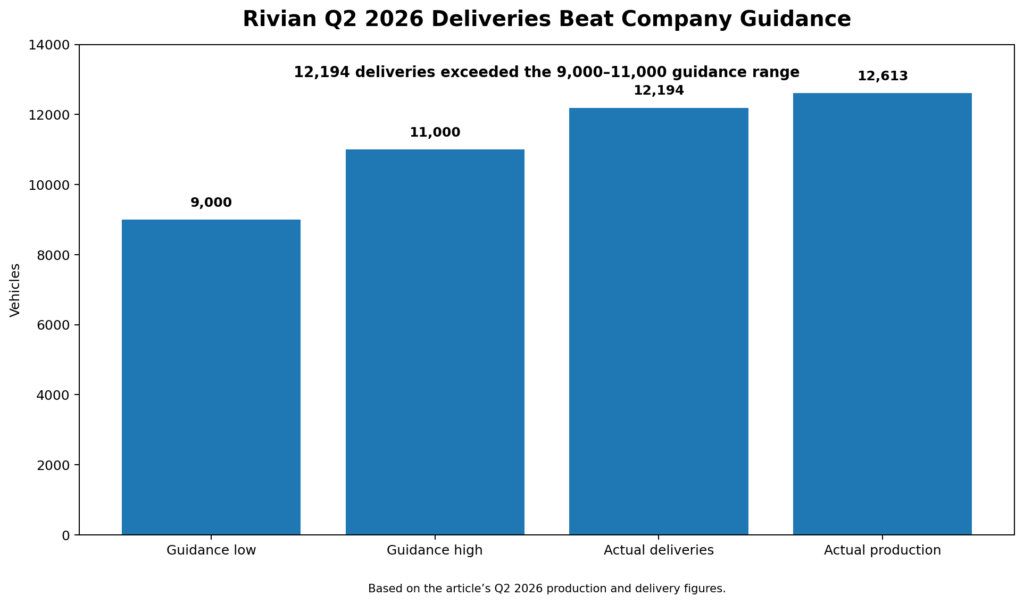
The biggest immediate catalyst for RIVN stock was the Q2 delivery beat.
Rivian delivered 12,194 vehicles in Q2 2026, above its prior forecast range of 9,000 to 11,000 vehicles.
That matters because EV investors often focus heavily on delivery volume.
Higher deliveries can indicate stronger demand, better production efficiency, better logistics, and improved inventory management.
For Rivian, the result was especially important because the company is still working toward profitability. When a company is not yet profitable, investors need evidence that volume is scaling in the right direction.
The Q2 delivery beat helped support the idea that Rivian’s demand is holding up better than feared.
It also reduced near-term concerns that the company’s R2 launch might cannibalize demand for the existing R1T and R1S lineup.
Why the 2026 Delivery Guidance Increase Matters
The delivery guidance increase may be even more important than the Q2 number itself.
Rivian raised its full-year 2026 delivery outlook to 65,000–70,000 vehicles, up from 62,000–67,000 vehicles.
That tells investors that the company is not treating Q2 as a one-off result.
Instead, management appears more confident in the second half of the year.
However, the new guidance also raises the bar.
Reuters noted that Rivian will need to deliver roughly 45,000 additional vehicles in the second half of the year to hit the updated full-year target.
That means the market will now expect stronger execution from the company.
If Rivian hits the new guidance, the stock could continue to re-rate higher.
If the company misses or shows margin deterioration, the rally could fade quickly.
R2 SUV: The Most Important Long-Term Catalyst

The R2 SUV is central to the Rivian investment thesis.
Rivian’s R1T and R1S helped establish the brand, but they are premium vehicles with a smaller addressable market. The R2 is designed to expand Rivian’s reach into a larger and more competitive segment.
The R2 is expected to compete more directly with high-volume electric SUVs, including Tesla’s Model Y.
That makes the R2 a make-or-break product for Rivian’s next growth phase.
If the R2 gains traction, Rivian could increase unit volume, improve plant utilization, reduce per-vehicle costs, and move closer to breakeven.
If the R2 launch disappoints, Rivian’s valuation could come under pressure because much of the long-term bull case depends on higher-volume production.
Investors should focus on three R2 questions:
Can Rivian produce the R2 at scale?
Can it sell the R2 without heavy discounting?
Can it improve margins as volume increases?
Until those questions are answered, RIVN stock remains a high-expectation growth trade.
Volkswagen JV: Why It Matters for Rivian Stock
The Volkswagen joint venture adds another important layer to the Rivian story.
Volkswagen Group has said it plans to invest up to $5.8 billion in Rivian and the joint venture by 2027. The partnership is focused on next-generation electrical architecture and software-defined vehicle technology.
This matters for two reasons.
First, it provides Rivian with financial support and a major strategic partner.
Second, it suggests that Rivian’s software and electrical architecture have value beyond Rivian’s own vehicle lineup.
That is important because automakers are increasingly competing on software, user experience, over-the-air updates, autonomy features, and vehicle electronics.
If Rivian’s software platform can scale beyond its own vehicles, the market may value the company as more than just an EV manufacturer.
However, investors should not overstate the JV too early.
The partnership must still translate into milestone payments, product integration, technology adoption, and long-term financial benefits.
Price Action: Why $18 and $20 Matter

RIVN stock moved strongly higher, but the price action also showed resistance near $20.
The stock traded as high as $19.78 intraday before pulling back toward $18.63.
That makes the $20 area an important psychological resistance level.
For short-term traders, the setup is clear:
If RIVN holds above $18, the market may continue to treat the delivery guidance increase as a positive revaluation signal.
If RIVN breaks above $20 with strong volume, momentum could accelerate.
If the stock falls below $18, the rally may look more like a short-term delivery-related spike.
The high volume makes this move more meaningful, but price confirmation is still needed.
Is Rivian Finally Turning the Corner?
Rivian is making progress, but it is too early to say the company has fully turned the corner.
The delivery beat and guidance increase are clearly positive.
Q1 2026 also showed signs of improvement, including revenue growth and consolidated gross profit. However, Rivian remains loss-making, and adjusted EBITDA losses are still significant.
The automotive business remains the key issue.
Rivian needs to show that it can sell vehicles at improving margins, reduce per-unit costs, and move toward positive automotive gross profit.
Software and services revenue can help, especially through the Volkswagen relationship, but the core EV manufacturing business still needs to improve.
For RIVN stock to keep rising, the market will need more than delivery growth.
It will need evidence of margin improvement.
Fundamental Analysis: Better Growth, Still Unprofitable
Rivian’s fundamentals are improving, but the company remains in a transition phase.
The positive side is clear.
Deliveries are stronger than expected.
Full-year guidance moved higher.
R2 demand appears to be an important growth driver.
Volkswagen provides strategic validation and financial support.
The negative side is also clear.
Rivian is still unprofitable.
EPS remains negative.
The company continues to invest heavily in R2 production, software development, and future vehicle programs.
Automotive margins still need to improve.
This makes Rivian different from a traditional automaker.
Investors are not valuing the company on current earnings. They are valuing the possibility that Rivian can scale production, lower costs, and eventually become a profitable EV platform.
That possibility is real, but it is not yet proven.
Operating Efficiency: Delivery Growth Is Good, Margin Improvement Is Better
From an operating efficiency perspective, the Q2 production and delivery results were encouraging.
Rivian produced 12,613 vehicles and delivered 12,194 vehicles during the quarter. That suggests the company is converting production into customer deliveries more effectively than the market expected.
However, production volume alone is not enough.
A car company can increase deliveries and still lose money if cost per vehicle remains too high.
The next important data points will be:
Automotive gross margin.
Adjusted EBITDA loss.
Cash burn.
R2 production costs.
Vehicle pricing.
Service and software contribution.
Rivian’s operating story will become much stronger if rising deliveries are paired with shrinking losses.
Risks for RIVN Stock
RIVN stock still carries several major risks.
The first risk is profitability. Rivian remains unprofitable, and the company must prove that higher delivery volume can reduce losses.
The second risk is R2 execution. The R2 is central to Rivian’s long-term growth story, but production ramp-ups are expensive and difficult.
The third risk is EV competition. Tesla, Ford, GM, Hyundai, Kia, Volkswagen, Chinese EV makers, and other competitors are all fighting for EV buyers.
The fourth risk is pricing pressure. If Rivian needs to discount vehicles to maintain demand, margins may remain under pressure.
The fifth risk is valuation. At a market cap above $20 billion, the stock already reflects significant expectations for R2 success and future profitability.
The sixth risk is cash burn. Rivian still needs to invest heavily in manufacturing, product development, and software.
These risks do not invalidate the bullish case, but they explain why investors should not treat the recent rally as risk-free.
RIVN Rally Sustainability Score
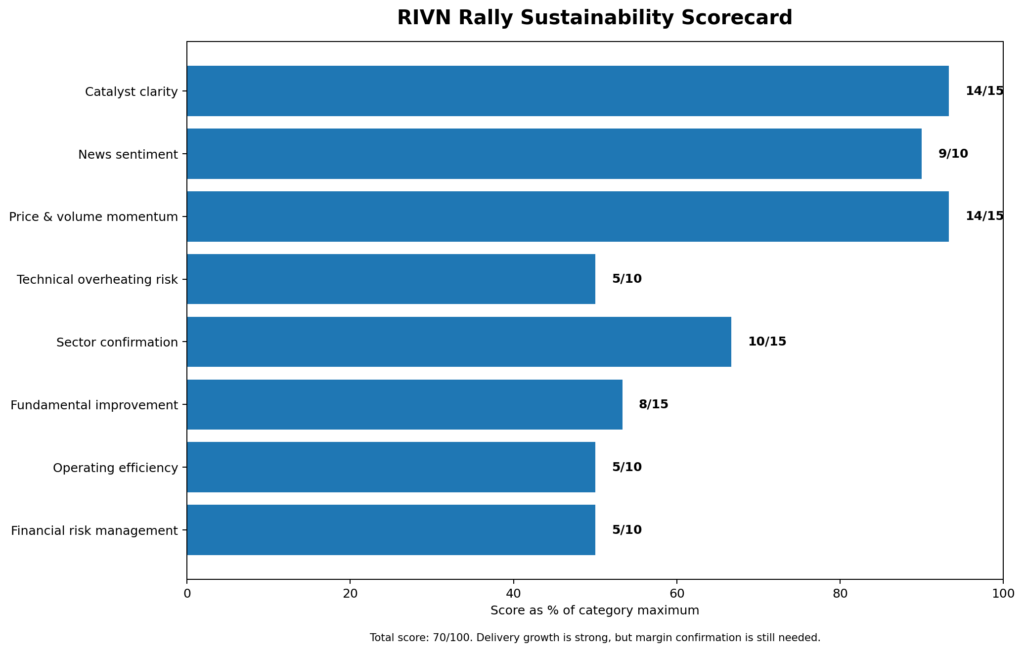
Overall Score: 70/100
Rating: Strong delivery-driven rebound, but margin confirmation is still needed
Catalyst Clarity: 14/15
The catalyst is clear: Q2 delivery results beat expectations, and Rivian raised its 2026 delivery guidance.
News Sentiment and Reliability: 9/10
The production and delivery figures came from the company, and major financial media confirmed the guidance-driven rally.
Price and Volume Momentum: 14/15
An 8%+ move with more than 78 million shares traded shows strong market interest.
Technical Overheating Risk: 5/10
The stock pulled back from the $19.78 intraday high, suggesting resistance near $20.
Sector Confirmation: 10/15
Rivian is tied to the EV sector, but this rally was driven more by company-specific delivery strength than a broad EV rally.
Fundamental Improvement: 8/15
Delivery growth and gross profit progress are positive, but Rivian remains unprofitable.
Operating Efficiency: 5/10
Production and deliveries improved, but R2 scaling, cost reduction, and automotive margin improvement remain key challenges.
Financial Risk Management: 5/10
The Volkswagen JV helps, but cash burn and R2 investment needs remain significant.
What Investors Should Watch Next
The first level to watch is $18. If RIVN holds above $18, the market may continue to support the post-guidance rally.
The second level is $20. A breakout above $20 with strong volume could signal a new momentum phase.
The third factor is Q2 earnings. Delivery numbers were strong, but investors still need to see revenue, gross margin, automotive gross profit, and adjusted EBITDA results.
The fourth factor is R2 production ramp-up. R2 is the biggest long-term catalyst, but execution risk is high.
The fifth factor is Volkswagen JV progress. Investors should watch milestone payments, software integration, and whether the partnership expands Rivian’s strategic value.
The sixth factor is cash burn. If Rivian reduces losses while raising deliveries, the stock could gain more credibility.
The seventh factor is EV pricing. If competition forces Rivian to discount heavily, margin improvement could be delayed.
Bottom Line
RIVN stock surged for a clear reason: Rivian delivered more vehicles than expected in Q2 2026 and raised its full-year delivery guidance.
That is a meaningful positive signal.
The move suggests that Rivian may be navigating the EV slowdown better than feared, supported by stronger R1 and EDV demand, early R2 momentum, and the strategic Volkswagen software JV.
However, Rivian is not yet a proven profit story.
The company remains unprofitable, automotive margin improvement is still critical, and the R2 production ramp will determine whether the long-term bull case becomes real.
The best interpretation is that RIVN stock is trying to re-rate from an EV turnaround story into a higher-confidence growth story.
But the rally still needs confirmation.
For continued upside, Rivian must hold the $18 area, break through $20, deliver solid Q2 earnings, improve margins, execute the R2 ramp, and show progress on the Volkswagen JV.
Until then, RIVN remains an attractive but high-risk EV growth stock.
FAQ
Why did RIVN stock go up?
RIVN stock rose because Rivian reported stronger-than-expected Q2 2026 deliveries and raised its full-year delivery guidance.
How many vehicles did Rivian deliver in Q2 2026?
Rivian delivered 12,194 vehicles in Q2 2026, above its prior guidance range of 9,000 to 11,000 vehicles.
What is Rivian’s 2026 delivery guidance?
Rivian raised its 2026 delivery guidance to 65,000–70,000 vehicles.
Why is the R2 SUV important for Rivian?
The R2 SUV is important because it targets a larger and more affordable market than Rivian’s premium R1 lineup. It could become the company’s key volume growth driver.
Is Rivian profitable?
Rivian is not yet consistently profitable. The company has shown gross profit improvement, but adjusted EBITDA losses and automotive margin challenges remain important risks.
What price levels matter for RIVN stock?
The $18 area is short-term support, while the $20 area is the next major resistance level.
Related Reading
- https://rivian.com/
- https://rivian.com/r2
- https://mgiedit.org/dlo-stock-surge-dlocal-emerging-market-payments-growth/
- https://mgiedit.org/soc-stock-surge-sable-offshore-financing-santa-ynez/
Disclaimer: This article is for informational purposes only and does not constitute investment advice, financial advice, or a recommendation to buy or sell any security. Investors should conduct their own research and consider their risk tolerance before making investment decisions.