Quick answer: Social Security benefits can be federally taxable in 2027 when “combined income” (other income plus tax-exempt interest plus half of benefits) exceeds $25,000 for a single filer or $32,000 for a joint return. Above $34,000 or $44,000, up to 85% of benefits can be included in taxable income. These thresholds are fixed in the tax code and are not adjusted for inflation, so the 3.6% benefit increase for 2027 moves more benefit dollars into taxable territory even when nothing else changes.
Data as of November 12, 2026. IRS forms and Publication 915 for tax year 2027 have not been published; the rules below come from the statute and the latest IRS worksheet. Examples are MGI calculations.
The combined-income test
The IRS states that benefits may be taxable when one-half of the benefits plus all other income, including tax-exempt interest, is more than the base amount for the filing status. SSA and many calculators call that total combined income; older articles call it provisional income.
Combined income = other income in adjusted gross income + tax-exempt interest + 50% of Social Security benefits.
The benefit figure is box 5 of Form SSA-1099. Medicare premiums deducted from the monthly payment are part of the benefits reported on that form, so a higher 2027 Part B premium lowers the deposit without lowering the amount that enters this formula. Supplemental Security Income is not taxable and is not included.
| Filing status | Base amount (up to 50% tier begins) | Adjusted base amount (up to 85% tier begins) |
|---|---|---|
| Single, head of household, qualifying surviving spouse | $25,000 | $34,000 |
| Married filing jointly | $32,000 | $44,000 |
| Married filing separately, lived with spouse at any time in the year | $0 | $0 |
| Married filing separately, lived apart all year | $25,000 | $34,000 |
The section of the tax code that sets these amounts contains no cost-of-living adjustment. Most other tax figures are indexed: the IRS raised the 2027 standard deduction to $16,600 for single filers and $33,200 for joint filers. The benefit thresholds stay where they are, which is the same erosion described in our guide to nominal versus real values.
How the taxable amount is calculated
The IRS worksheet reduces to five steps:
- Compute combined income.
- Subtract the base amount ($25,000 or $32,000). If the result is zero or less, no benefits are taxable.
- Split that excess into a first band of up to $9,000 ($12,000 for joint filers) and anything above it.
- Take 50% of the first band, but not more than 50% of benefits. Add 85% of the amount above the band.
- The taxable amount is the smaller of the step 4 result or 85% of benefits.
The $9,000 and $12,000 bands are simply the gaps between the two thresholds ($34,000 − $25,000 and $44,000 − $32,000).
Three households, tax year 2027
| Item | A: single, below the base | B: single, 50% tier | C: joint, 85% tier |
|---|---|---|---|
| Annual benefits | $18,000 | $24,000 | $40,000 |
| Other income | $14,000 | $18,000 | $50,000 |
| Combined income | $23,000 | $30,000 | $70,000 |
| Excess over base amount | $0 | $5,000 | $38,000 |
| Taxable benefits | $0 | $2,500 | $28,100 |
| Share of benefits taxable | 0% | 10.4% | 70.25% |
Household A
$14,000 + (50% × $18,000) = $14,000 + $9,000 = $23,000. That is below $25,000, so nothing is taxable.
Household B
$18,000 + $12,000 = $30,000. Excess: $30,000 − $25,000 = $5,000, all inside the $9,000 band. 50% × $5,000 = $2,500, which is less than half of benefits ($12,000) and less than 85% of benefits ($20,400). Taxable benefits: $2,500.
Household C
$50,000 + $20,000 = $70,000. Excess: $70,000 − $32,000 = $38,000. First band: $12,000 × 50% = $6,000. Above the band: $38,000 − $12,000 = $26,000, and $26,000 × 85% = $22,100. Sum: $6,000 + $22,100 = $28,100. Cap: 85% × $40,000 = $34,000. Taxable benefits: $28,100, the smaller figure. Even in the upper tier, this couple is not at the 85% maximum.
What the 3.6% COLA does on its own
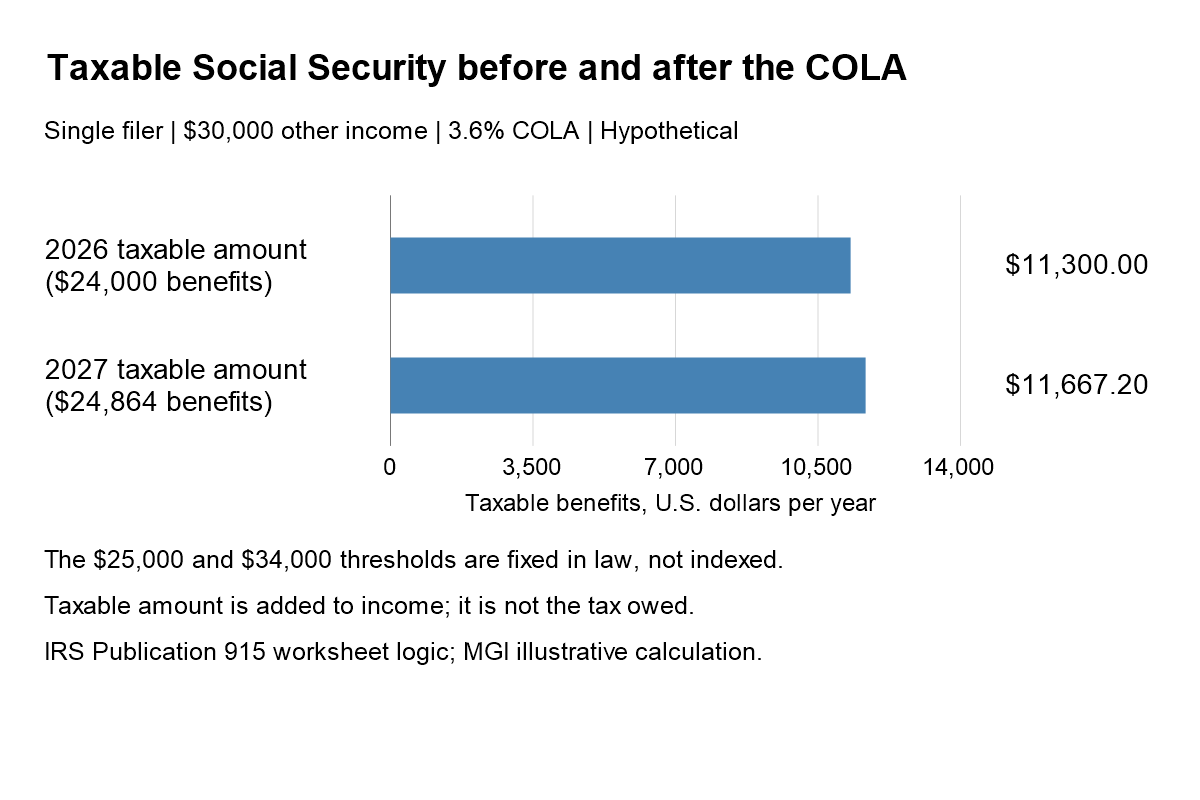
The 2027 cost-of-living adjustment is 3.6%. A $2,000 monthly benefit becomes $2,072, or $24,864 a year instead of $24,000, an increase of $864. Our 2027 COLA calculator handles other amounts. The table holds other income constant for three single filers who each receive that benefit.
| Other income (both years) | Taxable benefits, 2026 | Taxable benefits, 2027 | Change | Change as a share of the $864 raise |
|---|---|---|---|---|
| $12,800 | $0 | $116.00 | $116.00 | 13.4% |
| $20,000 | $3,500.00 | $3,716.00 | $216.00 | 25.0% |
| $30,000 | $11,300.00 | $11,667.20 | $367.20 | 42.5% |
First row, newly taxable. 2026: $12,800 + $12,000 = $24,800, under the base. 2027: $12,800 + $12,432 = $25,232; excess $232; 50% × $232 = $116. This retiree crosses the line because of the COLA alone.
Third row, upper tier. 2026: $30,000 + $12,000 = $42,000; excess $17,000; (50% × $9,000) + (85% × $8,000) = $4,500 + $6,800 = $11,300. 2027: $30,000 + $12,432 = $42,432; excess $17,432; $4,500 + (85% × $8,432) = $4,500 + $7,167.20 = $11,667.20. Benefits rose 3.6%, and taxable benefits rose $367.20.
The pattern is mechanical. Each extra dollar of benefits adds 50 cents to combined income. In the 50% tier that makes 25 cents taxable; in the 85% tier, 42.5 cents. If other income also rises, the effect is larger.
“Up to 85% taxable” is not an 85% tax rate
The percentage describes how much of the benefit is added to taxable income, not the tax charged. In the third row, $11,667.20 enters income. If that amount were taxed entirely at a 12% marginal rate, the tax would be $11,667.20 × 0.12 = $1,400.06, about 5.6% of the $24,864 in benefits. At 22% it would be $2,566.78, about 10.3%. The actual figure depends on the whole return, and deductions can reduce it to zero.
The $6,000 deduction for seniors applies in 2027
Current federal law includes a temporary deduction for seniors. According to the IRS, for tax years 2025 through 2028 an individual who is 65 or older by the end of the year may claim an additional $6,000 deduction, or $12,000 for a married couple when both spouses qualify. It is available to itemizers and non-itemizers, is in addition to the existing additional standard deduction for age 65, and requires a valid Social Security number and, for married taxpayers, a joint return. It phases out for modified adjusted gross income above $75,000 ($150,000 for joint filers).
Two points are often misreported. The deduction does not make Social Security tax-free, and it does not change the combined-income worksheet: the same amount of benefits is added to income as before. It reduces taxable income afterward. In the third-row example, income of $30,000 + $11,667.20 = $41,667.20, less the $16,600 standard deduction and the $6,000 senior deduction, leaves $19,067.20 before the regular age-65 addition. Taxpayers under 65, including early claimers at 62, do not qualify.
State income taxes
State treatment is separate from the federal rules. Some states tax Social Security benefits under their own exemptions and income limits, and others do not tax them at all; state rules can change from year to year. We have not verified a state-by-state list for 2027. Check the current instructions from your state’s revenue department rather than relying on a list.
Common mistakes
- Reading 85% as a tax rate. It is the maximum share of benefits included in income.
- Leaving out tax-exempt interest. Municipal bond interest is not taxed itself but counts in combined income.
- Using the full benefit in the formula. Only half of benefits is counted in combined income.
- Assuming the thresholds rise with the COLA. They do not.
- Filing separately without checking. For spouses who lived together at any time in the year, the base amount is $0.
Frequently asked questions
Is Social Security taxable in 2027?
It depends on combined income. Below $25,000 (single) or $32,000 (joint), no benefits are federally taxable. Above those amounts, between 0% and 85% of benefits is included in taxable income.
Did the 2025 tax law end the tax on Social Security?
No. It added the temporary $6,000 senior deduction described above. The rules that determine how much of a benefit is taxable were not changed.
Can I have tax withheld from my benefit?
Yes. The IRS says voluntary federal withholding from benefits is requested with Form W-4V.
Will the thresholds change in 2028?
Only if Congress amends the law. There is no automatic adjustment.
Sources
- IRS, Publication 915, Social Security and Equivalent Railroad Retirement Benefits: https://www.irs.gov/publications/p915
- IRS, Topic no. 423, Social Security and equivalent railroad retirement benefits: https://www.irs.gov/taxtopics/tc423
- IRS, Frequently asked questions, Social Security income: https://www.irs.gov/faqs/social-security-income
- 26 U.S.C. 86, Social security and tier 1 railroad retirement benefits (text via Cornell Legal Information Institute): https://www.law.cornell.edu/uscode/text/26/86
- IRS, Check your eligibility for the new enhanced deduction for seniors: https://www.irs.gov/newsroom/check-your-eligibility-for-the-new-enhanced-deduction-for-seniors
- IRS, Fact Sheet FS-2025-03, tax deductions for working Americans and seniors: https://www.irs.gov/newsroom/one-big-beautiful-bill-act-tax-deductions-for-working-americans-and-seniors
- IRS, IR-2026-133, tax inflation adjustments for tax year 2027: https://www.irs.gov/newsroom/irs-releases-tax-inflation-adjustments-for-tax-year-2027-taxpayers-continue-to-benefit-from-the-working-families-tax-cuts
- SSA, Cost-of-Living Increase and Other Determinations for 2027, 91 FR 67380: https://www.govinfo.gov/content/pkg/FR-2026-10-26/html/2026-21796.htm
General educational information, not individual tax advice. The examples simplify the IRS worksheet and omit adjustments, lump-sum payments and other special cases; use the worksheet for the tax year you are filing.