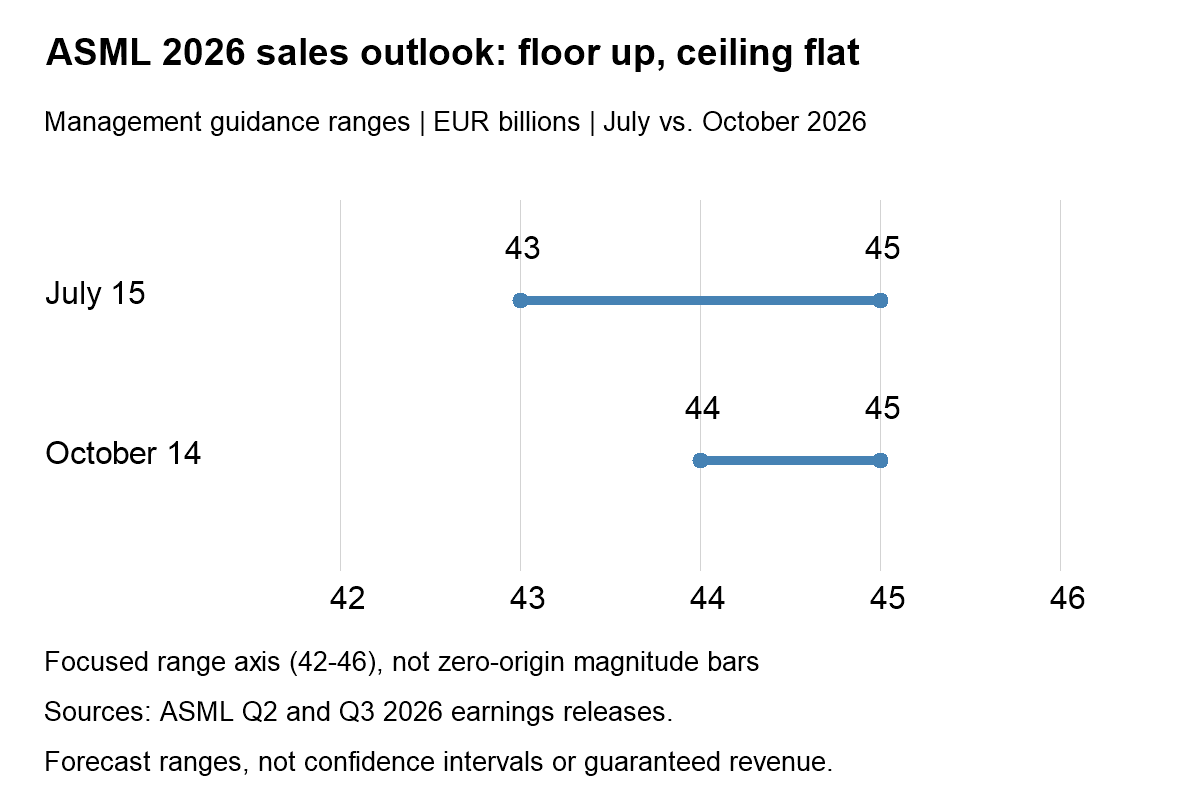
Quick answer: ASML raised its 2026 sales outlook from €43–45 billion to €44–45 billion. The floor rose €1 billion; the ceiling did not change. That is a stronger outlook, but it is not a €1 billion increase to every possible outcome—and it is not guaranteed revenue.
Prepared October 16, 2026, using ASML’s October 14 results and July 15 comparison, verified October 15. This is an earnings analysis, not a live share-price report.
What changed in ASML’s Q3 results?
ASML reported Q3 net sales of €11.662 billion and a 57.5% gross margin. Its October 14 release put full-year sales guidance at €44–45 billion and Q4 guidance at €14.2–15.2 billion. The July 15 release had guided full-year sales to €43–45 billion.
| Measure | July outlook | October outlook | MGI calculation |
|---|---|---|---|
| Lower endpoint | €43bn | €44bn | +€1bn |
| Upper endpoint | €45bn | €45bn | No change |
| Arithmetic midpoint | €44bn | €44.5bn | +€0.5bn |
| Range width | €2bn | €1bn | Halved |
How large is the upgrade, really?
MGI calculation: the midpoint moved from (43 + 45) / 2 = €44 billion to (44 + 45) / 2 = €44.5 billion. That is approximately 1.14% above the previous midpoint, not a €1 billion midpoint increase. The lower endpoint rose about 2.33%; the upper endpoint rose 0%.
These comparisons answer different questions. The floor describes the bottom of management’s stated range; the midpoint is an editorial arithmetic summary. Neither is a probability-weighted estimate. The range should not be presented as a statistical confidence interval with equal odds at every point.
The useful reading is that management removed part of its earlier lower-sales range. The announcement alone does not tell us exactly how likely each remaining outcome is. A narrower interval is not enough to calculate the chance of a revenue beat.
Why can a good earnings report still leave investors cautious?
A business result and a share-price return are different measurements. Investors may already have expected an upgrade, may focus on delivery timing, or may change the multiple they are willing to pay. Those are possible interpretation channels, not a claim that any one caused a particular trade.
To say “the stock fell despite a beat,” first verify the security, exchange, currency, session and consensus timestamp. A euro result, dollar quote and different trading window can create an impressive but invalid comparison. This analysis does not label the release a consensus beat or miss because it has not verified a matching consensus series.
What does the demand discussion actually promise?
Management said some customers were expressing interest in orders for 2029 and 2030 and that planned supply for 2027–2028 would not fully meet expected customer demand. Those are management’s forward-looking statements. Interest is not the same as completed sales, and future equipment demand is not the same as current cash received.
A practical monitoring chain is customer interest → accepted order → delivery → revenue recognition → cash collection. Each stage needs its own evidence. Do not count the same prospective business once as demand and again as if it were realized revenue.
Four checks for the next ASML update
- Compare both guidance endpoints, not just the phrase “raised outlook.”
- Separate reported revenue from future delivery plans and customer intentions.
- Track gross margin alongside the sales mix; growth alone does not establish profitability quality.
- Compare a claimed share-price reaction with a verified expectation and the correct market clock.
For the pre-release framework, see our ASML Q3 guidance preview. For another semiconductor reporting-basis check, read why TSMC’s 50.9% and 41.2% revenue growth figures can both be correct.
Frequently asked questions
Did ASML raise its 2026 sales ceiling?
No. The upper endpoint remained €45 billion; the lower endpoint increased to €44 billion.
Is €44.5 billion ASML’s promised sales figure?
No. It is the arithmetic midpoint of a guidance range, not a guaranteed result.
Do order discussions through 2030 count as today’s revenue?
No. Customer interest, orders and recognized revenue are different stages.
Bottom line: The outlook improved by lifting the floor, not by moving the entire range upward. Preserve that distinction before turning the AI-demand story into an investment conclusion. General educational analysis, not personalized investment advice.