Quick answer: Meta announced a conditional stock dividend of non-voting Class C shares. January 19, 2027 is the intended charter effective date, not a confirmed dividend delivery date. More shares do not mechanically create investment gains.
Checked October 22, 2026. This explains the announcement and an illustrative split calculation, not a live stock quote or a recommendation to buy META.
What did Meta announce about its stock split?
The company’s October 21 release specifies one Class C share per Class A or B share after charter effectiveness. It anticipates a two-for-one price adjustment, with unchanged voting power. Class A remains Nasdaq-listed; a Class C listing is intended.
Still pending: the board’s record and payment dates. Check later company notices before treating an announcement as an executed corporate action.
Does twice as many shares mean twice as much money?
No. The SEC’s stock-split explanation distinguishes a larger share count from increased shareholders’ equity. A split changes the units in which an ownership interest is expressed; it does not mechanically add revenue, cash or earnings.
Consider a generic, hypothetical same-class two-for-one split: 100 shares at $100 represent $10,000. After the mechanical adjustment, 200 shares at $50 still represent $10,000. This is not a META price forecast and does not assume Class A and Class C will trade at identical prices.
| Stage | Shares | Price | Position value |
|---|---|---|---|
| Before | 100 | $100 | $10,000 |
| After a same-class 2-for-1 split | 200 | $50 | $10,000 |
Why the earnings numbers still matter more than the share count
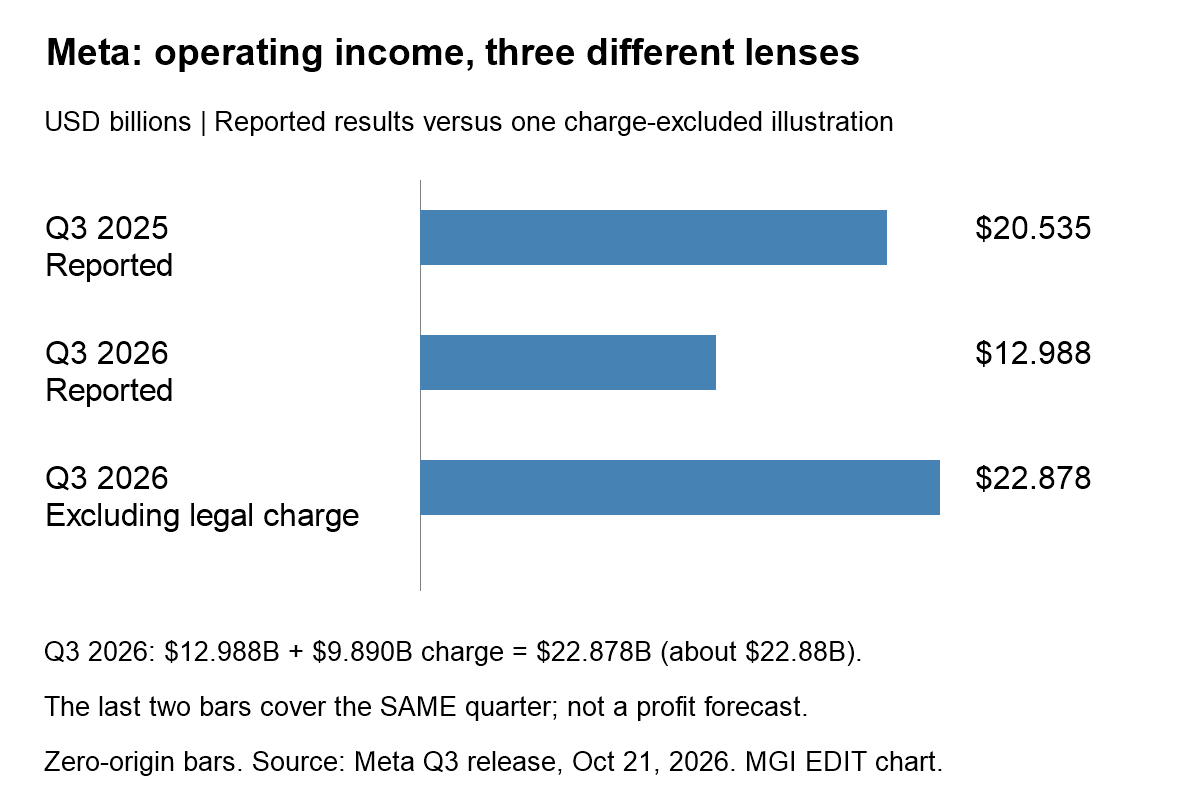
Q3 operating income was $12.988 billion versus $20.535 billion a year earlier. Excluding a $9.89 billion legal charge gives about $22.88 billion, per the company’s reconciliation.
These are different lenses, not competing versions of reality. The reported figure retains the recognized expense. The exclusion shows how much one identified charge changes the comparison; it does not make that cost economically irrelevant. A reader should not choose whichever number supports an existing bullish or bearish view.
The accompanying chart separates last year’s reported result, this year’s reported result and the company’s charge-excluded illustration. The last two refer to the same quarter; they are not a sequential profit forecast.
Four checks before acting on a split headline
- Separate the dates. A charter effective date, record date, ex-date and payment date are different milestones. Wait for the specific corporate-action notice rather than filling in missing dates.
- Identify the share class. Read the rights attached to the security you would own. An economic interest and a voting right are not interchangeable concepts.
- Keep valuation consistent. Compare a split-adjusted share price with consistently adjusted per-share figures. A lower quoted price alone does not establish a cheaper valuation.
- Distinguish distribution from future issuance. Receiving shares in a proportional distribution is not the same event as a company later issuing securities for financing or compensation. Read each transaction’s terms separately.
Why this topic, and what could change?
Google Trends’ U.S. Business & Finance 24-hour view, updated October 22 around 8:36 p.m. KST, showed the “meta stock” cluster at 50,000+ searches, up 400%, active. Related queries included the stock split. This is a rounded search-interest signal, not this article’s traffic or a return forecast. Live Trends view.
Follow the company’s later filings and broker notices for final implementation details. For broader context, read why earnings growth and stock-price returns can diverge and how to compare QQQ and QQQM without confusing price with cost.
FAQ: Is January 19 the day I receive Class C shares?
No delivery date is established by the announcement checked here. Follow the later corporate-action notice.
General investment education only, not personal investment, legal or tax advice. Corporate-action terms and market prices can change. No price target or guaranteed return is implied.