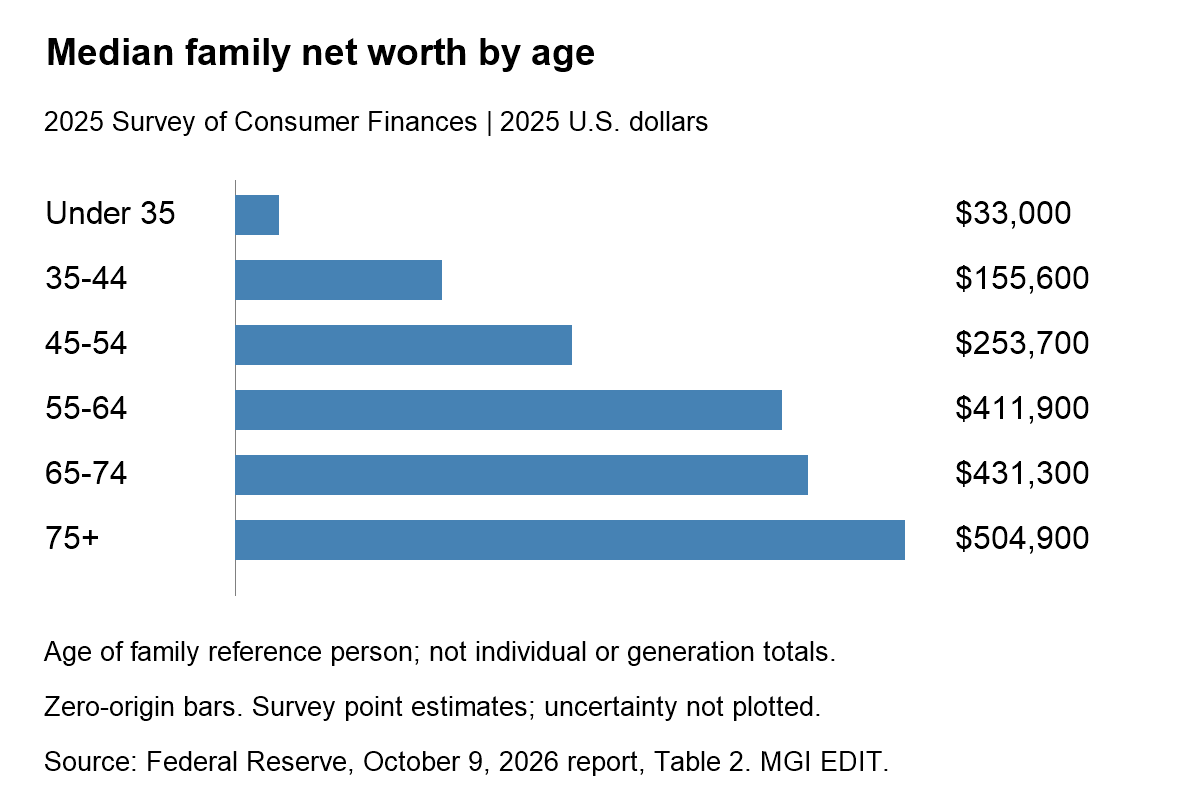
Quick answer: The Federal Reserve’s new 2025 survey puts median family net worth at $33,000 for under-35s and $504,900 for ages 75+. These are family-level estimates in 2025 dollars—not individual savings targets or live October 2026 account balances.
Checked October 18, 2026. The 2025 Survey of Consumer Finances was released October 9, 2026. The publication year and the survey year are different.
Why the boomer-versus-young-adult wealth question is trending
Google Trends’ U.S. Business & Finance view for the past 48 hours showed “boomer vs young adult net worth” at 10,000+ searches and +100% when checked October 18 around 10:31 p.m. Korea time. This is a changing, rounded search-cluster measure—not the number of people who will visit an article. Google Trends live view.
The useful response is a correctly labeled comparison, not a generational blame story. A 75+ age category is not synonymous with baby boomers, and the under-35 category is not every young individual.
Net worth by age: the new official median and average
| Reference person’s age | Median | Mean |
|---|---|---|
| Under 35 | $33,000 | $135,400 |
| 35–44 | $155,600 | $681,900 |
| 45–54 | $253,700 | $1,244,500 |
| 55–64 | $411,900 | $1,878,000 |
| 65–74 | $431,300 | $1,897,600 |
| 75+ | $504,900 | $1,962,200 |
Source: Federal Reserve, Changes in U.S. Family Finances from 2022 to 2025, Table 2, printed page 12. Age refers to the family’s reference person. Net worth is assets minus liabilities. These are survey point estimates; age-specific confidence intervals are not plotted here.
Why the median is not the average—and neither is your target
The median is the midpoint; the mean is the arithmetic average. Our calculation from the published estimates shows the under-35 mean is about 4.1 times its median. That is a warning against treating an average as the amount a typical young family must have saved.
Similarly, $504,900 ÷ $33,000 = 15.3. That cross-sectional ratio compares different families at different ages. It does not say today’s young families will multiply their wealth by 15.3, establish an investment return, or measure a transfer from one generation to another.
Do not compare an old screenshot with new dollars
The Fed’s current SCF page identifies the 2025 survey as the latest and provides historical tables in both nominal and inflation-adjusted terms. Before comparing an older figure, check the survey year, dollar basis, age bracket, and family definition. Changing any one can change the apparent gap.
A headline marked “2026” may describe a report released in 2026, a revalued older estimate, or proprietary account data. Those are not interchangeable. Do not combine them into a precise percentile ranking.
A practical net-worth worksheet
For a fictional family, cash of $10,000, investments of $25,000 and a vehicle worth $10,000 total $45,000. Subtract a $12,000 vehicle loan and $8,000 student loan: net worth is $25,000. Do not subtract the vehicle loan twice by entering both net vehicle equity and the full loan separately.
- Date every balance. Use a consistent snapshot rather than mixing today’s debt with last year’s asset value.
- Match the unit. Do not compare one partner’s accounts with a combined family estimate.
- Separate liquidity. Track readily available cash alongside total wealth; a valuable asset is not necessarily spendable today.
- Track your own change. Distinguish saving, debt repayment and market revaluation instead of treating every gain as investment skill.
Related: savings APY after monthly fees and why consumer confidence and spending can diverge.
Frequently asked questions
Does net worth mean money in the bank?
No. Assets and debts can produce a net-worth figure very different from available cash.
Am I behind if I am below the median?
The table alone cannot answer that. Household structure, obligations and goals matter; a survey midpoint is not a personal financial plan.
MGI EDIT data analysis for general information, not personalized financial advice. No percentile or future wealth outcome is promised.