Quick answer: Strong AI-related earnings do not guarantee rising AI stock prices. Investors pay for a stream of future profits, not just the latest quarter. A lower valuation multiple can outweigh earnings growth—even when the underlying business is expanding.
Checked October 18, 2026. This weekend analysis uses company information released during the week ended October 16; it is not a live quote or a prediction of Monday’s opening price.
Why the AI bubble question is back this weekend
Google Trends’ U.S. Business & Finance view, set to the past 48 hours, showed the “ai bubble” trend cluster at 5,000+ searches and +200% when checked October 18 at about 10:31 p.m. Korea time. These rounded, changing figures describe a search cluster—not investor positions, a crash probability or expected traffic to this website. Check the live Google Trends view.
Rather than treat the popularity of that question as its answer, separate three issues: whether customers are buying, whether suppliers earn attractive profits, and whether the price paid for a stock leaves room for disappointment.
What TSMC’s latest results establish—and what they do not
In its October 15 third-quarter release, TSMC reported U.S.-dollar revenue of $46.72 billion, up 41.2% from a year earlier, and a 66.4% gross margin. Management projected fourth-quarter revenue of $52.3 billion–$54.3 billion.
Those results document one manufacturer’s performance; the guidance remains a forecast. They do not measure the investment return of every AI customer or establish a fair price for every semiconductor stock. A chip supplier’s revenue is also an expense or investment for another business. Do not count both sides as independent proof of final demand.
How earnings can rise 20% while a share price falls 25%
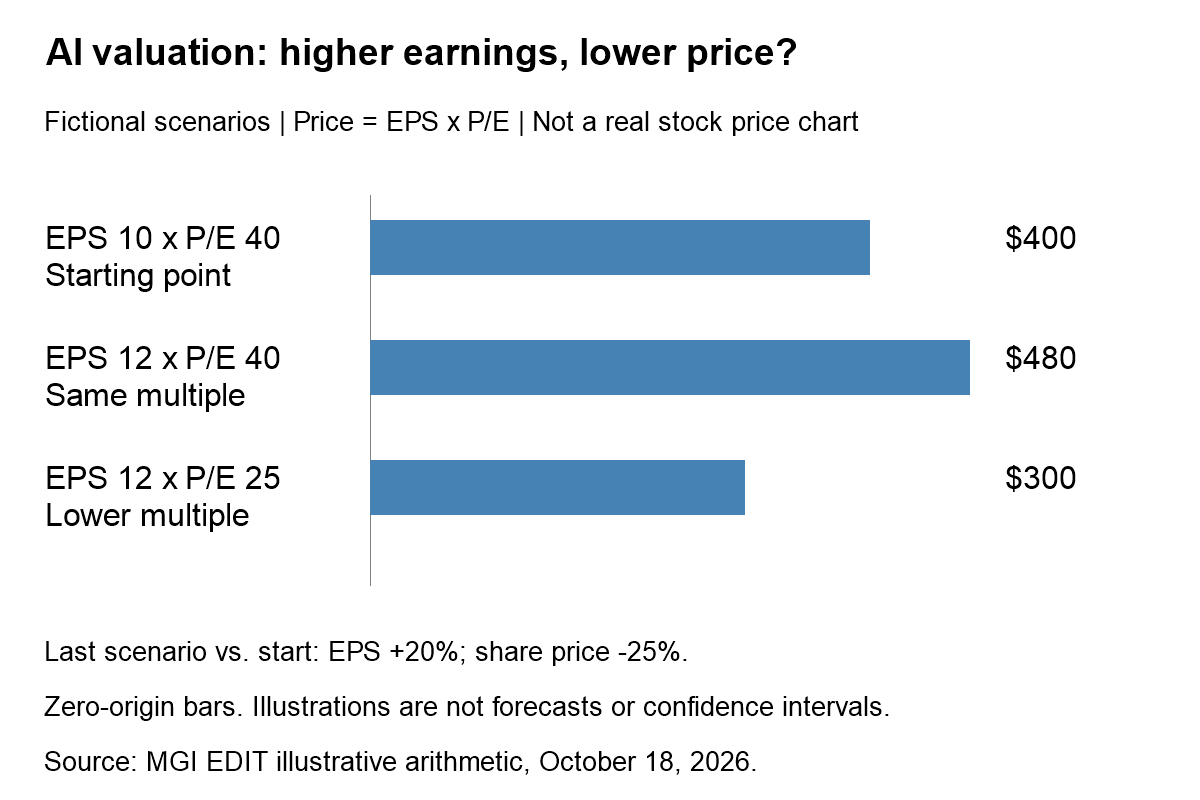
Here is a deliberately fictional valuation exercise. It is not a TSMC price target, a real stock chart or a forecast. Ignore dividends and other changes to isolate the arithmetic: share price = earnings per share × price/earnings multiple.
| Scenario | EPS | P/E | Price |
|---|---|---|---|
| Starting point | $10 | 40× | $400 |
| Higher earnings, same multiple | $12 | 40× | $480 |
| Higher earnings, lower multiple | $12 | 25× | $300 |
In the third scenario, EPS rises 20%, but the multiple falls 37.5%. The combined price change is (1.20 × 0.625 − 1) × 100 = −25%. Adding the two percentage changes would give the wrong answer. This is a mechanism that can reconcile business growth with investment losses; it is not proof that any particular stock is overvalued.
Four questions that are more useful than “bubble or not?”
The Federal Reserve’s May 2026 Financial Stability Report organizes vulnerabilities around valuations, borrowing, financial-sector leverage and funding risks. It is background, not an October trading signal. Apply that distinction to company filings:
- Valuation: What earnings assumptions justify the price, and what happens if growth slows?
- Cash conversion: After required capital spending, is cash available to support operations and obligations?
- Funding: Are expansion plans financed by operating cash, new equity or debt that must be refinanced?
- Customer economics: Are buyers converting AI capacity into recurring customer payments, or mainly committing to future capacity?
Keep reported revenue, contracted backlog, management forecasts and your own assumptions in separate columns. Label an unknown as unknown rather than filling it with a bullish or bearish story.
Continue with our TSMC earnings and currency-growth explanation and ASML guidance range analysis.
Frequently asked questions
Do record profits disprove an AI bubble?
No. Business profitability and the valuation investors assign to it are different questions.
Does a trending search prove an imminent crash?
No. Search activity measures attention. It cannot supply a reliable crash date or a trade instruction.
Bottom line: Test the price and the funding assumptions, not just the technology story. A sound business can still be an expensive investment.
MGI EDIT analysis for general information, not personalized investment advice. No return or price outcome is guaranteed.