
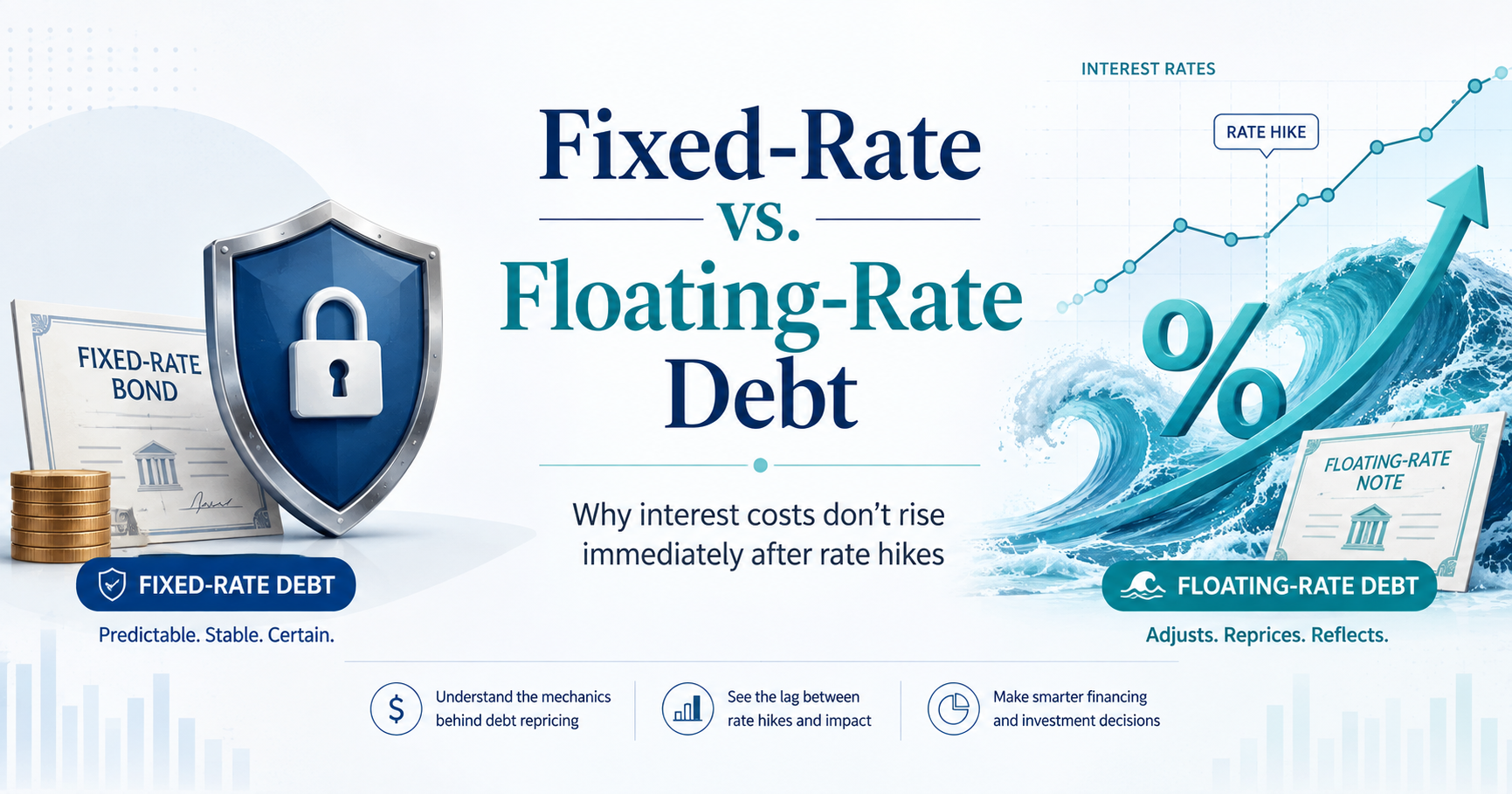
Fixed-rate vs floating-rate debt determines how quickly a company’s borrowing costs respond to interest rate hikes. Companies with fixed-rate bonds may keep paying the same coupon for years, while floating-rate borrowers can experience an increase in corporate interest expense much sooner.
In practice, that rarely happens.
A higher policy rate affects companies at different speeds because businesses do not all borrow in the same way. Some companies have locked in long-term fixed interest rates. Others rely on floating-rate loans that reset every few months. Some have large cash balances and do not need to borrow at all, while others must regularly refinance debt or raise new capital.
This is why the difference between fixed-rate and floating-rate companies is essential for understanding how monetary policy affects corporate earnings, investment, and the wider economy.
The Quick Answer
Corporate interest costs may not rise immediately after a rate hike because much of a company’s existing debt may carry a fixed coupon.
A company that issued a long-term bond at a low fixed rate continues paying the same contractual interest rate until the bond matures or is refinanced. By contrast, a company with floating-rate debt generally experiences higher interest payments much sooner because its borrowing rate resets according to a market benchmark.
The real impact of higher rates therefore depends on four main factors:
- The proportion of fixed-rate and floating-rate debt
- The company’s debt maturity schedule
- Its need for new borrowing
- Its ability to fund investment with internal cash flow
What Is a Fixed-Rate Company?
A fixed-rate company is not a formal corporate classification. It generally refers to a business whose debt portfolio is dominated by fixed-rate bonds or loans.
With fixed-rate debt, the interest rate is established when the company borrows the money. That rate normally remains unchanged throughout the agreed period.
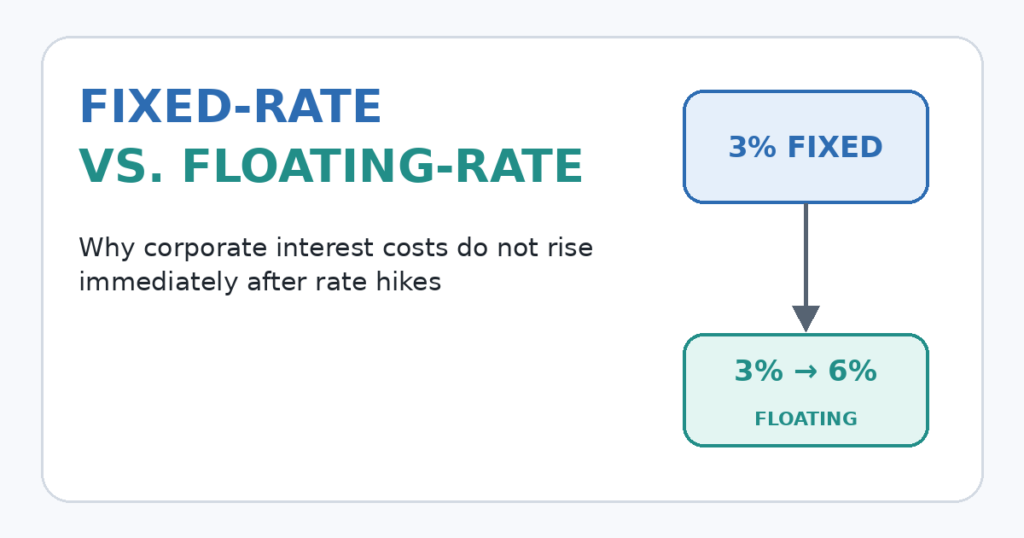
For example, suppose a company issues a five-year bond with a 3% annual coupon. Even if market interest rates later rise to 6%, the company generally continues paying the original 3% coupon until the bond matures.
This gives the company predictable interest payments and protects its short-term earnings from sudden increases in market rates.
However, fixed-rate debt does not eliminate interest-rate risk. It postpones much of that risk until the company must refinance.
What Is a Floating-Rate Company?
A floating-rate company is a business whose debt portfolio contains a significant amount of loans or securities with variable interest rates.
A floating borrowing rate is usually composed of two elements:
Reference rate + credit spread
The reference rate moves with financial-market conditions. The credit spread reflects the lender’s assessment of the company’s credit risk.
When the reference rate rises, the company’s borrowing cost can increase at the next scheduled reset date. Depending on the contract, that reset might occur monthly, quarterly, or at another agreed interval.
Floating-rate borrowers are therefore more directly exposed to monetary-policy tightening.
They may also benefit more quickly when interest rates fall.
Fixed-Rate vs. Floating-Rate Companies
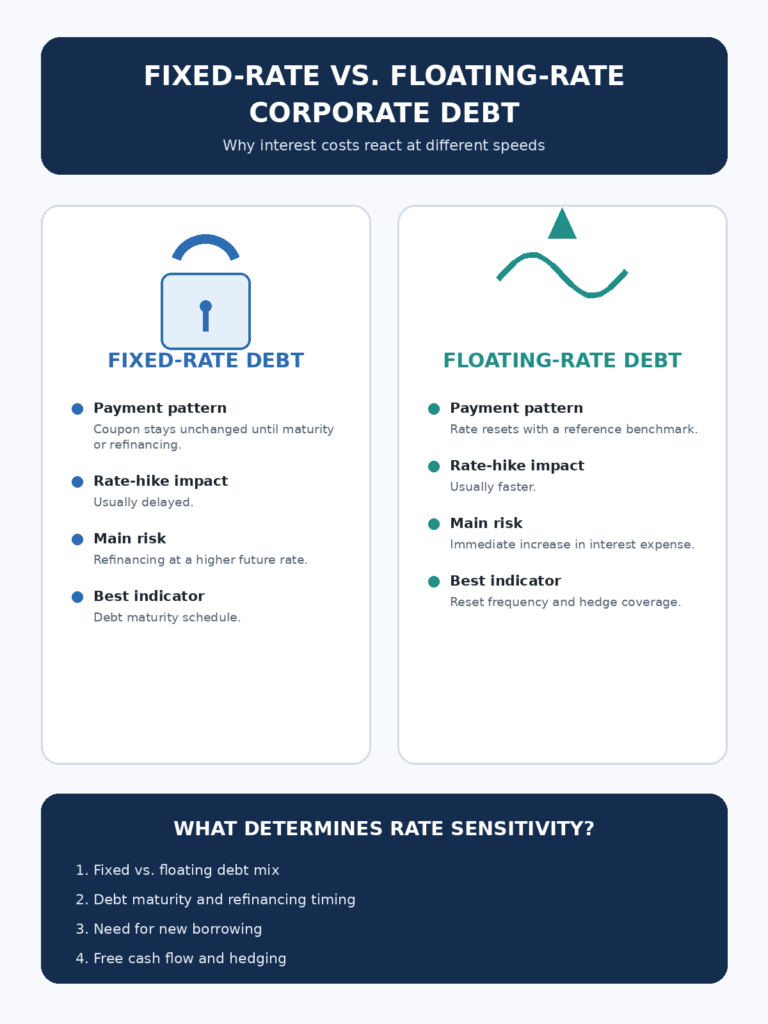
| Factor | Fixed-Rate Debt | Floating-Rate Debt |
|---|---|---|
| Interest payment | Remains contractually fixed | Changes with a reference rate |
| Reaction to rate hikes | Usually delayed | Usually faster |
| Short-term predictability | Relatively high | Relatively low |
| Main risk | Refinancing at a higher future rate | Immediate increase in interest expense |
| Benefit when rates fall | Limited until refinancing | Borrowing cost may decline after reset |
| Importance of maturity date | Very high | Important, but repricing may occur before maturity |
Most large companies use a combination of both types. The relevant question is not whether a company is entirely fixed-rate or floating-rate, but how its debt portfolio is structured.
Why Didn’t Corporate Interest Costs Rise Immediately After Rate Hikes?
1. Existing Fixed-Rate Debt Did Not Reprice
A central bank can change its policy rate, but it cannot retroactively rewrite the coupon on an existing fixed-rate bond.
If a company borrowed for ten years at a fixed interest rate during a low-rate period, the contractual coupon remains unchanged throughout that period.
Market yields may rise, and the market value of the bond may fall, but the company’s scheduled cash interest payment does not automatically increase.
This creates a time lag between monetary tightening and higher corporate interest expense.
2. Many Companies Locked In Low Rates Before the Tightening Cycle
When borrowing costs were low, many businesses issued long-dated fixed-rate debt and extended their maturity profiles.
As a result, they entered the subsequent rate-hiking period with much of their funding cost already locked in. Higher policy rates affected new borrowers immediately, but companies with existing fixed-rate debt were partially insulated.
A research report examining the 2022 U.S. rate-hiking cycle found that many companies had secured long-term fixed-rate financing during the low-rate period. Consequently, the increase in their actual interest burden was initially limited.
This helps explain why corporate activity and the broader economy can remain relatively resilient during the early stages of monetary tightening.
3. Refinancing Happens Gradually
Corporate debt does not usually mature all at once.
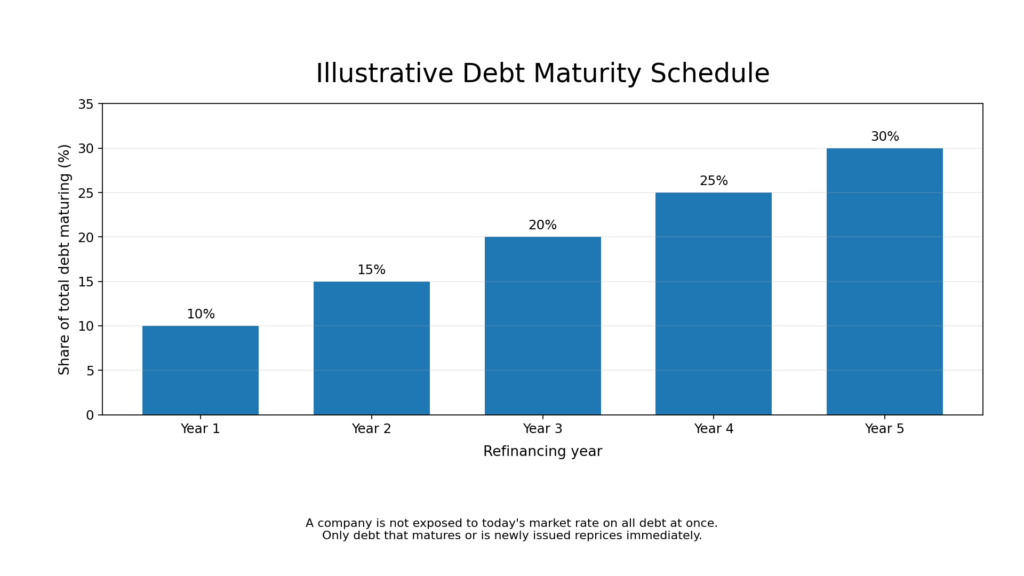
A large company may have bonds maturing across several years. Only the portion that matures during a particular year needs to be refinanced at the prevailing market rate.
Consider a company with the following debt maturity schedule:
- 10% maturing this year
- 15% next year
- 20% in two years
- The remainder maturing later
Even if current market rates are significantly higher, only the debt that matures or is newly issued will immediately reflect those rates.
The company’s average interest cost therefore increases gradually rather than overnight.
4. Cash-Rich Companies May Not Need New Debt
Interest-rate sensitivity also depends on whether a company needs external financing.
A company with strong operating cash flow and a large cash balance can fund wages, research, acquisitions, or capital expenditure without borrowing additional money.
This was particularly important for large technology companies during the early stages of the recent investment cycle. Strong cash generation allowed many of them to finance spending internally, reducing their immediate exposure to higher market rates.
By contrast, a company with weak cash flow may need to borrow frequently. It will feel the effect of higher rates much sooner.
5. Companies Can Hedge Floating-Rate Exposure
Some borrowers use interest-rate swaps or other hedging instruments to reduce their exposure to floating rates.
A company with a floating-rate loan may enter into a swap that economically converts the floating payment into a fixed payment. This can reduce short-term volatility in interest expense.
However, hedging does not make financing risk disappear. The company still faces counterparty risk, hedge expiration, transaction costs, and the possibility that future hedges will be more expensive.
A Simplified Example
Assume that Company A and Company B each have $1 billion of debt.
Company A: Fixed-Rate Debt
Company A borrowed $1 billion at a fixed annual rate of 3%.
Its annual interest cost is:
$1 billion × 3% = $30 million
If market borrowing rates rise to 6%, Company A may still pay $30 million a year until the debt matures.
Its interest expense does not immediately double.
Company B: Floating-Rate Debt
Company B pays a floating rate equal to a market reference rate plus a 2% credit spread.
Initially:
Reference rate: 1%
Credit spread: 2%
Total borrowing rate: 3%
Annual interest cost: $30 million
After monetary tightening:
Reference rate: 4%
Credit spread: 2%
Total borrowing rate: 6%
Annual interest cost: $60 million
Company B’s interest cost rises much sooner because its debt reprices with the market benchmark.
This simplified example excludes fees, hedging arrangements, taxes, and changes in the company’s credit spread, but it demonstrates the fundamental difference.
When Do Higher Rates Finally Affect Fixed-Rate Companies?
Fixed-rate companies become more sensitive to market rates when they must refinance, issue new debt, or increase investment spending beyond their internal cash flow.
Debt Maturity
When a low-coupon bond matures, the company must either repay it with cash or replace it with new financing.
If the old debt carried a 3% coupon and the new market rate is 6%, refinancing can substantially increase annual interest expense.
This is known as refinancing risk.
New Capital Expenditure
A company may have little immediate rate sensitivity while its investments are funded with operating cash flow.
That changes when capital expenditure exceeds internally generated cash.
If the business must issue bonds or take out loans to cover the funding gap, current market interest rates become much more important.
The source report notes that large technology companies have recently increased capital expenditure beyond operating cash flow and have become more active in the corporate bond market. This raises their interest-rate sensitivity compared with the earlier phase of the investment cycle.
A Wider Credit Spread
A company’s borrowing cost is not determined by government bond yields alone.
The total cost generally includes a credit spread that compensates investors for default and liquidity risk.
A company can therefore face higher borrowing costs even if the policy rate remains unchanged. If investors become concerned about its debt level, cash flow, investment returns, or creditworthiness, the credit spread may widen.
For weaker borrowers, a rising credit spread can be as important as the increase in the underlying market rate.
Why Fixed-Rate Debt Is Not Risk-Free
Fixed-rate debt provides short-term protection, but it can create a delayed refinancing problem.
A company may appear resistant to higher interest rates because its average coupon remains low. That stability can change quickly when a large amount of debt reaches maturity.
This is sometimes described as a refinancing wall: a concentrated period in which substantial debt must be renewed.
A company with long-term debt and widely distributed maturities may have more time to adjust.
A company with significant near-term maturities may experience a sharp increase in financing costs.
The maturity structure can therefore be more informative than the current average interest rate.
What Should Investors Examine?
Investors should look beyond the headline amount of debt and examine how that debt is structured.
Fixed-Rate and Floating-Rate Mix
A high floating-rate share generally means that interest expense reacts more quickly to market-rate changes.
A high fixed-rate share generally means that the impact is delayed until refinancing or new issuance.
Debt Maturity Schedule
The maturity schedule shows when existing debt must be repaid or refinanced.
Large near-term maturities increase exposure to current market rates.
Weighted Average Interest Rate
The average rate shows the company’s current interest burden, but it should be assessed together with future maturities.
A low average coupon may not be sustainable if a substantial amount of debt must soon be refinanced.
Free Cash Flow
Strong free cash flow can reduce the need for external borrowing.
When capital expenditure exceeds operating cash generation, a company may need to issue debt even if its existing borrowings are mostly fixed-rate.
Interest Coverage
Interest coverage measures the company’s ability to pay interest from operating earnings.
A declining ratio may signal that higher interest expense is becoming a meaningful financial burden.
Hedging Policy
Investors should determine whether the company uses interest-rate swaps, caps, or other derivatives and when those hedges expire.
Why the Delay Matters for the Economy
The delayed response of corporate interest costs can make an economy appear less sensitive to monetary tightening than it actually is.
During the early stage of a rate-hiking cycle, companies with long-term fixed-rate debt may continue investing and hiring. Their financial statements may show only a limited increase in interest expense.
However, the pressure can build gradually as:
- Floating-rate loans reset
- Existing bonds mature
- Companies issue new debt
- Cash balances decline
- Credit spreads widen
- Capital expenditure exceeds internal cash generation
Higher interest rates may therefore affect the economy through a delayed transmission process rather than an immediate shock.
Key Takeaway
The difference between fixed-rate and floating-rate companies explains why a policy-rate increase does not immediately produce an equal increase in corporate interest expense.
Fixed-rate borrowers are protected in the short term because their contractual coupons remain unchanged. Their main vulnerability appears later, when debt matures or new funding is required.
Floating-rate borrowers feel the effect sooner because their interest payments reset with market benchmarks.
To understand a company’s true interest-rate sensitivity, examine not only how much it has borrowed, but also:
- How the debt is priced
- When it matures
- Whether it is hedged
- How much cash the company generates
- Whether future investment requires additional borrowing
Interest-rate risk is ultimately a matter of timing, funding structure, and cash flow—not simply the level of the central bank’s policy rate.
Frequently Asked Questions
Do central bank rate hikes immediately increase corporate interest expense?
No. Companies with existing fixed-rate debt may continue paying the same coupon until the debt matures. Floating-rate borrowers usually experience the impact more quickly.
Are companies with fixed-rate debt protected from high interest rates?
They are partially protected in the short term. They can still face higher costs when refinancing maturing debt or issuing new debt.
Why are floating-rate companies more sensitive to monetary policy?
Their borrowing rates reset according to a market reference rate. When that benchmark rises, their interest payments generally increase at the next reset date.
Can a company convert floating-rate debt into fixed-rate debt?
A company may use an interest-rate swap to economically convert floating payments into fixed payments. The result depends on the terms, duration, cost, and counterparty structure of the hedge.
What is the most important indicator of future refinancing risk?
The debt maturity schedule is one of the most important indicators. It shows how much debt must be repaid or replaced and when refinancing pressure may increase.