
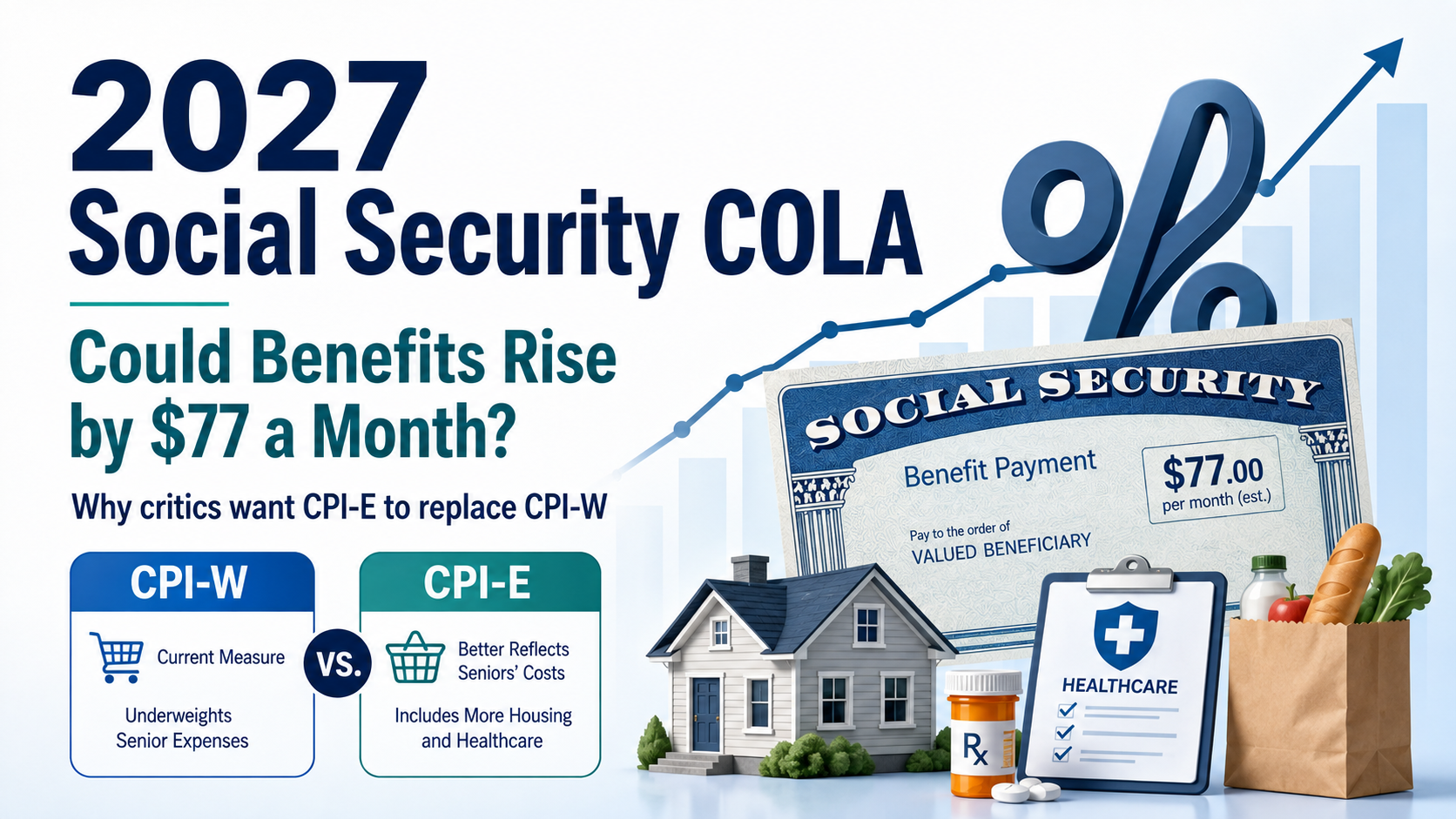
Social Security recipients could receive a larger cost-of-living adjustment in 2027, with the highest current forecast pointing to an increase of approximately 3.8%.
If that estimate proves accurate, the average retired worker could receive about $77 more per month, raising the estimated average monthly benefit to roughly $2,103.41.
However, advocates for older Americans say the increase may still fail to reflect the expenses retirees actually face. They argue that the government’s current inflation measure gives too little weight to costs such as housing and medical care.
The debate is not simply about whether Social Security benefits should rise. It is also about how the annual Social Security COLA should be calculated.
Key Takeaways
- Current 2027 Social Security COLA forecasts range from approximately 3.6% to 3.8%.
- A 3.8% increase could add about $77 per month to the average retirement benefit.
- The official 2027 COLA will not be determined until inflation data for July, August, and September 2026 are available.
- Social Security currently uses the Consumer Price Index for Urban Wage Earners and Clerical Workers, known as the CPI-W.
- Some senior advocates want the government to use the Consumer Price Index for the Elderly, or CPI-E, instead.
- CPI-E generally rises slightly faster because it gives greater weight to expenses commonly faced by older adults.
What Is the Current 2027 Social Security COLA Forecast?
Several organizations and analysts have published preliminary estimates for the 2027 Social Security cost-of-living adjustment.
| Forecaster | Estimated 2027 COLA |
|---|---|
| AARP analysis | 3.6% |
| Independent analyst Mary Johnson | 3.7% |
| The Senior Citizens’ League | 3.8% |
The Senior Citizens’ League currently has the highest estimate at 3.8%.
Under that projection, the average retiree would receive approximately $77 more per month, bringing the average benefit to around $2,103.41.
These figures remain forecasts. The official adjustment will depend on inflation readings during the third quarter of 2026.
When Will the Official 2027 COLA Be Announced?
The Social Security Administration typically announces the following year’s cost-of-living adjustment in October.
The calculation uses inflation data from:
- July
- August
- September
The government compares the average inflation index for those three months with the average from the same three-month period one year earlier.
If the index has increased, Social Security benefits rise by the same percentage. The new payment amount generally takes effect the following January.
If the index is unchanged or lower, benefits do not decrease. Social Security payments remain at their existing level.
How Is the Social Security COLA Currently Calculated?
The annual adjustment is based on the Consumer Price Index for Urban Wage Earners and Clerical Workers, commonly called the CPI-W.
The Bureau of Labor Statistics calculates the CPI-W by tracking changes in the prices of a basket of goods and services purchased by working households.
The basket includes categories such as:
- Housing
- Food
- Transportation
- Clothing
- Medical care
- Other everyday goods and services
The Social Security Administration reviews the third-quarter CPI-W average and compares it with the corresponding period from the previous year.
For example, if the CPI-W average rises by 3.8%, Social Security payments would also rise by approximately 3.8%.
Why Do Critics Say CPI-W Falls Short?
The central criticism is that the CPI-W primarily reflects the spending habits of working-age wage earners rather than retirees.
Social Security beneficiaries, particularly older retirees, may have very different spending patterns.
Older households often spend a larger share of their budgets on:
- Medical care
- Prescription drugs
- Housing
- Home maintenance
- Long-term care
- Insurance
They may spend less than working households on categories such as:
- Transportation
- Work-related clothing
- Commuting
- Certain food and beverage expenses
Because CPI-W is based on workers’ spending patterns, advocates say it may not accurately measure the inflation experienced by retirees.
A benefit increase can therefore match the official CPI-W inflation rate while still failing to keep pace with the costs seniors face most frequently.
What Is the CPI-E?
The alternative proposed by many senior advocacy groups is the Consumer Price Index for the Elderly, or CPI-E.
The Bureau of Labor Statistics introduced CPI-E in 1987 as an experimental measure designed to reflect the spending habits of Americans aged 62 and older.
CPI-E uses much of the same price data as other consumer price indexes. The main difference is how much weight it assigns to individual spending categories.
Expenses that represent a larger share of older households’ budgets receive greater weight in the calculation.
CPI-W vs. CPI-E
| Feature | CPI-W | CPI-E |
|---|---|---|
| Main population measured | Urban wage earners and clerical workers | Consumers aged 62 and older |
| Current use | Official Social Security COLA formula | Experimental research index |
| Medical-care weighting | Lower | Higher |
| Housing weighting | Lower | Higher |
| Transportation weighting | Higher | Lower |
| Typical long-term growth | Slightly slower | Generally slightly faster |
The difference between the two indexes may appear small in any single year. However, because Social Security adjustments compound over time, even small annual differences can become meaningful.
Would CPI-E Produce Larger Social Security Increases?
Historically, CPI-E has generally increased faster than CPI-W.
According to the analysis cited in the source material, a CPI-E-based Social Security COLA would have been higher than the CPI-W-based adjustment in most years between 1986 and 2025.
The average annual difference was approximately 0.2 percentage points.
That may not sound substantial. But Social Security adjustments are added to the existing benefit amount each year, meaning the effect compounds.
The cited analysis estimated that a person who began collecting Social Security in 1986 could have received a benefit approximately 8.1% higher in 2025 if the government had used CPI-E throughout that period.
Why Has the Government Not Adopted CPI-E?
Despite repeated proposals, CPI-E remains an experimental measure.
Several statistical and policy concerns have prevented it from replacing CPI-W.
Smaller Sample Size
The CPI-E is based on a smaller sample than the CPI-W.
According to the source material, its sample is approximately one-third the size of the CPI-W sample. A smaller sample can make an index more vulnerable to measurement and sampling errors.
Limited Data About Senior Shopping Patterns
CPI-E assumes that older adults and working-age households shop in similar locations and live in similar geographic areas.
Critics argue that retirees may shop at different types of stores, use different services, or live in areas with different inflation patterns.
Housing Costs Are Difficult to Measure
The index assigns a larger share of older adults’ expenses to housing.
The figures cited in the source place the CPI-E housing weight at approximately 49.1%, compared with 42.7% for workers.
However, many retirees own their homes outright and no longer make mortgage payments. This raises questions about whether a higher housing weight accurately represents the real cash expenses of all seniors.
Older homeowners may still face rising property taxes, insurance premiums, utility bills, maintenance costs, and rent-equivalent housing expenses. Even so, the appropriate housing calculation remains debated.
CPI-E Does Not Measure Every Senior Expense Perfectly
CPI-E may better reflect the broad spending patterns of older Americans, but it does not necessarily capture every expense faced by Social Security recipients.
The retiree population includes homeowners, renters, disabled beneficiaries, married couples, single retirees, and people living in assisted-care facilities.
No single inflation index perfectly represents every household.
Would a $77 Monthly Increase Be Enough?
Even the highest current forecast may not fully address the gap between Social Security income and retirees’ living expenses.
The source estimates that a 3.8% COLA would increase the average retirement benefit to around $2,103.41 per month.
It also cites average monthly living expenses for an older person of approximately $2,700.
Based on those figures, the average Social Security payment would remain roughly $597 below estimated monthly living costs.
That does not mean every retiree faces the same shortfall. Expenses vary significantly based on housing status, location, health, insurance coverage, taxes, and other income sources.
Nevertheless, the comparison illustrates why some advocacy groups believe changing the COLA formula alone may not be enough.
Why Medical and Housing Costs Matter So Much
A general inflation rate can fall even while expenses that disproportionately affect seniors remain elevated.
For example, retirees may be less affected by the cost of commuting or workplace clothing. At the same time, they may be more exposed to rising prices for:
- Medicare premiums
- Supplemental insurance
- Prescription medications
- Dental and vision care
- Rent
- Property taxes
- Home insurance
- Utilities
- In-home assistance
If these costs rise faster than the broader consumer basket, retirees can lose purchasing power even after receiving a COLA.
This is the main reason advocates favor an index built specifically around older consumers.
Could Congress Change the COLA Formula?
Replacing CPI-W with CPI-E would require federal legislative action.
Lawmakers would need to determine:
- Whether CPI-E is statistically reliable enough
- Whether the Bureau of Labor Statistics should improve or expand the index
- How much the change would increase Social Security spending
- How the additional cost would be financed
- Whether a different senior-focused index should be created
Using CPI-E would generally produce larger benefits over time, which would also increase the financial obligations of the Social Security program.
Supporters argue that the added cost would reflect the actual inflation experienced by beneficiaries. Opponents may raise concerns about program financing and the experimental nature of the index.
What Retirees Should Watch Before the Official Announcement
The current estimates may change before the government announces the official adjustment.
The most important information will be the CPI-W readings for July, August, and September 2026.
Retirees should also monitor:
- The official October COLA announcement
- Medicare premium changes
- Changes in tax withholding
- Supplemental insurance premiums
- State benefit and assistance programs
- Updates to the average Social Security payment
A higher gross Social Security benefit does not always translate into an equal increase in spendable income. Rising Medicare premiums or other deductions can reduce the net increase deposited into a recipient’s account.
The provided source does not specify projected 2027 Medicare premiums, so no estimate should be assumed at this stage.
The Bottom Line
The 2027 Social Security COLA could reach 3.8%, potentially adding approximately $77 per month to the average retirement benefit.
However, the estimate is not official. The final adjustment will depend on CPI-W inflation data for the third quarter of 2026.
The broader debate concerns whether CPI-W accurately measures the expenses faced by retirees.
Advocates believe CPI-E would provide a better reflection of senior spending because it assigns greater weight to medical care and housing. Although the average annual difference between CPI-W and CPI-E has historically been modest, those differences can compound into meaningfully higher benefits over a long retirement.
For now, CPI-E remains experimental, and changing the Social Security formula would require action from Congress.
Frequently Asked Questions
What is the projected Social Security COLA for 2027?
Current projections cited in the source range from approximately 3.6% to 3.8%. The highest forecast comes from The Senior Citizens’ League.
How much more could retirees receive in 2027?
A 3.8% increase could add approximately $77 per month to the average retirement benefit, raising it to around $2,103.41.
Is the 2027 Social Security COLA official?
No. The official adjustment will be calculated using CPI-W data for July, August, and September 2026 and is expected to be announced in October.
What inflation index does Social Security currently use?
Social Security currently uses the Consumer Price Index for Urban Wage Earners and Clerical Workers, or CPI-W.
What is CPI-E?
CPI-E is the Consumer Price Index for the Elderly. It is an experimental index intended to reflect the spending patterns of people aged 62 and older.
Would CPI-E produce higher Social Security benefits?
Historically, CPI-E has generally risen slightly faster than CPI-W. The difference may be small each year but can accumulate over several decades.
Why has CPI-E not replaced CPI-W?
CPI-E is still considered experimental, uses a smaller sample, and has methodological limitations involving housing, geography, and consumer shopping patterns.